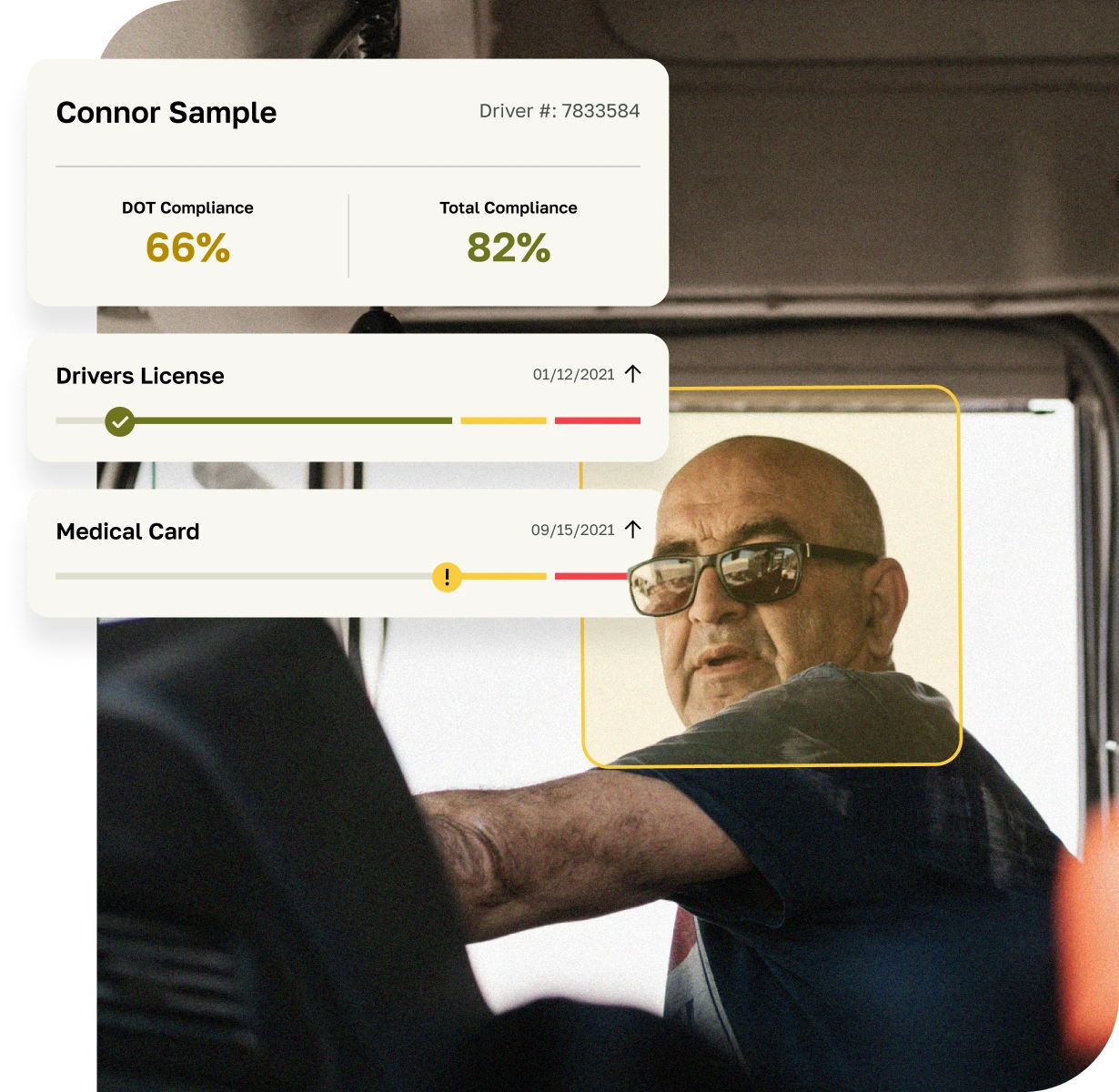

The best FMCSA Clearinghouse management vendor for a trucking fleet is the one that does three things together: runs and documents every required query on time, keeps the resulting records audit-ready inside the same system that holds the rest of the driver qualification file, and flags a prohibited-status driver before that driver is dispatched. Vendors that handle only the query transaction leave the hardest part, proving compliance during an audit, back with the fleet.
This guide covers the requirements a vendor has to support, the seven criteria that separate adequate vendors from strong ones, and how to decide between a consortium/third-party administrator, a standalone Clearinghouse tool, and a connected fleet compliance platform.
What is FMCSA Clearinghouse management?
FMCSA Clearinghouse management is the ongoing work of querying, reporting to, and maintaining records in the FMCSA Commercial Driver’s License Drug and Alcohol Clearinghouse, the federal database that records drug and alcohol program violations for CDL and CLP holders. For an employer, it covers four recurring obligations: pre-employment full queries, annual queries on every current CDL driver, reporting violations and refusals, and recording return-to-duty and follow-up testing milestones.
The obligations sit in 49 CFR Part 382, Subpart G. A vendor can execute the queries, but the regulatory responsibility stays with the motor carrier. That distinction is the reason documentation quality matters more than query throughput when choosing a vendor.
How often does an employer have to query the Clearinghouse?
Employers must query the Clearinghouse for each current CDL driver at least once within a rolling 365-day period, measured from the date of that driver’s last query, not from a fixed calendar date. FMCSA states this directly in its guidance on 49 CFR 382.701(b): the requirement is tracked on a rolling 12-month basis based on the date the employer conducted the last query.
This is a common point of confusion in Clearinghouse compliance. Many fleets run every annual query in January because they believe a January deadline exists. There is no federal January deadline. A driver queried on April 12 is due again by April 12 of the following year, and a follow-on query completed mid-year resets that driver’s 365-day clock from the follow-on date.
The practical consequence: per-driver date tracking is a hard requirement, not a convenience feature. A vendor that reports compliance at the fleet level, without a per-driver next-due date, cannot actually tell a compliance manager who is about to fall out of compliance.
What happens when a driver shows prohibited status?
A driver with prohibited status in the Clearinghouse may not perform any safety-sensitive function, including operating a commercial motor vehicle, until that driver completes the return-to-duty process. Under the Clearinghouse-II rule, state driver licensing agencies must also remove the commercial driving privilege from the license of a driver in prohibited status, a downgrade that applies until the return-to-duty process is complete. State licensing agencies have been required to query the Clearinghouse and act on prohibited status since November 18, 2024.
For fleets, this changed the risk profile of Clearinghouse management. A missed notification is no longer only a paperwork problem. It can mean a driver whose CDL is being downgraded by the state while the fleet still has that driver on the dispatch board. Vendor evaluation should therefore weight notification speed and escalation workflow heavily, not just annual query completion.
What should fleets look for in a Clearinghouse management vendor?
Fleets should evaluate Clearinghouse management vendors against seven criteria: per-driver query date tracking, notification and escalation speed, audit-ready documentation, integration with the driver qualification file, reporting and oversight depth, service model fit, and pricing transparency. The table below gives a specific test for each, so an evaluation produces evidence rather than impressions.
| Criterion | Why it matters | How to test it in a demo |
|---|---|---|
| Per-driver query date tracking | The annual requirement runs on a rolling 365 days per driver, not a shared calendar date. | Ask for a screen showing next-due date by driver, sortable, with drivers due in the next 30 days filtered. |
| Notification and escalation speed | Prohibited status now triggers a state CDL downgrade, so delay carries operational risk. | Ask how a record change reaches a named human, in what time frame, and what happens if that person is out. |
| Audit-ready documentation | An investigator wants proof of queries, consents, and dates, not a vendor’s assurance. | Request a sample export for a single driver covering three years, and confirm it is usable without vendor help. |
| Driver qualification file integration | Clearinghouse records are one part of the DQ file an auditor reviews as a whole. | Ask whether Clearinghouse status, medical cards, MVRs, and licenses appear in one driver record. |
| Reporting and oversight depth | Compliance leaders need exception reporting, not a list of completed transactions. | Ask for the standard report library and whether a document in processing is visible before review completes. |
| Service model fit | A 40-truck fleet and a 4,000-truck fleet need different amounts of managed support. | Ask what the vendor does versus what your team does, in writing, task by task. |
| Pricing transparency | Query fees are small and predictable; administration and add-on fees often are not. | Ask for total annual cost at your driver count, including onboarding, exports, and support tiers. |
Do you need a C/TPA or a fleet compliance platform?
Most fleets need both, because they solve different problems. A consortium/third-party administrator, or C/TPA, administers the drug and alcohol testing program itself: random selection pools, collection site networks, medical review officer services, and Clearinghouse query execution on the employer’s behalf. FMCSA describes the role in its guidance on consortium/third-party administrators.
A fleet compliance platform holds the resulting record. It keeps the query history, consents, medical certificates, licenses, and endorsements together in the driver qualification file, tracks what is expiring, and produces the documentation an investigator asks for. A C/TPA that executes queries flawlessly still leaves a fleet exposed if those query records sit in a separate portal from the rest of the DQ file when an audit opens.
The practical question in a vendor evaluation is not which layer to buy. It is which vendor owns the record of compliance, and whether that record is complete enough to survive an audit on its own.
Standalone Clearinghouse tool vs. connected compliance suite
A standalone Clearinghouse tool is the right choice for a fleet whose only compliance gap is query execution and whose driver records are already well managed elsewhere. A connected compliance suite is the better choice when Clearinghouse status is one of several credentials a small team is tracking manually. The comparison below sets out the trade-offs.
| Consideration | Standalone Clearinghouse tool | Connected compliance suite |
|---|---|---|
| Cost | Lower, priced for queries only | Higher, priced for the full driver file |
| Best fit | Query execution is the only gap | Driver credentials are tracked manually across spreadsheets and portals |
| Audit preparation | Records assembled from multiple systems at audit time | Driver record stays assembled year-round |
| Prohibited-status response | Alert arrives, action tracked outside the tool | Alert and follow-up sit on the same driver record |
| Administrative load | Lower for queries, unchanged elsewhere | Reduced across the full driver file |
| Vendor count | One more portal and login to manage | Fewer vendors, fewer handoff gaps |
| Switching effort | Minimal, since it plugs into existing records | Migration of existing driver files required |
Where Fleetworthy fits in Clearinghouse management
Fleetworthy addresses the record and audit-readiness layer of Clearinghouse management: keeping driver qualification records, credentials, and compliance documentation continuously audit-ready, so Clearinghouse status is tracked alongside everything else an investigator reviews rather than in a separate portal. Fleetworthy is trusted by 90% of the largest fleets in North America and offers the only complete technology suite for fleet readiness, uniting safety, compliance, toll management, and weigh station bypass.
Two options serve different fleet sizes:
- Fleetworthy Compliance gives larger fleets a managed-service team that keeps driver and asset records audit-ready. It provides dashboard visibility into incoming documents, drill-down SmartTiles for exception reporting, and automated medical-card tracking.
- Haul by Fleetworthy is self-service, AI-powered driver and asset compliance for small and mid-sized fleets without a dedicated compliance team. Its AI data extraction reads and validates documents automatically, reducing compliance administrative work.
Documented outcomes on the driver-record side include Golden Waffles, which raised DQ file compliance to 80% against a 92% target, which projected a $1.1M to $1.5M EBITDA increase by 2026 at the time of the case study, and QXO, a 3,000-truck fleet that moved to Fleetworthy for 10% lower cost with 750 additional driver licenses included. Fleetworthy was named 2025 North American Company of the Year for Commercial Vehicle Safety, Compliance, and Toll Management by Frost & Sullivan.
One scoping note worth stating plainly, because it should shape a shortlist: Clearinghouse query execution and drug and alcohol testing program administration are C/TPA functions. Fleets evaluating vendors should confirm with each provider which functions it performs directly and which it coordinates, and build the shortlist around where the compliance record will live.
How much does Clearinghouse management cost?
Clearinghouse management cost has two components: the FMCSA query fee, purchased in query plans through the Clearinghouse itself, and the vendor’s administration fee. Query fees are set by FMCSA and are the same regardless of which vendor runs the query, so they are not a differentiator. Current query plan pricing is published on the FMCSA Clearinghouse site.
The variable cost is administration, typically priced per driver per month or bundled into a broader compliance subscription. When comparing quotes, normalize to total annual cost at your actual driver count and ask specifically about onboarding fees, record export fees, support tiers, and what happens to pricing when driver count changes mid-term. Non-compliance carries its own cost: violations of 49 CFR Part 382, Subpart G are subject to federal civil penalties that FMCSA adjusts for inflation, listed on the FMCSA civil penalties page.
Ten questions to ask every Clearinghouse management vendor
- Do you track next-due query dates for each driver on a rolling 365-day basis?
- When a driver’s Clearinghouse record changes, who is notified, how, and within what time frame?
- What is the escalation path if the primary contact does not act on a prohibited-status alert?
- If I asked for three years of query history on one driver, could I review the export without your help?
- Does Clearinghouse status live on the same driver record as medical cards, MVRs, and licenses?
- Can I see a document the moment it arrives, or only after your team finishes reviewing it?
- Which tasks does your team perform, and which stay with mine? Provide it in writing.
- Do you audit records inherited from a previous vendor and report the gaps you find?
- Is my driver data pooled, sold, or shared across your other customers?
- What is total annual cost at my driver count, including every fee?