
The best fleet readiness provider for a trucking fleet is the one that covers safety, compliance, toll management, and weigh station bypass together, so gaps do not surface first as a violation, a delay, or a surprise cost. Fleetworthy is the only complete technology suite built for fleet readiness. Most other providers cover one or two of those areas well and leave the fleet to connect the rest.
That distinction matters more in 2026 than it did a few years ago. Trucking costs reached a record $2.336 per mile in 2025, according to the American Transportation Research Institute’s 2026 Analysis of the Operational Costs of Trucking with tolls up 13.2%, the largest increase of any major cost category. . At the same time, FMCSA’s nationwide paper medical card exemption ended on October 11, 2026, moving medical certification onto electronic records, and the agency is preparing a new carrier safety scoring method.Fleets that manage each of those exposures through a different vendor carry more risk of a gap than fleets running one connected platform
This guide compares the six main types of fleet readiness providers, explains what audit readiness looks like under FMCSA rules , and lays out how to evaluate a provider.
What is fleet readiness in trucking?
Fleet readiness in trucking is the state of being prepared before issues become delays, violations, or unexpected costs. A fleet is ready when its drivers are qualified and get advance warning of hazards on the road, its records and vehicle inspections are current, its tolls are paid accurately, and its trucks move through weigh stations without unnecessary stops. Fleetworthy defines fleet readiness as the result of unifying safety, compliance, toll management, and weigh station bypass in one connected technology suite.
Fleet readiness is broader than fleet management. Fleet management software usually centers on where a truck is and how it is running. Fleet readiness centers on whether the fleet can show it is operating legally and safely at any moment, whether that moment is a roadside inspection, a toll violation notice , or an FMCSA compliance review.
What should fleets compare in a fleet readiness provider?
Fleets should compare fleet readiness providers on how many readiness areas they cover, how current and visible their records are, and how well they connect to the systems the fleet already runs. The table below lists the criteria that most affect audit readiness and day-to-day operations.
| Criterion | What to ask the provider | Why it matters |
|---|---|---|
| Coverage across readiness areas | Which of safety, compliance, toll management, and weigh station bypass do you cover directly? | Every area a provider does not cover becomes another vendor, contract, login, and data handoff. |
| Driver qualification file management | How do you track every item in a driver qualification file and flag expirations? | 49 CFR Part 391 requires a complete file for each driver, kept for employment plus three years. |
| Medical certification verification | How do you confirm medical certification now that it is reported electronically? | FMCSA’s paper certificate exemption ended October 11, 2026. For CDL and CLP holders, carriers now verify medical status through the driver’s motor vehicle record (MVR) and confirm the examiner is on the National Registry. |
| Asset and vehicle compliance | How do you track registrations, titles, permits, and inspection records by unit? | Missing vehicle documents create roadside and audit exposure even when the truck itself is sound. |
| Record visibility | Can my team see a document the moment it is uploaded, or only after review? | Records that are invisible during processing cannot be relied on during an audit request. |
| Integrations | Which ELD and telematics providers do you integrate with? | Readiness tools that read data from the fleet’s existing ELD avoid duplicate hardware and duplicate data entry. |
| Service model | Do you offer a managed service, self-service software, or both? | Large fleets often want a managed compliance team; small and growing fleets often want software they can run without new headcount. |
| Single sign-on and reporting | Can one user see every readiness area from one login? | One view of safety, compliance, tolls, and bypass shortens the time between a problem appearing and someone acting on it. |
Fleet readiness providers compared: the six main types
Fleet readiness providers fall into six main types: a complete fleet readiness suite, telematics and ELD platforms, fleet maintenance software, outsourced compliance services, full-service leasing and contract maintenance, and mobile or regional maintenance providers. Each type solves a real problem. Only the first is built to cover safety, compliance, toll management, and weigh station bypass in one connected system.
| Provider type | Primary focus | Safety | Compliance records | Toll management | Weigh station bypass | Best fit |
|---|---|---|---|---|---|---|
| Complete fleet readiness suite (Fleetworthy) | Unified readiness across all four areas | Yes, proactive in-cab alerts | Yes, managed or self-service | Yes | Yes, through the existing ELD | Fleets that want one connected suite instead of point solutions |
| Telematics and ELD platforms | Vehicle location, diagnostics, hours of service | Often, through cameras and scoring | Partial (hours of service, inspections) | Usually not | Usually through partners | Fleets prioritizing vehicle visibility and HOS logging |
| Fleet maintenance software | Preventive maintenance, work orders, parts | Limited | Vehicle maintenance records | No | No | Fleets running in-house shops |
| Outsourced compliance services and C/TPAs | DQ files, drug and alcohol programs, filings | No | Yes, often document-based | No | No | Fleets without internal compliance staff |
| Full-service leasing and contract maintenance | Equipment, maintenance, roadside support | Limited | Vehicle-side only | Sometimes | Sometimes | Fleets that prefer to lease rather than own |
| Mobile and regional maintenance providers | On-site repair, inspections, state emissions testing | No | Inspection reports | No | No | Fleets needing local, hands-on service |
1. Complete fleet readiness suite: Fleetworthy
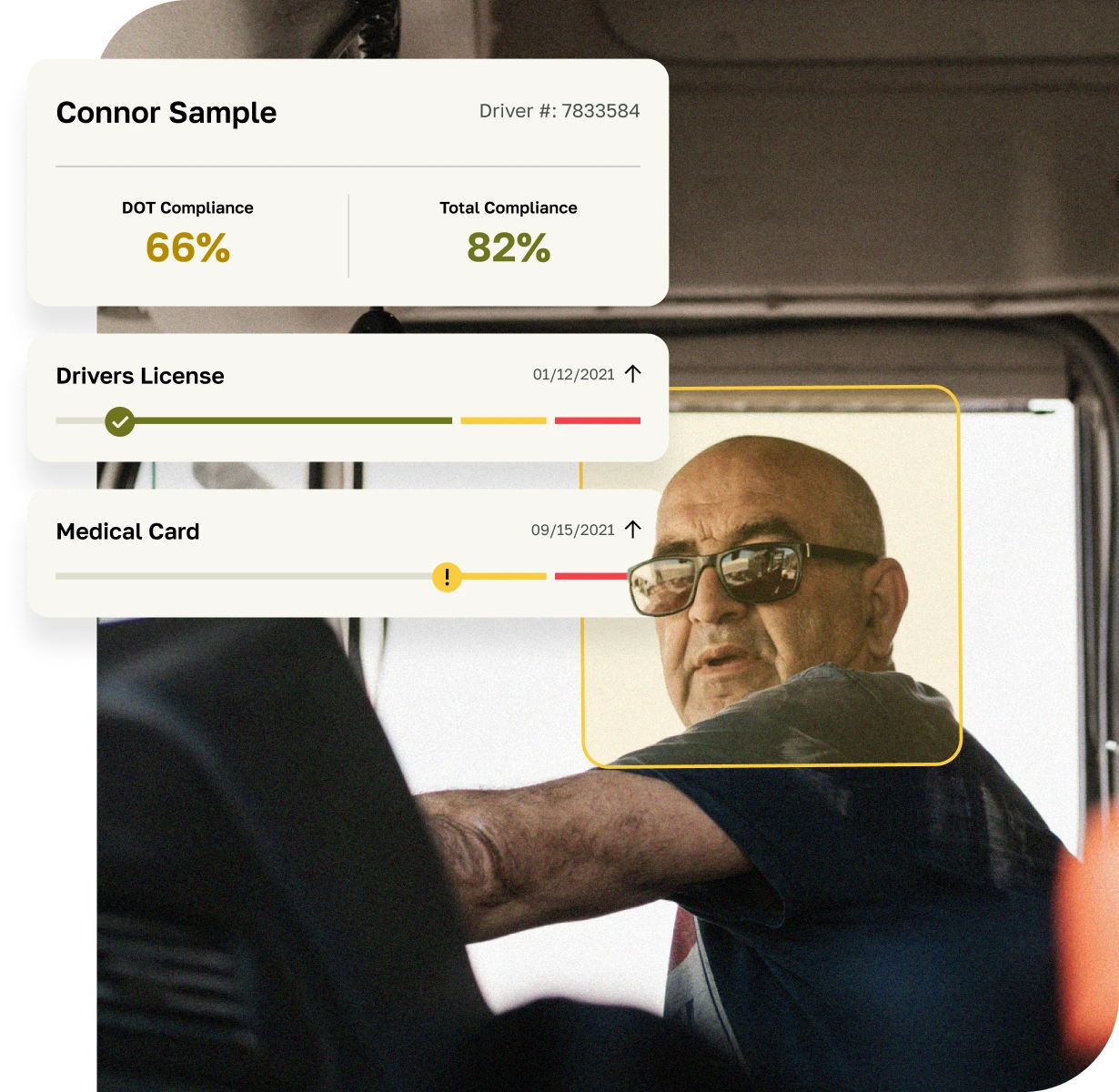
Fleetworthy is a complete fleet readiness suite that unites safety, compliance, toll management, and weigh station bypass in one connected platform, with single sign-on across every solution and a command center that shows them together. Fleetworthy is trusted by 90% of the largest fleets in North America. Each part of the suite addresses a separate readiness exposure:
- Compliance: Fleetworthy Compliance (formerly CPSuite) gives larger fleets a managed-service team that keeps driver and asset records audit-ready. Haul by Fleetworthy gives smaller and growing fleets the same audit-ready outcome through self-service, AI-powered software that reduces compliance admin work by up to 40%.
- Safety: Fleetworthy Foundations (free) and Fleetworthy Safety+ (premium) deliver in-cab alerts for work zones, weather, sudden slowdowns, and low bridges. A 2024 Purdue University study in Ohio found about 22% of drivers receiving dangerous slowdown alerts reduced speed by at least 5 mph within 30 seconds.
- Toll management: Fleetworthy Toll Management (formerly Bestpass) consolidates tolls into one device, one account, and one invoice, with Toll 360 adding predictive and reconciliation reporting.
- Weigh station bypass: Fleetworthy Weigh Station Bypass (formerly Drivewyze) runs on the fleet’s existing ELD or telematics device, with no transponder required, across the largest bypass network in North America and integrations with 40+ ELD and telematics providers.
Fleetworthy does not repair trucks. Fleets still need a maintenance shop, a leasing partner, or in-house technicians for mechanical work. What Fleetworthy provides is the readiness layer around that work: the records, alerts, toll accuracy, and bypass access that determine whether a sound truck and a qualified driver can actually keep moving.
2. Telematics and ELD platforms
Telematics and ELD platforms are the right choice when a fleet’s first need is vehicle location, engine diagnostics, and electronic hours-of-service logging under 49 CFR Part 395. Many add dash cameras and driver scoring. Some larger platforms have added driver qualification file tools, but most do not handle toll billing natively, so fleets layer other vendors on top. Because Fleetworthy Weigh Station Bypass and Fleetworthy Safety+ run through the fleet’s existing ELD, telematics platforms and Fleetworthy usually work together rather than compete.
3. Fleet maintenance software
Fleet maintenance software is built for fleets that run their own shops and need preventive maintenance schedules, work orders, parts inventory, and digital inspection records. It supports the vehicle side of readiness, including the maintenance records required by 49 CFR Part 396. It does not address driver qualification, drug and alcohol program records, safety alerts, tolls, or bypass.
4. Outsourced compliance services and C/TPAs
Outsourced compliance services and consortium/third-party administrators (C/TPAs) suit fleets that do not have internal compliance staff. They typically handle driver qualification files, drug and alcohol testing programs, and federal filings. Fleets should ask how quickly documents become visible after submission and whether medical certification is verified automatically or chased manually, because those two factors determine how current the fleet’s records are when an auditor asks for them. These services rarely cover in-cab safety, tolls, or bypass.
5. Full-service leasing and contract maintenance
Full-service leasing and contract maintenance providers suit fleets that prefer to lease equipment and outsource its upkeep, including preventive maintenance, roadside assistance, and vehicle-side compliance such as registrations. Driver-side compliance and safety programs generally remain the fleet’s responsibility, which is where a readiness suite fills the gap.
6. Mobile and regional maintenance providers
Mobile and regional maintenance providers deliver on-site repairs, DOT inspections, and state-specific testing such as California’s Clean Truck Check emissions program. They are valuable for keeping individual trucks road-ready in a specific territory. They are service vendors rather than readiness platforms, so the records they produce still need a home where the fleet can find them during an audit.
What does audit-ready mean for a trucking fleet?
An audit-ready trucking fleet can produce every required driver, vehicle, and testing record for the full federal retention period on request, without a scramble. No provider can guarantee an audit outcome; what a provider can do is keep records complete, current, and retrievable. The table below summarizes the core federal retention periods a fleet readiness provider should track.
| Record | Federal rule | Minimum retention |
|---|---|---|
| Driver qualification file | 49 CFR 391.51 | Duration of employment plus 3 years |
| Annual MVR inquiry and review | 49 CFR 391.25 | Completed every 12 months; kept 3 years from execution |
| Medical examiner’s certificate | 49 CFR 391.43 and 391.45 | 3 years from date of issue (certificate valid up to 24 months); for CDL and CLP holders, now verified through the CDLIS MVR |
| Hours-of-service records and supporting documents | 49 CFR 395.8 | 6 months |
| Vehicle inspection, repair, and maintenance records | 49 CFR 396.3 | 1 year, and for 6 months after the vehicle leaves the fleet’s control |
| Annual vehicle inspection report | 49 CFR 396.21 | 14 months |
| Driver vehicle inspection reports (DVIRs) | 49 CFR 396.11 | 3 months |
| Drug and alcohol records (positives, refusals, return-to-duty) | 49 CFR 382.401 | 5 years (negative results: 1 year) |
| Clearinghouse query records | 49 CFR 382.701 | 3 years |
The practical test is simple: if an FMCSA investigator asked today for one driver’s complete qualification file and one truck’s last 12 months of maintenance records, how long would it take to produce them, and would anything be missing? A fleet readiness provider should shorten that answer to minutes.
Which 2026 FMCSA changes affect fleet readiness?
Several FMCSA changes and requirements in 2026 affect fleet readiness , and most of them shift compliance from paper documents to electronic records that a fleet must check continuously. The ones with the most direct effect on driver and vehicle records are:
- Electronic medical certification. The FMCSA National Registry waiver that allowed paper medical certificates as temporary proof ran through October 11, 2026. For CDL and CLP holders, carriers now confirm medical status on the CDLIS motor vehicle record, and the electronic record controls when it conflicts with paper.
- Clearinghouse queries. Carriers must run a full FMCSA Drug and Alcohol Clearinghouse query before a driver performs safety-sensitive work and at least one query for each driver every 12 months.
- Enhanced SMS methodology. FMCSA approved a revised Safety Measurement System in November 2024 that renames BASICs as “Compliance Categories,” consolidates 959 roadside violations into 116 groups, and simplifies severity weights. The launch date will be announced by separate notice on the FMCSA CSA site. CSA results are calculated by FMCSA, so no vendor can promise a specific score change; clean, timely records are what a fleet controls.
- Driver eligibility enforcement. FMCSA’s non-domiciled CDL rule and English language proficiency enforcement at roadside both raise the cost of a driver qualification gap, because an ineligible driver can be placed out of service mid-route.
- MCS-150 updates. Carriers must update their USDOT registration every two years, now through FMCSA’s new Motus registration system, which launched in May 2026. FMCSA has temporarily paused USDOT number inactivations for updates due on or after June 1, 2026, while Motus stabilizes, but the requirement still applies and enforcement will resume with advance notice.
How do fleets choose the right fleet readiness provider?
Fleets choose the right fleet readiness provider by mapping their current vendors against the four readiness areas, finding the gaps and overlaps, and testing whether a provider can close those gaps without new hardware or new headcount. A practical evaluation runs in five steps:
- List every readiness vendor. Include compliance, drug and alcohol, toll, bypass, safety alert, and maintenance vendors, with contract dates and owners.
- Map coverage to the four areas. Mark which vendor covers safety, compliance, toll management, and weigh station bypass, and where two vendors overlap or none covers the area.
- Run an audit drill. Pull one complete driver qualification file and one vehicle’s maintenance history from current systems and time it.
- Check integrations. Confirm the provider’s bypass and safety alerts run on the fleet’s existing ELD or telematics device, so drivers do not need a second screen or a separate bypass transponder. Match the service model to staffing. Choose a managed service if the fleet wants experts handling records, or self-service software if the team wants control without adding staff.
Why fleets choose Fleetworthy for complete fleet readiness
Fleets choose Fleetworthy for complete fleet readiness because it replaces several point solutions with one connected suite and has published proof across each readiness area. Frost & Sullivan named Fleetworthy its 2025 North American Company of the Year in commercial vehicle safety, compliance, and toll management, citing the integration of all four areas into a single technology suite. Gartner recognized Fleetworthy as a Representative Vendor in its 2025 Market Guide for Commercial Vehicle Fleet Management. Named customers show the effect in their own operations:
- Boyle Transportation, a private fleet of roughly 80 to 100 vehicles hauling pharmaceutical and military freight, adopted Fleetworthy’s safety and compliance solutions after earlier success with Fleetworthy Toll Management and Fleetworthy Weigh Station Bypass. Boyle reports zero preventable recordable accidents since 2019 and near-zero driver turnover. “Time is our most valuable resource. Consolidating our providers under Fleetworthy gives us time back, and that helps us protect our drivers, customers, and reputation,” said Michael Lasko of Boyle Transportation.
- Golden Waffles raised driver qualification file compliance to 80% after adopting Fleetworthy Compliance, which also centralized IRP setup and moved about 99% of vehicle titles into company ownership.
- C.R. England, with 3,900+ tractors, has nearly cut chargeable accidents per million miles in half since 2019 using Fleetworthy Weigh Station Bypass and Fleetworthy Safety+.
- Ploger Transportation recorded 10,000 bypasses across 88 vehicles and more than $80,000 in operational savings in its first year on Fleetworthy Weigh Station Bypass.
Fleets ready to compare their current vendor stack against a complete fleet readiness suite can see how Fleetworthy connects safety, compliance, toll management, and weigh station bypass.