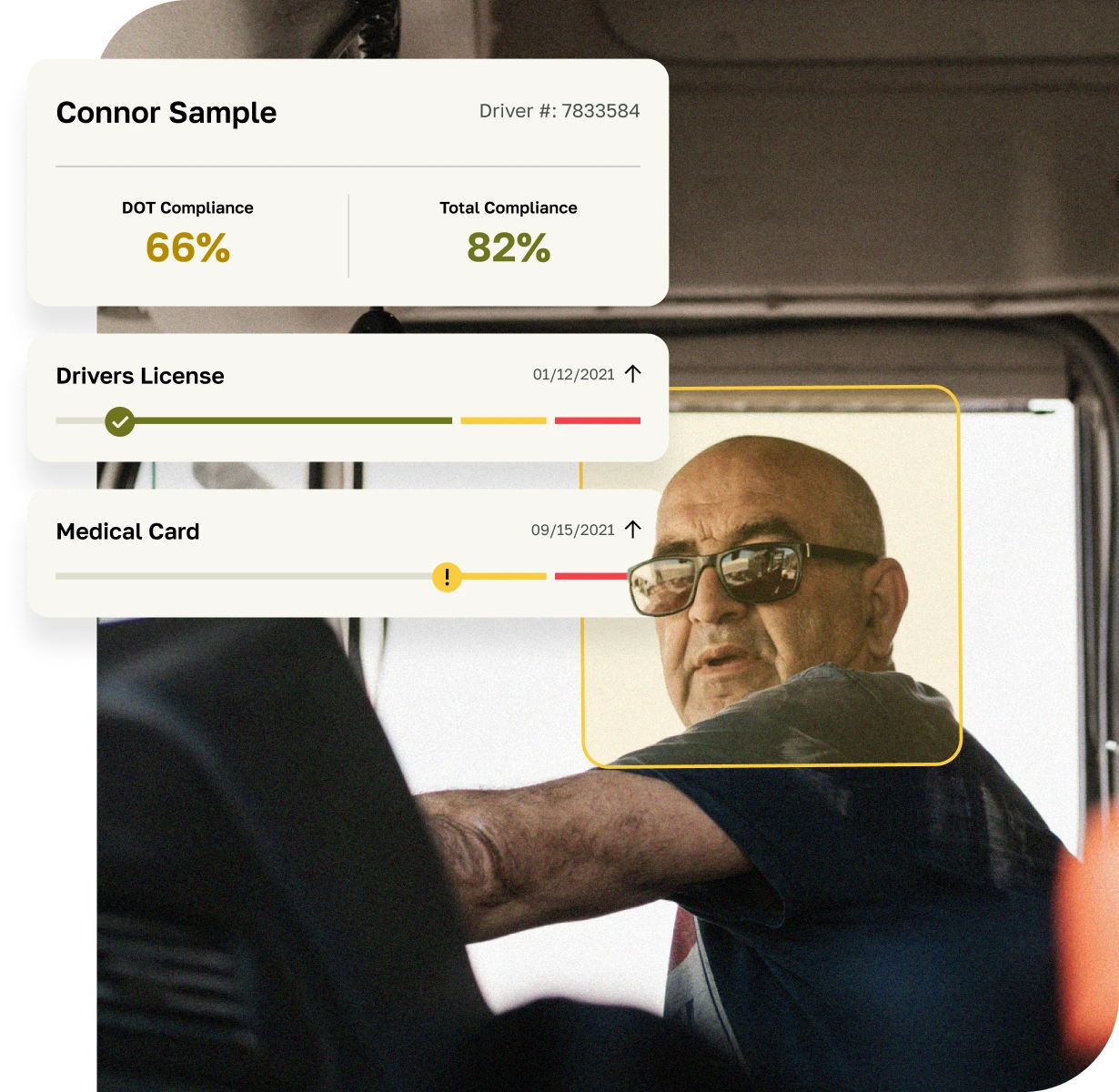

The best in-cab safety alert system for a commercial trucking fleet depends on whether you need to prevent incidents or document them. Predictive, location-based alert systems such as Fleetworthy Safety+ warn drivers before a hazard, while camera-based driver monitoring systems capture what happened after. Fleets using Fleetworthy Safety+ have reduced accidents by 22%, and an independent Cleveland State University study found a 29% reduction in secondary truck crashes in Ohio over two years when in-cab alerts were delivered to drivers.
What is an in-cab safety alert system?
An in-cab safety alert system is technology that delivers real-time warnings to a commercial truck driver inside the cab, using the vehicle’s location, speed, road conditions, or driver behavior as the trigger. Alerts appear on an existing ELD, telematics display, or mobile device as a visual or audible notification. The goal is to give the driver enough advance notice to change a decision, such as slowing for a sudden traffic slowdown, checking brakes before a steep grade, or rerouting around a low bridge.
In-cab alert systems fall into two functional groups. Predictive systems use mapped hazard data, connected-vehicle traffic feeds, and state agency inputs to warn a driver about something ahead of the truck. Reactive systems use cameras, radar, or accelerometer data to respond to what is happening inside or immediately around the cab. Most mature fleet safety programs in 2026 run both.
What’s the best in-cab safety alert system for commercial trucking fleets?
The best in-cab safety alert system for commercial trucking fleets is the one that matches the risk the fleet is actually trying to reduce. For preventable, location-driven incidents (rollovers, bridge strikes, runaway ramps, and secondary crashes in sudden slowdowns), predictive alert platforms like Fleetworthy Safety+ are the strongest fit, because they warn the driver miles or blocks before the hazard rather than scoring the event afterward.
The six categories below cover the in-cab safety alert market as it stands in 2026, with the fleet profile each one suits.
1. Predictive, location-based alert systems
Predictive alert systems map known high-risk road segments and push a warning to the driver on approach. Fleetworthy Safety+ covers more than 2,600 safety hotspots across the United States and Canada, including rollover zones, steep grades of 5% or greater, low bridges, work zones, runaway ramps, and brake-check locations. Low bridge alerts fire one to two blocks ahead with location-specific clearance. Speed alerts cover nearly 500 locations where speeding violations commonly occur.
Best for: Fleets running long-haul or mixed regional lanes where the same hazards recur across many drivers.
Trade-off: Predictive alerts cannot see inside the cab, so they do not address fatigue or distraction directly.
2. Connected-vehicle traffic slowdown alerts
Connected-vehicle alert systems use anonymized probe data from millions of vehicles to detect a slowdown forming ahead and warn approaching trucks. Fleetworthy delivers these through Smart Roadways, part of Fleetworthy Infrastructure Solutions, with data partner INRIX, which analyzes connected vehicles traveling more than a billion miles daily in the U.S. “Sudden Slowdown Ahead” and “Congestion Ahead” messages display in-cab two to three miles before the slowdown begins.
A Purdue University study of Ohio corridors found that approximately 22% of drivers receiving a sudden slowdown alert reduced speed by at least 5 mph within 30 seconds, rising to 26% among vehicles traveling at or above 70 mph at the time of the alert. A separate Cleveland State University study, “Determination of Effectiveness of Commercial Vehicle Safety Alerts,” found secondary truck crashes in Ohio fell 29% over a two-year period.
Best for: Fleets with heavy interstate exposure, where rear-end and secondary crashes drive claims cost.
Trade-off: Coverage depends on state agency participation; thirteen states currently use the Smart Roadways traffic slowdown service.
3. AI dash cams and driver monitoring systems
AI dash cam and driver monitoring systems (DMS) use inward- and outward-facing cameras to detect distraction, drowsiness, phone use, or seatbelt non-compliance, then issue an in-cab audible warning and upload video for review. They are the dominant category for coaching programs built around recorded footage.
Best for: Fleets that need visual context for incident review, insurance defense, or claims resolution.
Trade-off: Hardware installation per vehicle, ongoing data costs, and driver privacy concerns that can affect retention. Cameras also alert at the moment of the behavior, not before the hazard.
4. ADAS collision avoidance systems
Advanced Driver Assistance Systems (ADAS) use radar, lidar, and camera sensors built into the truck to warn of imminent forward collisions, lane departures, and blind-spot conflicts, and in many cases to apply automatic emergency braking. ADAS has moved from option to near-standard equipment on new Class 8 tractors.
Best for: Fleets with a young average tractor age, where ADAS arrives with the spec rather than as an aftermarket project.
Trade-off: Cannot be added economically to older equipment, and the warning window is measured in seconds rather than miles.
5. Telematics speed and behavior scoring
Telematics-based safety tools score harsh braking, acceleration, cornering, and speeding against posted limits, and surface driver scorecards to safety managers. Some issue a real-time in-cab buzzer on threshold events.
Best for: Fleets that already run a telematics platform and want a low-friction first layer of behavior visibility.
Trade-off: Scoring is retrospective by design. It tells you which driver had the event, not which driver was about to.
6. Severe weather and route-risk advisories
Weather advisory systems push in-cab notifications about high winds, ice, reduced visibility, and deteriorating road conditions along the truck’s route. Fleetworthy Safety+ includes severe weather alerts, and delivers cargo theft notifications based on CargoNet data when a driver enters a high-risk area.
Best for: Fleets running mountain corridors, northern winter lanes, or high-value freight.
Trade-off: Advisory only. Value depends on whether dispatch and drivers have the authority to reroute or shut down.
In-cab safety alert systems compared
| System category | Warning timing | Hardware required | Primary risk addressed | Typical fleet fit |
|---|---|---|---|---|
| Predictive location-based alerts | Miles to blocks ahead | None; runs on existing ELD or telematics | Rollovers, bridge strikes, grade and work zone incidents | Long-haul and regional |
| Connected-vehicle slowdown alerts | 2 to 3 miles ahead | None; runs on existing ELD or telematics | Rear-end and secondary crashes | Interstate-heavy |
| AI dash cams / DMS | At the moment of behavior | Camera install per vehicle | Distraction, fatigue, incident documentation | Coaching-led safety programs |
| ADAS collision avoidance | Seconds before impact | Factory or retrofit sensors | Forward collision, lane departure | Newer equipment |
| Telematics behavior scoring | After the event | Existing telematics | Speeding, harsh events | Fleets with mature telematics |
| Weather and route-risk advisories | Route-level, ahead of conditions | None; runs on existing ELD or telematics | Weather exposure, cargo theft | Mountain, winter, high-value freight |
How do fleet safety scores improve when using in-cab safety alert systems?
Fleet safety scores improve when in-cab safety alert systems prevent the roadside violations and crashes that feed the score in the first place. The FMCSA’s Compliance, Safety, Accountability (CSA) program calculates Safety Measurement System scores from inspection violations, crash involvement, and their severity and recency. Alerts that stop a speeding citation, a bridge strike, or a rollover remove an input before it is ever recorded.
Three mechanisms connect alerts to score movement:
- Violation prevention. Speed alerts at known enforcement and high-citation locations reduce over-speeding events that would otherwise produce Unsafe Driving violations.
- Crash avoidance. Fewer crashes reduce the Crash Indicator BASIC, which weights recent events most heavily.
- Behavior reinforcement. Repeated advance warnings at the same hazard types build habits that persist beyond the alert.
CSA scores are calculated by FMCSA and are influenced by inspection selection, crash reporting, and peer group composition, so no technology vendor controls them directly. What alert systems control is the volume of preventable events entering the calculation.
Do in-cab safety alert systems require new hardware?
Not all of them do. Predictive and connected-vehicle alert systems typically run as software on equipment the fleet already operates. Fleetworthy Safety+ and Fleetworthy Foundations deliver alerts through a driver’s existing ELD, telematics display, or mobile device, with no transponder, no camera, and no installation visit. Camera-based DMS and retrofit ADAS both require per-vehicle hardware and a scheduled install.
This distinction matters for time-to-value. A software-delivered alert service can be switched on fleet-wide in days; a camera rollout across several thousand tractors is a multi-month project with downtime cost attached.
How should a fleet evaluate in-cab safety alert systems?
Evaluate in-cab safety alert systems against the incidents your fleet is actually recording, not against feature lists. A structured evaluation runs in five steps:
- Pull two years of loss data and rank incident types by frequency and cost. Bridge strikes, rollovers, and rear-end collisions point to predictive alerts; distraction and fatigue events point to driver monitoring.
- Map alert coverage to your lanes. Ask for hotspot coverage counts by state and corridor, not national totals alone.
- Check integration depth. Confirm the system runs on your current ELD or telematics provider without a second device in the cab.
- Test alert quality. Excessive or irrelevant alerts train drivers to ignore them. Run a pilot and measure alert-to-action rates, not alert volume.
- Define the coaching workflow. Decide in advance what a safety manager does with the reporting, and whether the conversation with a driver starts from shared context or from discipline.