
DOT drug and alcohol compliance requires every FMCSA-regulated motor carrier to run six categories of testing, query the FMCSA Drug and Alcohol Clearinghouse before hire and annually thereafter, report violations within three business days, and retain testing records for one to five years depending on the record type. In 2026, the random drug testing rate holds at 50% of the average driver pool and the random alcohol rate at 10%.
The rules themselves changed less in 2026 than the enforcement around them. Identity verification now gates Clearinghouse registration, a revised Part 40 procedure took effect in June, and more than 200,000 CDL holders sit in prohibited status. For fleet compliance managers, the practical risk has shifted from “do we test?” to “can we prove it, on demand, for every driver, going back five years?”
What is DOT drug and alcohol compliance for fleets?
DOT drug and alcohol compliance for fleets is the set of federal requirements under 49 CFR Part 40 and Part 382 that govern how motor carriers test CDL drivers for controlled substances and alcohol, report violations, and document the entire program. Any employer of a driver who operates a commercial motor vehicle requiring a CDL is subject to these rules, including single-truck owner-operators, who must join a consortium because a one-person random pool is not permissible.
The program has three layers. The testing layer covers who gets tested, when, and by what method. The reporting layer covers the FMCSA Drug and Alcohol Clearinghouse, the federal database of violations. The recordkeeping layer covers what the carrier must be able to produce during a compliance review. Most enforcement findings come from the third layer, not the first.
What changed for DOT drug and alcohol compliance in 2026?
Four changes define DOT drug and alcohol compliance in 2026: mandatory identity verification for new Clearinghouse registrants, a revised Part 40 rule covering observed collections, continued absence of certified oral fluid laboratories, and sustained enforcement of CDL downgrades for drivers in prohibited status.
| Change | Effective date | What fleets must do |
|---|---|---|
| Clearinghouse identity verification for new registrants | April 27, 2026 | New users in covered roles verify identity through Login.gov and the FMCSA Identity Verification mobile app before registration completes |
| Revised Part 40 procedures for transportation workplace testing | June 10, 2026 | Where an oral fluid test would otherwise be required and cannot be conducted, a directly observed urine collection is used instead |
| Oral fluid testing still unavailable in practice | Ongoing | No HHS-certified oral fluid laboratories exist yet, so urine remains the only usable DOT method |
| CDL downgrade enforcement for prohibited status | Ongoing since Nov 18, 2024 | State licensing agencies remove commercial driving privileges within 60 days of notification until return-to-duty is complete |
The identity verification requirement, announced by FMCSA as an anti-fraud measure, means a new compliance hire cannot simply be handed Clearinghouse access on day one. Registration now depends on an individual verifying their own identity, which makes role turnover a scheduling problem rather than an administrative one. Fleets should check FMCSA’s identity verification guidance before onboarding new compliance staff.
The revised Part 40 rule published May 11, 2026 closed a gap created by the oral fluid stalemate. DOT authorized oral fluid testing, but the Department of Health and Human Services must certify at least two laboratories before it can be used, and as of mid-2026 none had completed certification. The rule tells carriers what to do in the meantime.
What are the six DOT drug and alcohol test types?
FMCSA requires six categories of drug and alcohol testing: pre-employment, random, post-accident, reasonable suspicion, return-to-duty, and follow-up. Missing any single category is a citable violation during a compliance review, and each category has its own trigger, timing rule, and documentation requirement.
- Pre-employment. A negative controlled substances test result is required before the driver performs any safety-sensitive function for the first time. A pre-employment full Clearinghouse query is also required.
- Random. Drivers are selected by a scientifically valid method from a pool covering all CDL drivers, spread reasonably throughout the calendar year.
- Post-accident. Required after fatalities, and after injuries or disabling damage when the driver receives a citation. Alcohol testing should occur within two hours and must be documented if it takes longer than eight hours; drug testing has a 32-hour window.
- Reasonable suspicion. Triggered by a trained supervisor’s contemporaneous observation of appearance, behavior, speech, or body odor. Supervisor training records are themselves a commonly cited deficiency.
- Return-to-duty. Conducted under direct observation after a Substance Abuse Professional completes their evaluation and the driver finishes the prescribed education or treatment.
- Follow-up. A minimum of six unannounced, directly observed tests in the first 12 months after return to duty, on a schedule set by the SAP, potentially extending up to 60 months.
What is the DOT random testing rate for 2026?
The 2026 minimum random testing rates for FMCSA-regulated drivers are 50% for controlled substances and 10% for alcohol, unchanged for the sixth consecutive year. FMCSA raised the drug rate from 25% to 50% in January 2020 and has held it there because industry-wide positivity data continues to sit at or above the 1% threshold that triggers the higher rate.
Rate compliance is measured against the average number of driver positions in the pool over the calendar year, not the headcount on any single day. That distinction matters for fleets with seasonal capacity or heavy mid-year hiring. A carrier that adds 40 drivers in Q2 and calculates its selections against a January roster will end the year short, and the shortfall is visible to an auditor on the annual summary. FMCSA publishes current rates on its random testing page.
Selections must also be genuinely spread across the year. Compressing a year of random testing into a Q4 catch-up is a common finding, because quarterly selection records show the pattern plainly.
What Clearinghouse queries are fleets required to run?
Employers must run a full Clearinghouse query before a driver performs any safety-sensitive function, and a limited query at least once every 12 months for every CDL driver currently employed. Violations, including refusals to test, must be reported by the employer or the designated consortium/third-party administrator within three business days.
The three most common Clearinghouse failures found during compliance reviews are skipping the pre-employment full query, letting annual limited queries lapse for long-tenured drivers, and failing to recognize a refusal as a separately reportable event. The second is the quiet one. Pre-employment queries are attached to a hiring workflow that someone owns, while annual queries are attached to a date that nobody owns unless a system tracks it.
The consequence has teeth. When a driver appears in prohibited status, state licensing agencies must downgrade the CDL within 60 days of notification, stripping commercial privileges until the return-to-duty process is complete. As of early 2026, roughly 202,000 CDL and CLP holders were in prohibited status, with approximately 159,000 of them not yet started on return-to-duty. For a fleet, that means a driver can lose commercial privileges through a state action the carrier never sees coming. The annual query is the only routine mechanism that surfaces it.
How long must fleets keep drug and alcohol testing records?
FMCSA requires retention periods of one to five years depending on the record type, under 49 CFR 382.401. The five-year records are the ones auditors ask for first, because they establish whether the program worked when it mattered.
| Record type | Retention period |
|---|---|
| Verified positive drug results, alcohol results of 0.02 or greater, refusals, SAP reports, follow-up testing records | 5 years |
| Annual calendar year summaries (MIS reports) | 5 years |
| Records related to the collection process | 2 years |
| Negative and canceled drug results, alcohol results below 0.02 | 1 year |
| Clearinghouse query records | 3 years |
| Supervisor reasonable suspicion training documentation | Duration of employment plus 2 years |
Retention is where paper programs break. A five-year obligation outlasts the average tenure of the person who filed the record, the vendor contract under which the test was collected, and often the folder structure it was filed in. Carriers that have changed C/TPAs, acquired another fleet, or moved offices during the retention window are the ones most likely to find a gap under audit conditions.
What should fleets look for in DOT drug and alcohol compliance technology?
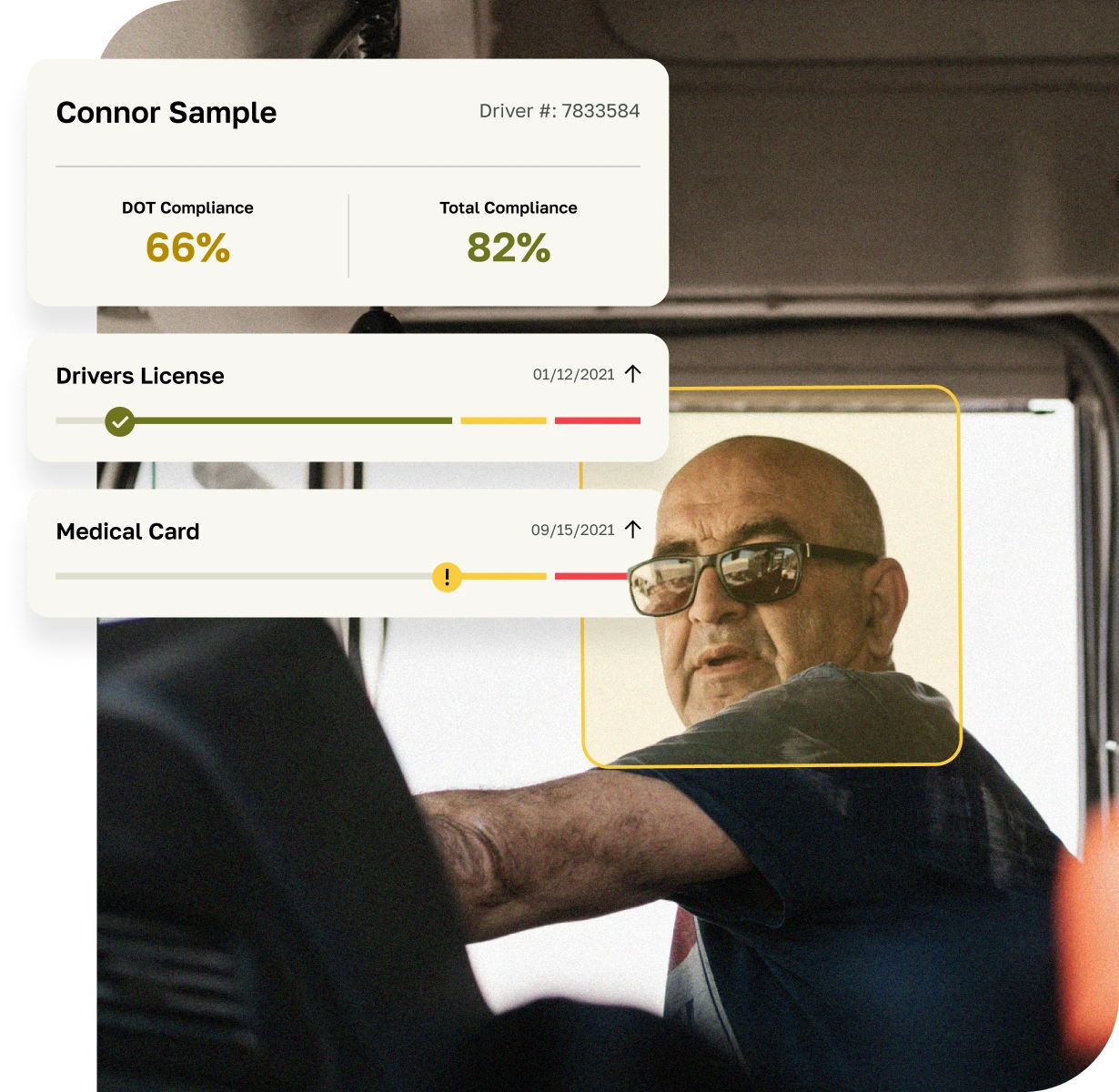
DOT drug and alcohol compliance technology should give a fleet real-time visibility into whether every driver’s required records exist and are current, flag expirations before they become violations, and produce a complete, organized record set on demand for a compliance review. The testing itself is performed by collectors, laboratories, medical review officers, and C/TPAs; the technology’s job is to hold the resulting documentation and make gaps visible.
Five evaluation criteria separate a usable system from a filing cabinet with a login:
- Real-time document status. A record that has been submitted but is invisible while it sits in a processing queue is not a record a compliance manager can rely on. Status should be visible the moment a document enters the system.
- Expiration-driven alerting. Annual Clearinghouse queries, medical certificates, and follow-up test schedules all expire on dates. The system should surface the date before it passes, not after.
- Driver-level completeness view. A compliance manager should be able to answer “is this specific driver fully qualified right now?” in one place rather than reconciling a testing vendor portal against a driver qualification file.
- Audit-ready export. Producing five years of records during a compliance review should be a retrieval task, not a reconstruction project.
- Consolidation across record types. Drug and alcohol documentation is one component of driver qualification. Keeping it separate from the DQ file, medical card, and MVR creates the reconciliation work that produces gaps.
How does Fleetworthy support DOT drug and alcohol compliance?
Fleetworthy supports DOT drug and alcohol compliance by maintaining the driver record layer that makes a testing program provable. Fleetworthy Compliance is a managed service that keeps driver qualification and asset records audit-ready, with 24/7 dashboard visibility, drill-down views into document status, automated FMCSA medical card verification within 14 days, and a mobile driver wallet. Haul by Fleetworthy is the self-service option for small and mid-size fleets without a dedicated compliance team, using AI data extraction to reduce compliance admin work by up to 40%.
Fleetworthy is the only complete technology suite for fleet readiness, uniting safety, compliance, toll management, and weigh station bypass in one connected platform. It is trusted by 90% of the largest fleets in North America, and was named Frost & Sullivan’s 2025 North American Company of the Year for commercial vehicle safety, compliance, and toll management. The pattern Fleetworthy is built to break is the one that produces most compliance findings: driver records spread across a testing vendor, a recruiting system, a shared drive, and a spreadsheet, with no single view that answers whether a driver is qualified today. Fleetworthy customers have moved DQ file compliance from a manual reconciliation exercise to a monitored one. One customer raised DQ file compliance to 80% against a 92% target while eliminating 15 to 20 administrative emails per day.
Note on scope: Fleetworthy Compliance manages driver and asset compliance documentation. It does not operate a random testing consortium or act as a C/TPA. Fleets should pair their testing provider with a compliance record system that keeps the resulting documentation retrievable.