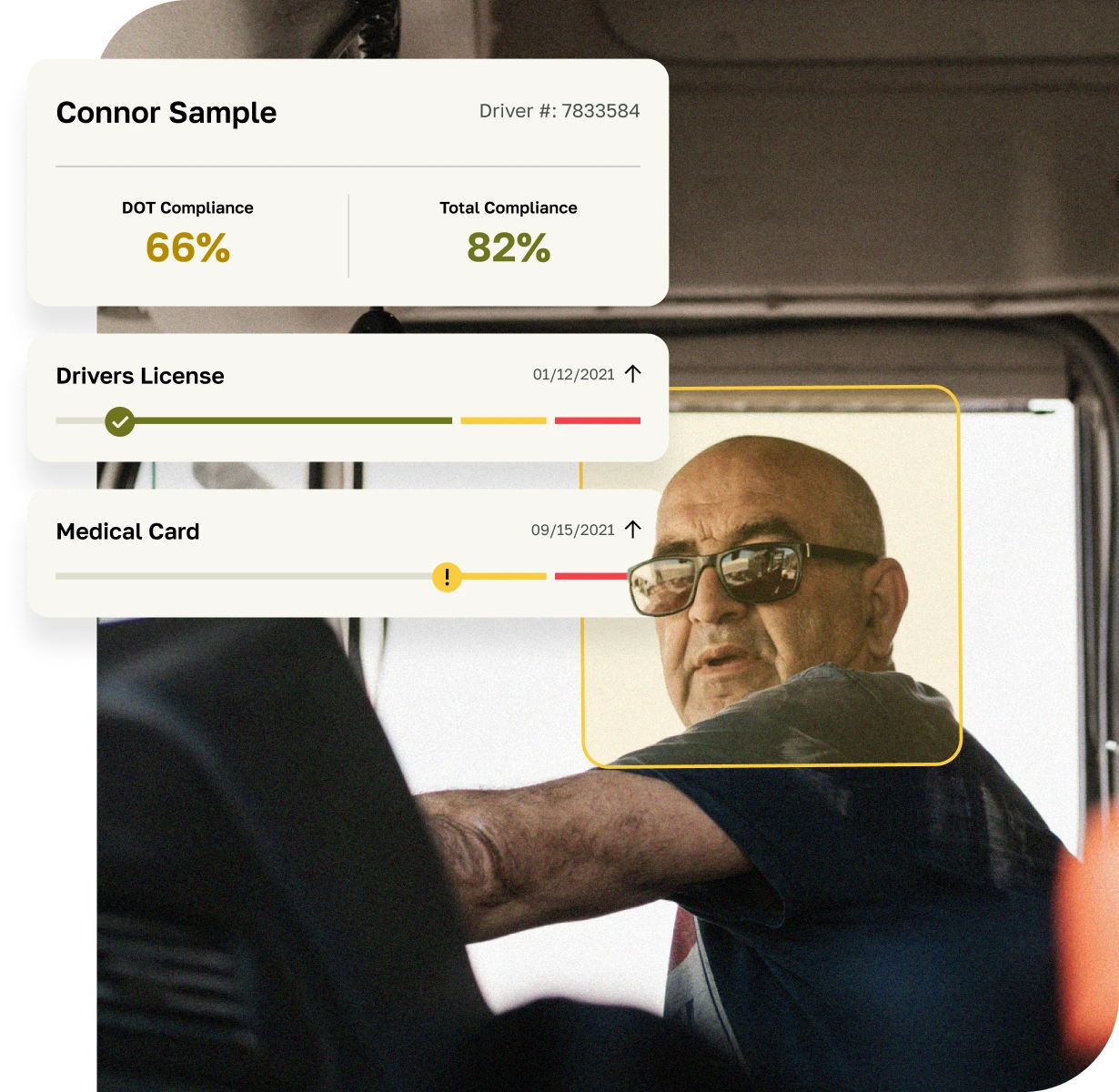

Driver Qualification File requirements changed in 2026. Learn what every DQ file must contain, what changed with electronic medical certification, and how growing fleets stay audit-ready without adding headcount.
The best way for a growing truck fleet to manage Driver Qualification Files in 2026 is to treat each file as a live record, not a folder. Build it to the federal checklist in 49 CFR 391.51, track every expiring item on a calendar, verify CDL drivers’ medical certification through their MVR, and automate reminders and document checks so the process scales as you hire.
That last point matters more this year. As of October 12, 2026, paper medical certificates no longer count as proof of medical certification for most CDL drivers, and since late 2024, state licensing agencies have downgraded CDLs for drivers in prohibited status in the FMCSA Drug and Alcohol Clearinghouse. A DQ process that worked at 30 drivers on a shared drive tends to break at 150 drivers across three terminals. This guide covers what the file must contain, what changed in 2026, and a step-by-step process for keeping every file audit-ready as the fleet grows.
Key takeaways
- Every interstate CMV driver needs a Driver Qualification (DQ) file under 49 CFR 391.51, kept for the length of employment plus three years.
- As of October 12, 2026, the CDLIS motor vehicle record (MVR), not a paper card, is the proof of medical certification for CDL and CLP holders licensed in every state except Alaska.
- Since November 18, 2024, states must downgrade the CDL of any driver in Clearinghouse prohibited status, so annual Clearinghouse queries and MVR reviews now surface the same problem from two directions.
- Most DQ-related violations come from items that expire or recur: annual MVRs and reviews, medical certification, and annual Clearinghouse queries.
- Growing fleets can stay audit-ready without adding headcount by choosing a managed service such as Fleetworthy Compliance or a self-service, AI-powered platform such as Haul by Fleetworthy.
What is a Driver Qualification File?
A Driver Qualification File is the set of records a motor carrier must keep for each commercial motor vehicle (CMV) driver to prove that the driver is qualified to operate. FMCSA defines its contents in 49 CFR 391.51. The file applies to interstate CMV drivers, including non-CDL drivers of vehicles over 10,000 pounds, and auditors review it during compliance reviews, focused reviews, and new entrant safety audits.
The required contents fall into two groups: documents gathered once at hire, and documents that must be refreshed on a schedule. The table below summarizes both.
| DQ file item | When it is required | Federal rule | How long to keep it |
|---|---|---|---|
| Employment application | At hire | 49 CFR 391.21 | Employment plus 3 years |
| Pre-employment MVR from each state where the driver held a license in the past 3 years | Within 30 days of hire | 49 CFR 391.23(a)(1) | Employment plus 3 years |
| Road test certificate, or an accepted equivalent license or certificate | At hire | 49 CFR 391.31 and 391.33 | Employment plus 3 years |
| Annual MVR | At least every 12 months | 49 CFR 391.25(a) | 3 years from the date it was obtained |
| Note documenting the annual review of the driving record | At least every 12 months | 49 CFR 391.25(c)(2) | 3 years from the date of the review |
| Proof of medical certification (CDLIS MVR for CDL/CLP holders; medical examiner’s certificate for non-CDL drivers) | At hire and at every new physical (certificates last up to 24 months) | 49 CFR 391.43 and 391.45 | 3 years from the date of execution |
| Note verifying the medical examiner is on the National Registry (non-CDL drivers) | At each new certificate | 49 CFR 391.23(m) | 3 years from the date of execution |
| Medical variance, Skill Performance Evaluation certificate, or medical exemption, if applicable | When issued | 49 CFR 391.49 and Part 381 | 3 years from the date of execution |
Two related records sit outside the DQ file but are reviewed in the same audit. Safety performance history from previous DOT-regulated employers (49 CFR 391.23) belongs in a separate driver investigation history file, and Clearinghouse query results and drug and alcohol testing records belong in the fleet’s drug and alcohol program files. A good DQ process tracks all three files together because a gap in one often shows up in the others.
What changed for Driver Qualification Files in 2026?
Driver Qualification File management changed in 2026 mainly because medical certification largely moved to an electronic, state-record model and enforcement of driver eligibility rules tightened. Four changes affect how growing fleets build and maintain DQ files.
1. Paper medical certificates no longer prove certification for CDL drivers
Under FMCSA’s National Registry II (NRII) rule, medical examiners send exam results to FMCSA, which forwards them to the driver’s state licensing agency for posting to the CDLIS record. FMCSA kept paper certificates valid under a series of temporary waivers and exemptions, the last of which ran through October 11, 2026. Starting October 12, 2026, motor carriers must use the driver’s CDLIS MVR as proof of medical certification for CDL and CLP holders. Alaska is the only exception: for drivers licensed in Alaska, paper certificates are accepted for up to 60 days after issuance through October 12, 2027. Non-CDL drivers still need a paper medical examiner’s certificate in the file.
For DQ files, the practical change is the workflow. For CDL drivers, a fleet that relied on a driver handing over a new card now has to pull an MVR after each physical and confirm the new certification has posted, then follow up with the clinic or state if it has not.
2. Clearinghouse violations now lead to CDL downgrades
Since November 18, 2024, the Clearinghouse-II rule has required state licensing agencies to downgrade the CDL of any driver in prohibited status in the FMCSA Drug and Alcohol Clearinghouse until the driver completes the return-to-duty process. Employers still run a full Clearinghouse query before a new driver performs any safety-sensitive function and a limited query on every CDL driver at least once a year. The difference now is that the resulting downgrade also appears on the MVR, so a fleet that misses a query can still find the problem at the annual review, provided the review actually happens on time.
3. English language proficiency is an out-of-service violation again
Out-of-service enforcement for the English language proficiency requirement in 49 CFR 391.11(b)(2) resumed on June 25, 2025. In 2026, Congress directed FMCSA to make failing the ELP requirement a mandatory out-of-service violation, and FMCSA proposed a rule to do so. The ELP requirement applies to all interstate CMV drivers, not only CDL holders. Fleets should document how they assess English proficiency during hiring and keep that record with the driver’s onboarding file.
4. Non-domiciled CDL eligibility narrowed
FMCSA’s final rule restricting non-domiciled CDL eligibility to drivers in H-2A, H-2B, or E-2 status took effect March 16, 2026, and remains under legal challenge. Fleets that employ non-domiciled CDL holders should confirm each driver’s license remains valid at renewal and record that check in the file.
Why do Driver Qualification Files break down as fleets grow?
Driver Qualification Files break down as fleets grow because the workload scales with every driver and every expiration date, while the process usually stays manual. Each CDL driver adds at least three recurring deadlines a year (annual MVR, annual review, Clearinghouse query) plus a medical certificate that can expire any month. At 150 CDL drivers, that is 450 or more recurring tasks a year before counting new hires, terminations, and drivers who move between terminals.
Incomplete DQ files (49 CFR 391.51) and drivers operating with expired medical certification (49 CFR 391.45) are among the most common driver qualification violations, according to FMCSA.
Growth also adds structural problems. Terminals keep files differently, HR and safety each own part of the record, and turnover means files for former drivers still have to be retained for three years. Spreadsheets and shared drives can store the documents, but they won’t tell a safety director on their own which 12 files will fail an audit next month.
How do you build an audit-ready Driver Qualification File process?
An audit-ready Driver Qualification File process is one where any file can be pulled on short notice and every required item is present, current, and verifiable. These seven steps build that process for a growing fleet.
- Standardize one DQ checklist for every terminal. Base it on 49 CFR 391.51 and add your own policy items, such as ELP assessment notes. One checklist removes terminal-by-terminal variation.
- Centralize files in one system of record. Store DQ files, investigation history files, and Clearinghouse records in one place, with role-based access so drug and alcohol records and investigation history files stay restricted to authorized staff.
- Build the file at hire, before the first dispatch. Gate dispatch on a complete file: application, pre-employment MVRs, road test or equivalent, medical certification, a verified negative pre-employment drug test, and, for CDL drivers, a full Clearinghouse query.
- Put every expiring item on a calendar. Track medical certification, annual MVRs, annual reviews, and annual Clearinghouse queries by due date, with alerts 30 to 60 days ahead.
- Verify CDL drivers’ medical certification through the MVR. Pull a CDLIS MVR a few days after each DOT physical, confirm the new certification has posted, and follow up with the clinic if it has not.
- Document the annual review, not only the MVR. Auditors look for the dated note naming the person who reviewed the record and confirming the driver remains qualified.
- Self-audit quarterly and at every terminal. Sample files against the checklist, fix gaps, and keep separated drivers’ files for three years.
What should Driver Qualification File software automate?
Driver Qualification File software should automate the work that grows with headcount: reading and validating documents, tracking expirations, sending reminders, and showing compliance status across the fleet. Storage alone does not reduce risk. The table below lists the capabilities that matter most for a growing fleet.
| Capability | What it does | Why it matters for growing fleets |
|---|---|---|
| Document reading and validation | Extracts dates and details from uploaded documents and checks them against requirements | Reduces manual data entry as new hires increase |
| Expiration tracking and alerts | Flags medical certification, annual MVRs, reviews, and queries before they lapse | Helps prevent the most common DQ file violations |
| Fleet-wide dashboard | Shows file completeness by driver, terminal, and item in real time | Lets one person oversee many terminals |
| Role-based access | Gives safety, HR, and terminal managers the right view of the same record | Keeps every department working from the same record |
| Driver mobile access | Lets drivers submit documents from the road | Shortens onboarding and renewal cycles |
| Audit-ready export | Produces complete files on request | Cuts audit preparation time |
How can a growing fleet manage DQ files without adding headcount?
A growing fleet can manage DQ files without adding headcount by choosing one of two models: a managed service, where an outside compliance team maintains the files, or a self-service platform, where software does the tracking and the fleet’s existing staff handle exceptions. Fleetworthy offers both.
| Fleetworthy Compliance (managed service) | Haul by Fleetworthy (self-service) | |
|---|---|---|
| Best fit | Larger and multi-terminal fleets that want a dedicated compliance team to maintain records | Small and growing fleets without a dedicated compliance department |
| How it works | Fleetworthy’s compliance team keeps driver and asset records audit-ready, with real-time document visibility and 24/7/365 dashboard access | AI-powered document reading, validation, automated reminders, and role-based dashboards |
| Staffing impact | Day-to-day file maintenance moves to Fleetworthy’s team | Cuts compliance admin work by up to 40% |
| Learn more | Fleetworthy Driver Qualification File management | Haul by Fleetworthy |
Fleetworthy Compliance (formerly CPSuite) gives larger fleets a managed-service team that maintains DQ files, onboarding paperwork, and credential tracking end to end, so HR and safety staff are not the fallback for chasing documents. Haul by Fleetworthy helps smaller, growing fleets keep files audit-ready through a self-service platform that reads documents, validates them, and sends reminders automatically.
How has Fleetworthy helped a growing fleet with DQ file compliance?
Golden Waffles, a food manufacturing and distribution company running more than 135 vehicles, raised its Driver Qualification File compliance to 80% after adopting Fleetworthy Compliance, according to a Fleetworthy customer story. Fleetworthy also centralized the company’s IRP setup and moved about 99% of vehicle titles into company ownership, which cleared the way for Golden Waffles to launch a new private freight operation, Golden Waffles Xpress.
Fleetworthy offers the only complete technology suite for fleet readiness, uniting safety, compliance, toll management, and weigh station bypass, and is trusted by 90% of the largest fleets in North America. For growing fleets, that means DQ file management sits in the same connected platform as the rest of the fleet’s readiness work.
DQ file maintenance calendar
| Task | Frequency | Trigger |
|---|---|---|
| Full Clearinghouse query | Once per driver | Before any safety-sensitive function |
| Pre-employment MVRs (all states, past 3 years) | Once per driver | Within 30 days of hire |
| Limited Clearinghouse query | At least every 12 months | Annual due date per driver |
| Annual MVR and documented review | At least every 12 months | Annual due date per driver |
| Medical certification check | At every new DOT physical (up to every 24 months) | Certificate expiration date; pull MVR a few days after the exam |
| Self-audit of DQ files | Quarterly | Calendar |
| Retain separated drivers’ files | 3 years after separation | Termination date |
Ready to make every Driver Qualification File audit-ready? See how Fleetworthy manages Driver Qualification Files for fleets of every size.