
What Are Toll Transponders and How Do They Work? Complete Fleet Guide
On the road, your fleet can pay tolls in various ways. The most traditional way is with cash, but your drivers will have to keep receipts, and your accounting teams will need to calculate reimbursements. Technology and cameras at collection points let you link your license plates to a prepaid account, but it may take some time for toll authorities to pair the plate with your information.
Toll transponders make connecting your payment information with toll authorities easy, letting you better track charges and identify miscalculations. But how does electronic tolling work? Understanding the method thoroughly and its benefits can help you determine whether it will best suit your company and fleet.
What Is a Transponder for Tolls? Understanding Toll Tags and Electronic Passes
Toll transponders, also known as toll tags, are wireless transmitters that attach to your truck and send a radio signal to tolls. They connect toll authorities with your payment information, allowing collectors to charge your account efficiently and provide you with essential transaction data. When you need to manage large fleets of trucks, transponders can be a great tool to track and store toll information.
Toll transponders have many names and types. You can also call them toll tags, an electronic toll pass or by the transponder’s brand, like E-ZPass. Most toll transponders sit on your dashboard or stick to your windshield, so toll authorities can easily scan them. However, if you have a car-hauler or your windshield is blocked, you can also get an exterior toll tag that attaches to your license plate or roof.
Types of Toll Transponders
There are several types of toll transponders available for fleet operations:
- Windshield-mounted transponders – Most common for commercial vehicles, mounted on the inside of the windshield
- License plate-mounted transponders – Attached to the front or rear license plate, ideal for vehicles with obstructed windshields
- Roof-mounted transponders – Used for car haulers and other specialty vehicles
- Portable transponders – Can be moved between vehicles, useful for fleet rotation
- Multi-state transponders – Work across multiple states and toll authorities
Major Transponder Providers
Several major providers offer toll transponder services across North America:
- E-ZPass – Available in 17 states along the East Coast and Midwest
- FasTrak – Primary provider in California
- SunPass – Covers Florida toll roads
- TxTag – Serves Texas toll facilities
- Multi-state providers – Companies offering coverage across multiple states and providers
How Does a Toll Transponder Work? The Technology Behind Electronic Tolling
Understanding how toll transponders function is essential for fleet managers looking to optimize their toll payment strategy. The technology is sophisticated but designed to be seamless for drivers.
Toll passes function with electronic toll collection (ECT) systems, which are a group of transmitters, scanners and cameras. Lasers scan the area for oncoming traffic and alert the other tools in the system when one of your trucks approaches the tolling point. Readers scan for the transponders, which give off a radio transmission the readers can process. Cameras fixed to both sides of the checkpoint will take pictures of your front and back plates. Lastly, ground sensors will count how many axles the vehicle has.
The Electronic Toll Collection Process
Here’s how the toll collection process works step-by-step:
- Detection: Laser sensors detect your approaching vehicle
- Transponder Read: Readers scan your transponder’s radio signal
- License Plate Capture: Cameras photograph your front and rear license plates
- Axle Count: Ground sensors determine your vehicle’s classification
- Data Transmission: All information is sent to tolling authority networks
- Account Matching: System matches transponder data to your prepaid account
- Automatic Charging: Toll amount is automatically deducted from your account
- Transaction Recording: Complete record is logged for your account
Data Collected During Toll Transactions
Along with your account information, scanners will send the following data to tolling authorities:
- Date and time – Exact timestamp of toll passage
- Location – Specific toll facility and entry/exit points
- The number of axles – Vehicle classification for rate determination
- Vehicle type – Classification affecting toll rates
- Transponder ID – Unique identifier linked to your account
- License plate information – Backup identification method
These factors will determine the toll cost. Many toll authorities will adjust rates depending on the time and season to accommodate heavier traffic. Larger vehicles, like a truck, might also have varied prices.
The scanners link to tolling authority networks, which process your transponder data and attach it to an existing account. Once connected, it will charge the toll amount automatically. Your account will let you view and manage your payments online, making it more efficient than other tolling methods.
Advantages of Toll Transponders for Fleet Operations
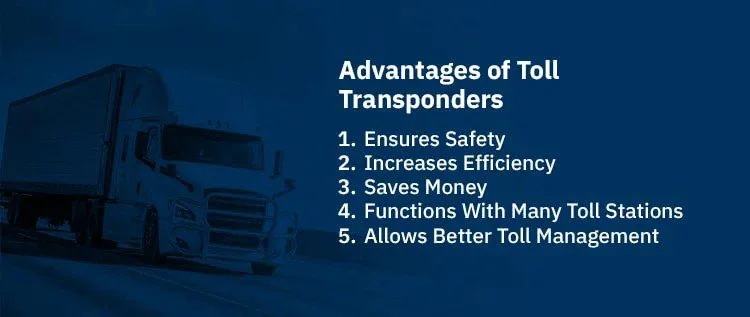
While companies can use multiple methods to pay tolls, transponders have many benefits. When determining the right payment option for your company, learning the benefits of toll passes can help you make an informed decision.
1. Ensures Safety – Hands-Free Toll Payment
Accidents are common around toll booths. If paying with cash, drivers might turn their attention away from the road to find or sort money. Lines can move slowly, causing drivers to switch lanes suddenly to quicken the process. Electronic tolling is fast and hands-free, allowing drivers to pass through checkpoints with more care for other motorists around them.
Safety benefits include:
- No need to take eyes off the road
- No fumbling for cash or payment methods
- Reduced lane-changing incidents
- Faster passage through toll areas
- Decreased accident risk at toll booths
2. Increases Efficiency – Faster Toll Processing
Toll transponders are great for increasing toll payment efficiency. Without the need to fumble for cash, your drivers can move quickly through checkpoints. Further, many tolls designate lanes for electronic tolling, increasing traffic flow by separating those who need to use cash.
Some tolling authorities are moving away from stopping to pay entirely. Instead, drivers will pass checkpoints at highway speeds, and toll technology will record vehicle and account information. This system can further increase driving efficiency by reducing the stops your drivers take.
Efficiency improvements include:
- Reduced toll booth wait times
- No stops required at many toll facilities
- Highway-speed toll passage at modern facilities
- Faster route completion times
- Reduced driver fatigue from toll stops
3. Saves Money – Volume Discounts and Reduced Fees
Toll rates depend on many factors, and some toll authorities include your chosen payment methods. As more authorities try to switch to electronic processes, they offer discounts and cheaper rates to entice motorists to use options like toll transponders over cash or mail options. Discounts can save up over time, helping you cut your spending. Further, you can avoid hefty processing fees that come with other choices.
Cost savings typically include:
- Electronic payment discounts (typically 5-15% savings)
- Elimination of cash handling fees
- Avoidance of mail payment processing fees
- Volume discounts for large fleets
- Reduced violation fees through proper transponder use
- Better account management reducing errors
For a fleet with 50 vehicles averaging $2,000 annually in toll costs, electronic transponder discounts can save $5,000-$15,000 per year.
4. Functions With Many Toll Stations – Multi-State Coverage
Tolling work varies by state and locality, with each area prioritizing different factors. Toll transponders are compatible with all toll types. Whether drivers have to stop at tolls or drive underneath checkpoints, your fleet can travel everywhere it needs without surprises. Transponders provide a more widespread solution than other options.
Multi-state coverage benefits:
- Works across multiple states and toll authorities
- Compatible with different toll technologies
- No need for multiple payment methods
- Simplified fleet operations across regions
- Consistent payment processing nationwide
5. Allows Better Toll Management – Enhanced Tracking and Reporting
Because payments process electronically, your accounting team can access, check and file payments. When you use cash, you have to count on your drivers to save receipts and reimburse when necessary. Paying by mail causes accounting to wait for toll authorities to process and send dues. You can more efficiently manage your account and check payments for correct charges.
Management benefits include:
- Real-time transaction visibility
- Detailed reporting by vehicle and driver
- Easy identification of billing errors
- Simplified accounting and reconciliation
- Route optimization based on toll data
- Cost allocation by department or project
Comparing Toll Payment Methods: Transponders vs. Alternatives
Understanding how toll transponders compare to other payment methods can help you make the best choice for your fleet.
| Payment Method | Speed | Cost | Convenience | Tracking |
|---|---|---|---|---|
| Toll Transponders | Fastest | Lowest (with discounts) | Excellent | Excellent |
| License Plate/Toll-by-Plate | Fast | Medium | Good | Good |
| Cash Payment | Slow | High (no discounts) | Poor | Poor |
| Mail Payment | Very Slow | High (processing fees) | Very Poor | Poor |
What Is a Tolling Violation and How to Prevent Them
Tolling violations occur when someone goes through a toll station without fully paying. Violations can include underpaying or passing without paying. Tolling violations are often caused by transponder problems, like having an expired, invalid or broken one. Another example of tolling violations include not having enough cash when reaching the terminal.
Common Causes of Toll Violations
- Expired or inactive transponder
- Malfunctioning transponder
- Improperly mounted transponder
- Insufficient account balance
- Using transponder on wrong vehicle
- Transponder not registered with toll authority
- License plate misread by toll cameras
- Vehicle classification errors
Preventing Toll Violations
You can avoid most tolling violations by linking your license plate to a prepaid account. Because most tolling checkpoints document your transponder information and license plate, your license plate account can act as a backup plan. You can bypass a tolling violation if you have money in this account.
Prevention strategies:
- Maintain adequate account balances
- Regularly inspect transponders for damage
- Keep transponder mounting clean and secure
- Update transponder registrations annually
- Link license plate to prepaid account as backup
- Train drivers on proper transponder use
- Monitor account activity regularly
- Use professional toll management systems for automated monitoring
What to Do If You Receive a Toll Violation
If you don’t have your trucks linked to a prepaid license plate account, the tolling authorities will send a payment request to the address registered with that plate. Because they had to search the plate and send you the invoice, the cost will likely include a processing fee. You might also have a time limit to submit the payment without further penalties.
For detailed guidance on handling violations, see our comprehensive guide on how to dispute toll violations.
Transponder Maintenance and Best Practices
Proper transponder maintenance is essential for reliable toll payment and violation prevention.
Regular Maintenance Tasks
- Monthly: Visually inspect transponder for damage or dirt
- Quarterly: Clean transponder lens and mounting area
- Annually: Verify transponder registration and account status
- As needed: Replace damaged or malfunctioning transponders
Transponder Mounting Best Practices
- Mount transponder on clean, dry windshield
- Position in center-top area of windshield for optimal reading
- Ensure transponder is visible to toll readers
- Avoid mounting behind tinted film or reflective materials
- Keep mounting area free from dirt and debris
- Use manufacturer-approved mounting hardware
Integrating Toll Transponders Into Your Fleet Management Strategy
For optimal results, integrate toll transponders into a comprehensive fleet management strategy.
A comprehensive toll management solution can help you:
- Manage multiple transponders across your fleet
- Monitor account balances and spending
- Identify and resolve violations quickly
- Optimize routes based on toll costs
- Generate detailed reporting and analytics
- Negotiate volume discounts with toll authorities
- Ensure compliance across all vehicles
Manage Your Electronic Toll Payments With Professional Solutions
When you want a safe and easy payment method for your drivers, electronic tolling is an excellent choice. Your drivers can pass efficiently through tolling points, and your accounting teams can access the transaction information as tolling authorities submit them.
Professional toll management providers can help you:
- Select the right transponders for your fleet
- Ensure coverage at every toll facility
- Maximize electronic payment discounts
- Streamline account management
- Handle violations and disputes
- Provide comprehensive reporting
Professional providers work with tolling authorities to find discounts and make electronic payments accessible. They can help you pair your fleet with the right transponders from major providers, ensuring your drivers will have coverage at every toll. Their systems make payment history more visible to accounting teams, helping them better understand toll patterns and quickly identify mistakes.
Request a Demo of Professional Toll Management Solutions Today
Not sure which toll management approach is right for you? Professional tolling specialists are here to help. They can identify the right transponder strategy to save you the most money and time.
To learn more about optimizing your fleet’s toll payment strategy with professional transponder management and comprehensive toll solutions, contact us today or request a demo. Our team can help you select the right transponders, maximize your savings, and streamline your entire toll management process.