
Toll Violations Explained: How Fleets Can Avoid Them and Dispute Charges
As a fleet manager or owner-operator, various duties take up your time as you try to manage your fleet vehicles efficiently, drivers and customer service. While your business and fleet grow, you may notice that managing tolls and violations will become challenging. The more vehicles you have on the road, the more likely you’ll miss a toll fee in the mail and end up with an inconvenient fine.
Eventually, you can end up spending more time handling toll disputes and paying fees than focusing on your essential business processes. Instead of dealing with these frustrations, consider how a toll management solution can help take the burden of tolls off of your shoulders and allow you to do more for your core operations.
Below, we’ll discuss some common issues with tolls and how you can dispute and avoid violations. Understanding toll violations is critical for fleet managers who want to reduce costs and maintain compliance across their operations.
What Is a Toll Violation? Understanding the Basics
A toll violation is a notice given to drivers who use the wrong toll lanes or don’t comply with the rules governing the use of toll facilities. Drivers or fleet owners who don’t pay the proper toll fee on time or at all will receive a violation notice for failing to pay the fees.
Many drivers and fleet managers unexpectedly receive toll violations through the mail because they don’t realize they passed through a toll incorrectly or there was an issue with their transponder. Additionally, toll violations can get lost in the mail or be put aside where they go unnoticed, leading to costly consequences.
The vehicle owner and operator of the vehicle are jointly responsible for the toll violation if it’s not paid. As a fleet manager, the violation notice will likely be sent to you if your name is on the vehicle registration. This notice will require payment for the toll due and an administrative fee. It’ll also note the period of time in which you can submit or dispute the violation.
If you fail to pay or respond to the instructions on the violation notice, you may incur additional fees or a suspended vehicle registration. If the violation continues to go unanswered, it can have severe consequences on your fleet’s car insurance and even lead to the suspension of your or your operator’s driver’s license.
What Causes Toll Violations? Common Reasons Fleet Drivers Get Citations
Though you may receive a violation notice for simply forgetting to pay your tolls or going through the wrong lanes, there are other causes of toll violations. Depending on how many fleet vehicles you own or how far your business delivers goods, your drivers may run into plenty of chances to incur toll violations, sometimes without their knowledge.
Understanding the causes of toll violations is essential for implementing prevention strategies. Some common causes of toll violations include:
- Using a toll lane without a valid transponder – This is one of the most common violations. Drivers must have an active, valid transponder to use express or toll lanes.
- Using an in-state transponder for an out-of-state toll – Transponders may not be valid across state lines. Multi-state operations require proper transponder coverage.
- Entering an express or toll lane improperly – Drivers must follow proper procedures for entering toll lanes to avoid triggering violations.
- Using a toll lane with insufficient funds in your transponder account – Prepaid accounts must maintain adequate balances to cover tolls.
- Accessing a toll lane in a vehicle other than the registered fleet vehicle on the toll pass – Transponders are vehicle-specific and cannot be transferred between vehicles.
- Using a deactivated pass – Expired or deactivated transponders will trigger violations.
- Using a toll lane with an unregistered vehicle – All vehicles must be properly registered with tolling authorities.
- Using a transponder that has not been mounted properly – Improper mounting can prevent proper signal transmission and cause misreads.
While these are general guidelines your drivers shouldn’t break, every state has different toll rules. Knowing what could cause a toll violation in your state and any locations where your fleet transports goods is critical. If you have a larger fleet, it can be more difficult to stay on top of toll payments and ensure you pay violations promptly.
A professional toll management system can help track compliance and alert you to potential violations before they occur.
How Much Is a Toll Road Violation? Breaking Down the Costs
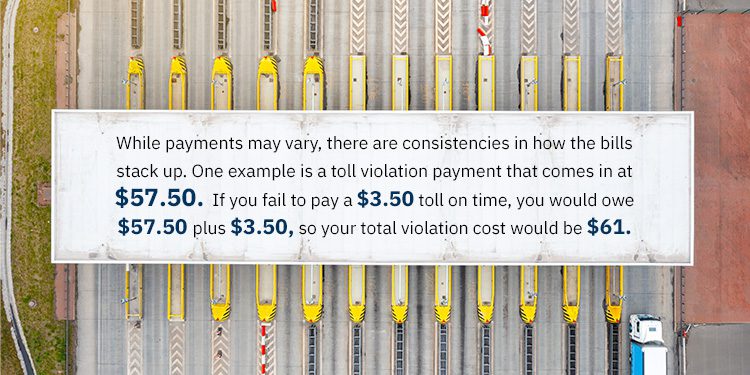
Understanding toll violation costs is crucial for budgeting and understanding the financial impact of non-compliance. While payments may vary, there are consistencies in how the bills stack up.
One example is a toll violation payment that comes in at $57.50. This does not include the initial toll amount due. If you fail to pay a $3.50 toll on time, you would owe $57.50 plus $3.50, so your total violation cost would be $61. Weekend toll rates will apply if necessary.
The cost of a toll violation increases if you miss your first violation notice. A second violation notice will be mailed to you if you do not respond to the first. This second notice will cost an additional $42.50. If you miss this one as well, the DMV might put a hold on your vehicle’s registration.
A violation will be issued if your toll violation has not been paid within five days after it was issued. A separate violation will apply for each unpaid notice.
Understanding Your Toll Violation Bill: Detailed Breakdown
This breakdown of a balance will help you understand what you are paying and how violations accumulate:
- Amount due: This is the total amount of money owed to pay for the violation.
- Previous balance: This is the previous balance reflected on your last bill. A negative number reflects any unpaid tolls that are carried over from your previous bill. A positive number means you have money in your account and nothing is due from your last bill.
- Payments: This value reflects any payments, reversals, refunds or credit available since your last payment.
- Tolls: Here, you see the total amount owed solely in tolls since your last payment.
- Other charges: This is where miscellaneous charges are listed, like pass purchases.
- Fees and civil penalties: There is a late fee that must be paid should you not address your violation promptly. Your bill will include the late fee and another list of civil penalty charges levied since your previous bill. The fees and rates charged for violations and civil penalties vary depending on the state in which the violation took place.
- Ending balance: This number is usually the same as the amount due, as it reflects all the previously listed payments. If it is listed as a negative number, it means nothing is owed.
The “New Activity” section of your bill includes a detailed breakdown of all new payments made or due since your last bill. The activity listed includes toll payments, toll charges, fees, penalties, pass purchases and other related information. The listed activities are sorted by date, with the newest additions at the top and the oldest relevant activity at the bottom.
The Financial Impact of Toll Violations on Fleet Operations
For fleet managers, understanding the cumulative financial impact of toll violations is critical. A single violation might seem manageable, but violations across a large fleet can quickly add up to thousands of dollars in unnecessary expenses.
Consider a fleet with 50 vehicles. If just 10% of those vehicles incur one violation per month, that’s 5 violations × $61 per violation = $305 per month, or $3,660 per year. For larger fleets, this number can easily exceed $10,000 or more annually.
Beyond the direct costs, violations can impact:
- Insurance premiums – Multiple violations can increase fleet insurance costs
- Driver safety ratings – Violations affect driver compliance records
- Administrative overhead – Time spent disputing and managing violations
- Vehicle registration holds – Unpaid violations can result in registration suspension
- Operational disruptions – Vehicles with registration holds cannot legally operate
This is why toll violation prevention should be a priority for any fleet manager.
How to Handle Toll Violations: Step-by-Step Guide
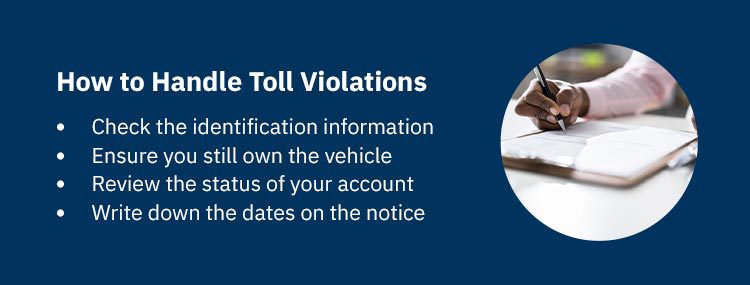
If you receive a toll violation addressed to you or one of your drivers, here are some steps you can take to manage the violation and ensure it’s been rightfully issued to you:
Step 1: Check the Identification Information
Ensure the correct name and license tag number. Check the license tag image to see if it’s blurry, this can lead to clerical errors and cause a state’s Department of Motor Vehicles to send a toll violation notice to the wrong address. Misidentification is a common reason for incorrect violations.
Step 2: Ensure You Still Own the Vehicle
If you’ve recently sold one of your fleet vehicles to replace it or if it’s been stolen, you likely won’t be liable for the toll charges. Verify that the vehicle in question is still part of your active fleet.
Step 3: Review Your Account Status
Check your accounts with the tolling authorities to ensure your transponder or pass is active and current. If you have a prepaid toll account, check if there’s enough money in the account to cover your driver’s tolls. Account status issues are a frequent cause of violations.
Step 4: Write Down the Dates on the Notice
Some toll violation notices give you as little as two weeks to pay or dispute the charges. These deadlines differ in every state, so it’s critical to read the notice carefully and mark your calendar to ensure you take action well before the deadline.
How to Dispute a Toll Violation: The Complete Process
If you’ve followed the steps above and determined your toll violation is incorrect or addressed to the wrong person, follow these steps to submit a toll violation dispute:
Step 1: Call the Customer Service Number
The toll authority that sent you the notice should have a website or toll-free number to call and register a dispute. Be sure to call or go online promptly after receiving the notice so you can rectify the issue as soon as possible. Quick action can prevent additional fees and penalties.
Step 2: Download and Fill Out the Appropriate Form
If you need to submit a dispute online, download the correct form and fill it out. Some forms may have a list of reasons you can choose to explain why you’re disputing the violation. Others ask for a written explanation. Be sure to include any evidence that will help your dispute go through.
Step 3: Submit Your Dispute Form
You may be able to submit your dispute by mail, fax, email or over the phone. Check with the toll authority and ensure you choose the correct contact method. Keep copies of all correspondence for your records.
For more detailed guidance on this process, learn more on disputing toll violations here.
How to Avoid Toll Violations: Prevention Strategies for Fleet Managers
The best approach to toll violations is prevention. Here are some proven ways your fleet drivers can avoid toll violations:
Know the Route
Your drivers should be aware if there’s a toll on the way to their destinations and know the benefits of their toll pass, such as the amount in their pre-paid account. Route planning should include toll information and cost estimates.
Be Prepared for a Change of Plans
If your drivers need to change their intended routes or destinations due to traffic or an accident that creates a detour, they must be prepared to pass new tolls and use them correctly. Drivers should understand how to navigate unfamiliar toll roads.
Pay Attention to Toll Signs
Talk with the operators of your fleet vehicles and ensure they know how tolls work. Make sure they use the correct lanes by reading the signs at the toll plaza to avoid violations. Driver training is essential for violation prevention.
Maintain Proper Transponder Management
Ensure all transponders are:
- Properly mounted in vehicles
- Active and current
- Registered for the correct vehicle
- Funded with adequate balances
- Updated for multi-state operations
Use a Professional Toll Management Solution
One of the best ways to avoid toll violations is to use a toll management solution that manages toll violations and gives you one bill and one point of contact with tolling authorities to make it easier to catch inconsistencies or issues with tolling.
A comprehensive toll management platform provides:
- Real-time violation alerts
- Automated compliance monitoring
- Centralized account management
- Dispute assistance
- Detailed reporting and analytics
Understanding Different State Toll Violation Rules
Toll violation rules vary significantly by state. For example:
- Pennsylvania – Violations on the Pennsylvania Turnpike have specific procedures and fees
- New York – E-ZPass violations have different rules than non-E-ZPass violations
- Florida – Toll violations on Florida’s toll roads have unique fee structures
- Ohio – Ohio Turnpike violations follow specific state guidelines
If your fleet operates across multiple states, understanding these regional differences is critical. A multi-state toll management solution can help navigate these complexities.
The Role of Technology in Preventing Toll Violations
Modern toll transponder technology has improved significantly, but violations still occur. Advanced toll management systems now include:
- Automated account monitoring – Real-time alerts for low balances
- GPS integration – Route optimization to avoid unnecessary tolls
- Violation prediction – Alerts for potential compliance issues
- Multi-state coverage – Unified management across jurisdictions
- Automated dispute processing – Streamlined violation resolution
Understanding electronic tolling vs. traditional tolling can help you make informed decisions about your toll strategy.
Manage Your Toll Payments and Violations With Professional Solutions
Simplify your truck fleet’s toll payments and violation management with professional toll management solutions. Our sophisticated tools enable you to track payments by truck plate number and much more. With our highly trained customer service team and commercial toll experts, we’re here to answer your questions whenever you need us.
We also provide you with a powerful web portal that provides advanced analytics tools, business intelligence and other tools to help you proactively manage your toll payments and gain insights into the data collected on your fleet.
Our toll management platform helps you:
- Reduce violation occurrences
- Streamline dispute resolution
- Consolidate billing from multiple authorities
- Gain real-time visibility into toll expenses
- Improve compliance across your fleet
To find out more about the many solutions, products and services we can offer you, contact our team today. You can also call us at 888-410-9696 for prompt service and answers on how we can support you in toll violation disputes and prevention.