The trucking industry has never been more demanding. Regulatory pressure is accelerating. Costs are harder to control. And most fleets are running on platforms built in silos — multiple logins, multiple reports, no unified picture of what’s actually happening across their operation.
Fleet readiness is the answer to that fragmentation. Not a metric. Not a dashboard. An operational state.
Either your fleet has it or it doesn’t.
75%
of top North American fleets trust Fleetworthy
925+
weigh station bypass sites across U.S. & Canada
2M+
vehicles and drivers supported
40+
years of combined industry experience
The Definition
Fleet Readiness, Defined
Fleet readiness is the operational state in which a commercial fleet can put any truck on any route on any given day without exposure to compliance violations, unexpected costs, or avoidable delays.
This definition has three components because each represents a distinct category of operational risk. Addressing two out of three does not make a fleet ready. It shifts exposure elsewhere.
A fleet with strong compliance but unmanaged tolls still loses 1–3% of its operating budget to violations and administrative waste. A fleet with compliance and toll management but no weigh station bypass still costs a compliant driver 30–45 minutes every time they pull off the highway unnecessarily and risks losing that driver entirely.
Fleet readiness is a new operational standard. Most fleets have not yet reached it.
The reason most fleets fall short is not a lack of effort. It is a structural problem: the technology required to manage safety and compliance, toll costs, and weigh station bypass has historically come from three separate vendors with three separate platforms, three separate contracts, and zero shared visibility. That fragmentation is the problem fleet readiness solves.
The Industry Context
Why This Matters Now
Regulatory pressure is accelerating.
FMCSA enforcement is stricter. The compliance burden is not going away — it’s growing. Fleets that treat compliance as a checkbox function are accumulating risk they can’t see until it surfaces in an audit or an incident.
Costs are harder to control.
Toll spend is opaque. Violations are preventable but frequent. Unnecessary weigh station stops frustrate drivers and cost real money across thousands of routes. Every dollar of avoidable cost is a margin problem.
Data is fragmented.
Most fleets run multiple vendor platforms, each with its own login, its own report, and its own support line. No one sees the full picture. Decisions get made with incomplete information, and gaps persist.
The Framework
The Three Pillars of Fleet Readiness
Fleet readiness is built on three pillars. Each addresses a distinct category of operational risk: compliance risk, financial risk, and operational inefficiency.
A fleet is not fully ready unless all three are addressed. Each requires dedicated technology and consistent execution. Together, they define what it means to operate with confidence.
01 ·· Safety and Compliance
Every driver qualified. Every asset legal. Every audit survived.
Compliance is the foundation. Driver qualification files, HOS and ELD oversight, DOT drug and alcohol programs, FMCSA Clearinghouse management, asset permitting, and DVIR records are not administrative tasks. They are the basis of legal operation and the difference between surviving an audit and losing operating authority.
- Driver Qualification File Management
- FMCSA Clearinghouse and drug and alcohol programs
- HOS and ELD compliance oversight
- Licensing, permitting, IRP and IFTA management
- Proactive in-cab safety alerts
- Roadside inspection tracking and CSA management
$20K+
per FMCSA violation in high-risk categories is the cost of gaps in this pillar
02 ·· Toll Management
Every toll accounted for. Every error caught. Every dollar recovered.
Toll management is one of the most overlooked cost centers in fleet operations and one of the most measurable. Unmanaged toll spend runs 20–30% above where it should be.
There are more than 60 tolling authorities across North America, each with its own billing system, transponder requirements, and reporting format. Managing them manually costs fleets 1–3% of operating budget in violations, errors, and administrative time.
The benchmark is simple: one device, one account, one invoice. Any deviation introduces complexity, error risk, and overhead.
- Nationwide coverage under one device, one account, one invoice
- Automated misread identification
- GPS-matched transaction validation
- Predictive cost forecasting
- Automated reconciliation
- Volume discounts and negotiated rates
80%
fewer toll violations for fleets using Fleetworthy Toll Management
03 ·· Weigh Station Bypass
Every compliant truck keeps moving. Every delay is avoidable.
Weigh station bypass is often treated as a driver convenience. Fleets should see it as an efficiency and cost lever.
A weigh station stop that could have been bypassed costs a driver 30–45 minutes. Multiply that across hundreds of drivers and thousands of routes. Then add the retention impact: drivers are three times more likely to stay with fleets that offer bypass. At a turnover cost of $5,000–$12,000 per driver, retention alone justifies the investment.
For a compliant truck, the stop is avoidable. And the avoidance compounds.
- 925+ bypass sites across U.S. and Canada
- Transponder-free, works on existing ELD or telematics devices
- Real-time bypass decisions based on current safety scores
- Integrated with 40+ leading ELD and telematics providers
- Expedited inspection capabilities
- Proactive in-cab safety alerts included
$11.95
saved per bypass equals $11K+ annually for a typical 50-truck fleet
The Cost of Incomplete Readiness
Fleet Readiness is an Operational State. You Either Have It or You Don’t.
Fleet operations are not a collection of independent problems. They are a system of interdependent risks and outcomes.
Gaps in any pillar carry ongoing financial consequences that compound over time. Fleet leaders who treat readiness as a compliance exercise — something to address before an audit or after an incident — pay for that framing in ways that don’t show up on a single line item.
60-70%
reduction in administrative time reported by Boyle Transportation after deploying Fleetworthy’s complete technology suite — while achieving zero preventable accidents since 2019.
The compounding effect matters. Increased costs reduce margins. Reduced margins limit investment in better systems. Gaps persist.
Fleet readiness breaks that cycle by addressing root causes, not symptoms.
Fragmented systems also create blind spots. Safety performance impacts insurance costs. Compliance eligibility impacts bypass decisions. Operational efficiency impacts profitability. When these aren’t connected, decisions get made without full visibility.
Pillar One
Safety and compliance: the foundation that everything else depends on
Safety and compliance is the most complex of the three pillars — and the one with the most direct legal exposure. FMCSA regulations touch every aspect of fleet operations: how drivers are hired, how their hours are tracked, how vehicles are maintained, how drug and alcohol testing is administered, and how all of it is documented for the moment a DOT auditor arrives.
The challenge is not that fleets don’t understand these requirements. Most do. The challenge is the operational weight of managing them continuously — across hundreds of drivers, dozens of vehicles, multiple terminals, and an evolving regulatory environment — without a dedicated compliance infrastructure.
Driver qualification: the highest-risk compliance gap
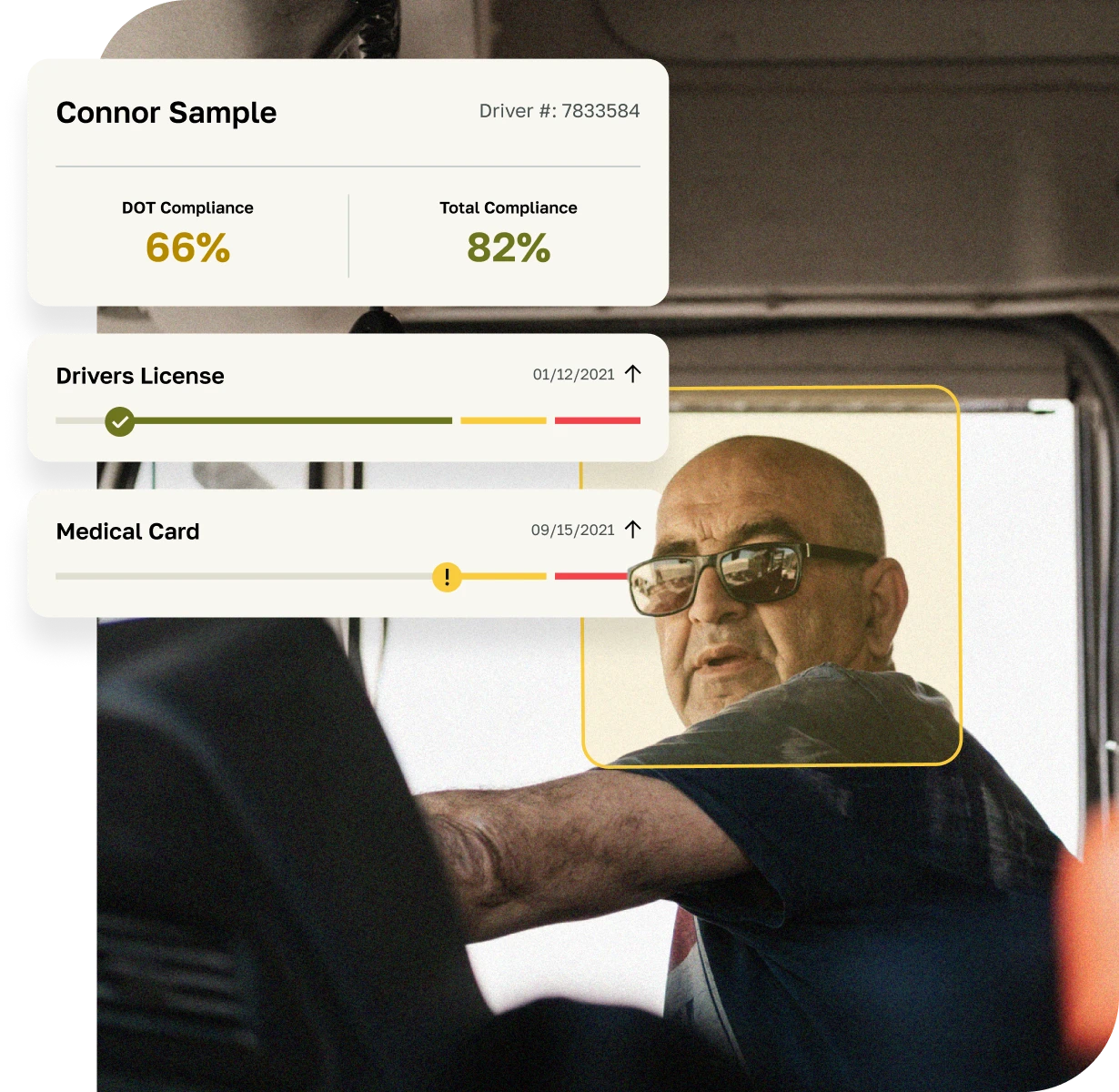
Driver Qualification file management is where most compliance failures begin. A DQ file is the documented record of a driver’s eligibility to operate a commercial vehicle — medical certification, license status, employment history, drug and alcohol testing records, and FMCSA Clearinghouse queries. Every file must be complete. Every document must be current. And every expiration must be caught before it becomes a violation.
In a 200-truck fleet, that is 200 active files, each with multiple documents on different renewal cycles. Managing them manually — or in spreadsheets — is not a compliance program. It is a liability waiting to be documented.
Fleetworthy’s safety and compliance solution, delivered through CPSuite for mid-to-large fleets and HAUL by Fleetworthy for self-service operations, provides dedicated compliance specialists and AI-powered document management to handle DQ file oversight on behalf of the fleet. Fleets see a 25 percent improvement in CSA BASIC scores in the Driver Fitness category and recover 1 to 2 FTE annually in compliance labor.
Proactive safety: preventing violations before they happen
Compliance audit-readiness is the defensive posture. Proactive safety is the offensive one. In-cab safety alerts — delivered through Fleetworthy Safety+ — warn drivers of approaching hazards, speed violation zones, severe weather conditions, and high-risk road segments before they reach them. This is not driver monitoring. It is driver support.
The impact is measurable. Fleets using Safety+ see 30 to 50 percent fewer critical safety events. C.R. England reduced accidents by 50 percent per mile after deploying the system. Drivers who receive these alerts are twice as likely to slow down when approaching a hazard zone.
Safety events that don’t happen don’t affect CSA scores. CSA scores that improve reduce insurance premiums by $1,000 to $3,000 per truck annually. The financial case for proactive safety compounds over time in a way that reactive compliance management cannot replicate.
Pillar Two
Toll management: the cost center most fleets underestimate
Toll management sits in a category of operational costs that fleet leaders know are real but rarely quantify with precision. There are more than 60 tolling authorities across North America. Each one has a different billing system. Different transponder requirements. Different violation processes. Different reporting formats. Managing them is not a task — it is a specialty.
Fleets that manage tolls manually — or with a patchwork of regional transponder programs — pay for that complexity in three ways: direct violations, administrative time, and missed discounts. On average, that adds up to 1 to 3 percent of operating budget. For a fleet running $50 million in annual revenue, that is $500,000 to $1.5 million per year absorbed by an avoidable problem.
The one-device, one-account, one-invoice standard
The benchmark for toll management efficiency is simple: one device in the truck, one account per fleet, one consolidated invoice at the end of the month. Every deviation from that standard — a regional pass here, a separate E-ZPass account there — creates reconciliation overhead, introduces error risk, and adds administrative burden that compounds with fleet size.
Fleetworthy Toll Management (formerly Bestpass) sets this standard and enforces it at scale. Fleets consolidate all tolling under Complete Pass+ for nationwide coverage, Horizon Pass for regional operations, or E-ZPass for the eastern corridor — all managed from a single platform with centralized billing, automated reconciliation, and real-time visibility into toll spend.
The results are not incremental. Fleets using Fleetworthy Toll Management see 80 percent fewer toll violations, 95 percent fewer payment errors, and a 30 percent reduction in time spent managing multiple tolling authorities. Faith Technologies eliminated nearly all of its 20 weekly violations and reclaimed more than four hours per week in billing and reconciliation time — while managing 500-plus vehicles with just three staff members.
From reactive billing to proactive financial control
Traditional toll management is reactive: bills arrive weeks after travel, violations surface after they escalate, and reconciliation happens long after route decisions are made. Fleetworthy reverses that sequence.
TollGenius integrates GPS and ELD data with toll transaction records to validate every charge in near real time — flagging misassignments, catching misreads, and surfacing anomalies before they become invoiced errors. TollPredict forecasts toll costs by route before trucks depart, giving fleet managers and finance teams visibility into expected costs rather than billing surprises. TollReconcile closes the loop automatically, comparing predicted charges to posted bills and initiating dispute resolution when discrepancies are found.
97%
reduction in toll violations at Faith Technologies — from 20 per week to 2–3 per month — after consolidating nationwide toll coverage under Fleetworthy.
Pillar Three
Weigh station bypass: the pillar that pays for itself on the first route
Weigh station bypass is often treated as a driver benefit — a nice-to-have that improves the cab experience and reduces frustration. That framing undervalues it significantly. Bypass is a financial instrument, an efficiency tool, and a driver retention strategy. For fleets that run high-mileage routes through inspection-dense corridors, it is also one of the fastest-returning technology investments available.
Every weigh station pull-in for a compliant truck costs $11.95 in fuel, driver time, and operating expenses. A 50-truck fleet avoiding 940 unnecessary pull-ins annually saves more than $11,000 in direct costs — before accounting for the fuel efficiency gains, the idle time reduction, the CSA exposure avoided at the inspection site, and the driver satisfaction impact.
The largest bypass network in North America
Fleetworthy Weigh Station Bypass (formerly Drivewyze PreClear) operates the largest bypass network in North America, covering more than 925 weigh station and inspection sites across the United States and Canada. That network is 70 percent larger than the next-largest provider. In practical terms, that difference means more bypass opportunities on more routes — and bypass savings that compound every time a driver passes a covered site.
The system requires no transponder. It runs on the existing ELD or telematics device already in the cab, integrating with 40-plus leading providers including Samsara, Geotab, Motive, Platform Science, and Trimble. Deployment does not require hardware procurement, installation scheduling, or driver retraining. It requires an activation.
Driver retention: the ROI that does not show up in bypass math
Drivers are three times more likely to stay with a fleet that offers weigh station bypass technology than with one that does not. At an average turnover cost of $5,000 to $12,000 per driver retained, the math on bypass extends well beyond the per-stop savings.
Brenny Transportation switched from a competitor with limited coverage — particularly in Wisconsin — to Fleetworthy and recovered 120 hours of productive fleet time per week. Their driver retention rate reached 85 percent, significantly above the industry average. The safety program, supported by Safety+ in-cab alerts bundled with bypass, allowed the company to build a proactive coaching culture instead of reacting to incidents after the fact.
Expedited Inspection: when bypass is not possible
Not every truck earns a bypass every time. When a pull-in is required, Expedited Inspection reduces the friction of that interaction. Fleetworthy is the first and only bypass company to offer automated electronic Record of Duty Status transfer to enforcement officers at participating sites — pre-filling inspection data, reducing manual entry, and shortening the average inspection time. Fewer minutes in the inspection lane means faster return to the mainline, fewer hours-of-service impacts, and less disruption to delivery schedules.
Why Completeness Matters
Why two out of three is not fleet readiness
The case for each pillar is clear on its own. The case for all three together is different — and more important.
Fleet operations are not a collection of independent problems. A driver who receives an in-cab alert about an upcoming weigh station is also a driver whose DQ file is managed, whose HOS is monitored, and whose truck carries a transponder that eliminates the billing friction after the route. Those systems do not just coexist — they reinforce each other. Safety outcomes improve when compliance is current. Compliance costs drop when safety scores improve. Bypass ROI increases when the fleet is operating at full efficiency. These are connected outcomes, not parallel ones.
The fragmented alternative — three vendors, three platforms, three support relationships — produces the opposite effect. Data does not move between systems. Compliance teams do not see toll patterns. Operations managers cannot see safety event clusters by route. Every decision gets made with incomplete information, and the gaps between systems become the gaps in fleet performance.
Fleetworthy is the only provider that delivers all three
There are vendors who do compliance well. There are vendors who do toll management well. There are vendors who do bypass well. There is one technology provider that brings best-in-class solutions across all three pillars into a single platform, a single support relationship, and a single view of fleet readiness: Fleetworthy.
This is not a claim about feature parity. It is a structural fact. Fleetworthy was built through the combination of the most trusted names in each category — Bestpass in toll management, Drivewyze in weigh station bypass, and CPSuite in compliance management — and unified them under one technology suite with purpose-built integrations across all three. No other technology provider offers this combination. Certainly not at the scale of 75 percent of North America’s top fleets, 925-plus bypass sites, and 2 million-plus vehicles and drivers supported.
For a fleet evaluating its readiness gaps, the question is not which pillar to prioritize. It is which gaps to close first — and which provider can close all of them without introducing the fragmentation that created the problem in the first place.
40%
faster vehicle licensing turnaround and 15%+ cost reduction in compliance — RWE Clean Energy, using Fleetworthy across Safety and Compliance, Toll Management, and Weigh Station Bypass.
Fleetworthy’s Role
The Only Complete Suite for Fleet Readiness
The Only Complete Suite for Fleet Readiness
Until now, no single technology provider has built safety and compliance, toll management, and weigh station bypass as one.
Fleetworthy does.
When these solutions are connected, vehicle, driver, toll, and compliance data are no longer trapped in separate systems. You get a complete, real-time picture of your fleet’s readiness, not something stitched together from exports or assembled in a spreadsheet.
For fleets, this means:
- Reduced risk and proactive audit readiness
- Lower operating costs and eliminated inefficiencies
- Drivers moving safely and efficiently
- One account, one support relationship, one unified experience
75%
of the top fleets in North America trust Fleetworthy to support millions of vehicles and drivers. The technology you may have relied on as CPSuite, Bestpass, or Drivewyze now lives inside a single, connected platform built for complete fleet readiness.
Frequently Asked Questions
Fleet Readiness: Common Questions
What is fleet readiness?
Fleet readiness is the operational state where a fleet can put any truck on any route on any given day without exposure to compliance violations, unexpected costs, or avoidable delays.
What are the three pillars of fleet readiness?
Safety and compliance, toll management, and weigh station bypass. Each addresses a distinct category of operational risk. Addressing two out of three is not fleet readiness.
Why do fleets need all three?
Each gap carries independent costs that compound across operations. Safety performance affects insurance. Compliance affects bypass eligibility. Operational efficiency affects profitability. These are connected — not separate problems.
What does fleet readiness technology cost?
Fleet readiness technology costs vary based on fleet size, solution selection, and service model. Fleetworthy offers managed compliance services through CPSuite for mid-to-large fleets and a self-service platform through HAUL by Fleetworthy for growing operations. Toll management is structured around fleet size with volume discounts. Weigh station bypass is a per-truck subscription with no hardware cost. Across all three, fleets consistently report that the technology pays for itself through violations avoided, administrative time saved, and operational efficiency gained. Contact Fleetworthy for a fleet-specific assessment.
How is fleet readiness different from fleet management?
Fleet management focuses on logistics. Fleet readiness focuses on risk, compliance, cost control, and operational efficiency. It’s a higher standard — and a more complete one.
How do you measure fleet readiness?
By evaluating performance across compliance, cost control, and operational efficiency metrics. Most fleets discover at least one significant readiness gap during their first assessment.
What are the biggest risks to fleet readiness?
Compliance violations, unmanaged toll spend, and unnecessary operational delays. All three are preventable. All three are measurable.
What technology supports fleet readiness?
Solutions that proactively manage compliance, provide toll visibility and control, and enable weigh station bypass and safety capabilities — connected as one platform.