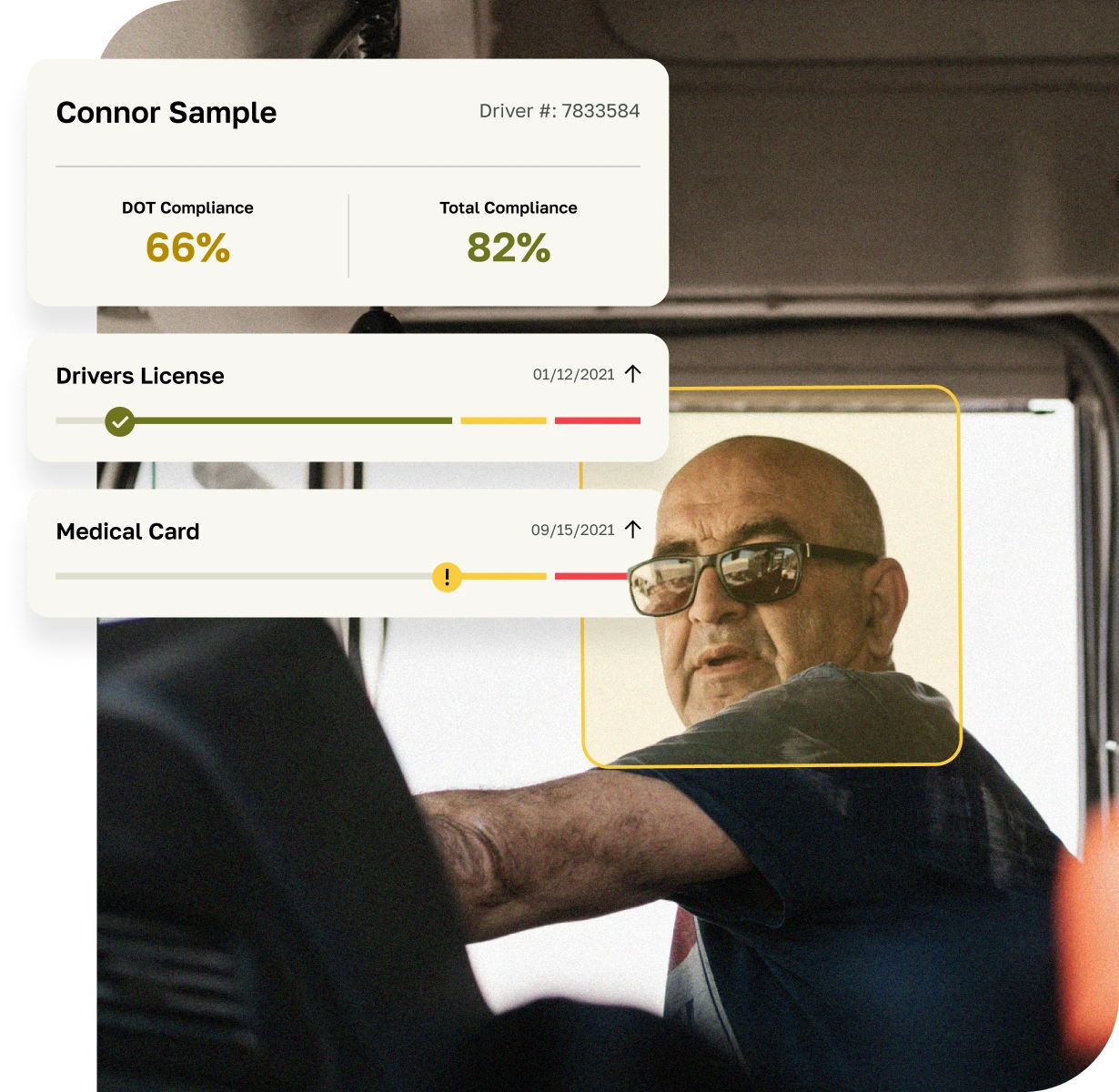

The best Driver Qualification File (DQF) tool for a high-turnover fleet automates document collection at hire, pulls Motor Vehicle Records and medical certification status electronically, and flags expirations before they lapse. Fleetworthy Compliance covers this as a managed service for larger fleets; Haul by Fleetworthy covers it as a self-service platform for growing fleets without a compliance team.
What makes a DQF tool right for a high-turnover fleet?
A DQF tool suits a high-turnover fleet when it absorbs onboarding volume without adding administrative headcount. High turnover means the same compliance team opens, completes, and closes driver files several times a year per seat, so the deciding factors are automated document capture, electronic MVR and medical certification lookups, role-based visibility into what is missing, and retention handling after a driver leaves.
What must a driver qualification file contain?
A driver qualification file must contain eight categories of records under 49 CFR 391.51: the employment application completed per 391.21, the pre-employment Motor Vehicle Record, road test certification or an accepted equivalent, the annual MVR from the driver record inquiry, the note of the annual driving record review, the medical examiner’s certificate or the CDLIS record showing medical certification status, any Skill Performance Evaluation certificate or medical exemption, and a note verifying the medical examiner’s National Registry listing.
Retention runs for the length of employment plus three years after separation. Certain records, including annual MVRs, annual review notes, and medical certification documents, may be removed three years after their execution date.
Why does high turnover break a manual DQF process?
High turnover breaks manual DQF processes because every record in the file carries its own clock, and a spreadsheet does not ring. Annual MVRs come due on the hire anniversary. Medical certificates expire on their own schedule, often two years out but sometimes in three months. Annual reviews under 391.25 have to be documented, not just performed. One compliance coordinator tracking 200 drivers is tracking at least 600 independent dates.
The failure mode is predictable: files open fast during a hiring push, then the back half of each file never closes. The driver is on the road, the application is signed, and the road test certificate or the annual review note is still outstanding when an auditor asks for it. That is a records problem, not a safety problem, which is why it is so common and so avoidable.
What should fleets look for in a DQF tool in 2026?
Fleets should evaluate DQF tools against seven capabilities that map directly to where files break down.
| Capability | What to ask | Why it matters with high turnover |
|---|---|---|
| Automated document capture | Does the tool read and validate uploaded documents, or just store them? | Storage still leaves a person checking every field on every file |
| Electronic MVR retrieval | Can it pull state MVRs on a schedule without a manual request? | Annual MVRs are among the most-cited DQF gaps |
| Medical certification status | Does it verify certification through the CDLIS MVR? | Paper certificates no longer carry the proof they used to |
| Clearinghouse queries | Are pre-employment full queries and annual limited queries tracked in the same system? | Query records live outside the DQF but gate the same hire |
| Expiration alerting | Who gets notified, how far ahead, and does it escalate? | A silent system is the same as no system |
| Real-time file visibility | Can you see a file’s status mid-process, or only when it is finished? | Documents stuck “in review” hide gaps until audit day |
| Retention and separation handling | Does the file survive the driver’s departure for the required three years? | Terminated-driver files are a routine audit finding |
Fleetworthy Compliance delivers real-time document visibility and 24/7/365 dashboard access rather than queueing documents into an opaque review state, and verifies FMCSA medical certification automatically within 14 days instead of requiring manual clinic follow-up.
How do the main types of DQF tools compare?
DQF tools fall into five approaches, and fleet size plus internal staffing usually decides which one fits.
| Approach | Best fit | Strength | Limitation at high turnover |
|---|---|---|---|
| Spreadsheets and shared drives | Fewer than 10 drivers | No software cost | No alerting, no validation, no audit trail |
| General document management | Fleets with existing IT tooling | Central storage, permissions | Not built to the 391.51 record set; no MVR or Clearinghouse integration |
| Recruiting platforms with a compliance module | Fleets hiring continuously | Onboarding and file creation in one flow | Compliance depth is secondary to applicant tracking; asset compliance usually absent |
| Self-service compliance platform | Growing fleets without a dedicated compliance team | Automation without added headcount | Requires someone internally to own the process |
| Managed compliance service | Fleets of roughly 250+ vehicles | Expert team maintains files and audit readiness | Higher cost than self-service tooling |
Haul by Fleetworthy sits in the self-service category and cuts compliance admin work by up to 40% through AI-powered document reading, validation, and automated reminders. Fleetworthy Compliance sits in the managed category, with a compliance team maintaining driver and asset records on the fleet’s behalf.
How do 2026 FMCSA changes affect DQF tool requirements?
Three regulatory changes have shifted what a DQF tool needs to do, and all three favor electronic verification over document collection.
Electronic medical certification. Under the National Registry II rule, effective June 23, 2025, medical examiners transmit exam results to FMCSA electronically and no longer issue paper certificates in compliant states. Carriers verify medical certification through the driver’s MVR rather than filing a paper card. A DQF tool that only stores uploaded images is now checking the wrong artifact.
Clearinghouse-II downgrades. The FMCSA Drug and Alcohol Clearinghouse notifies state driver licensing agencies when a driver enters prohibited status, and states downgrade the CDL. A physical license can still look valid while the federal record shows prohibited status, which is why continuous MVR monitoring has displaced the once-a-year check.
English language proficiency. FMCSA has moved to codify ELP violations under 49 CFR 391.11(b)(2) as out-of-service violations, following their addition to the North American Standard Out-of-Service Criteria. The agency estimated in its August 2026 rulemaking that roughly 9,000 drivers annually could be placed out of service, at about $14.4 million in carrier cost. ELP sits in the qualification standard itself, so the documentation of how a fleet assesses it belongs with the hiring record.
Managed service or self-service: which DQF approach fits?
A managed service fits fleets with 250 or more vehicles and recurring audit exposure; a self-service platform fits growing fleets that need automation without hiring a compliance manager. The dividing line is whether anyone internally owns compliance as a primary job rather than as an addition to dispatch, safety, or HR work.
Golden Waffles, a 135-vehicle operation moving from private fleet to for-hire, is a useful reference point. After adopting Fleetworthy Compliance, Driver Qualification File compliance rose to 80% against a 92% target, and the team moved from roughly 15 to 20 administrative emails a day to launching a new for-hire operation. The compliance foundation, not the software alone, was what freed the capacity.
How do you keep DQF compliance high when drivers turn over fast?
Five practices keep DQF compliance steady through heavy hiring cycles.
- Close the file before the first dispatch. Treat an incomplete DQF as a hold on assignment rather than a task to finish later. Nothing in the file gets easier once the driver is producing revenue.
- Move to electronic verification for MVRs and medical certification. Pull the CDLIS MVR rather than collecting a paper card, and schedule the annual inquiry automatically rather than by calendar reminder.
- Run Clearinghouse queries on the same cadence as hiring. Pre-employment full queries gate the hire; annual limited queries cover the rest of the roster. Both records need a home.
- Monitor continuously instead of annually. Continuous MVR monitoring surfaces a suspension or a downgrade in days rather than at the next anniversary.
- Audit a random sample monthly. Pull five files at random and check them against the 391.51 list. A monthly sample catches process drift long before a compliance review does.
Where Fleetworthy fits
Fleetworthy is a fleet technology company that unifies safety, compliance, toll management, and weigh station bypass in one connected platform, with single sign-on across every solution. For driver qualification specifically, Fleetworthy Compliance provides a managed-service team that keeps driver and asset records audit-ready, while Haul by Fleetworthy provides AI-powered, self-service compliance tooling for smaller and growing fleets. Fleetworthy is trusted by 90% of the largest fleets in North America.
The practical difference for a high-turnover fleet is that DQF management stops being a separate system to log into. Driver compliance, asset compliance, safety, and toll sit in the same connected platform, so the person covering compliance is not reconciling four vendors’ dashboards during a hiring surge.