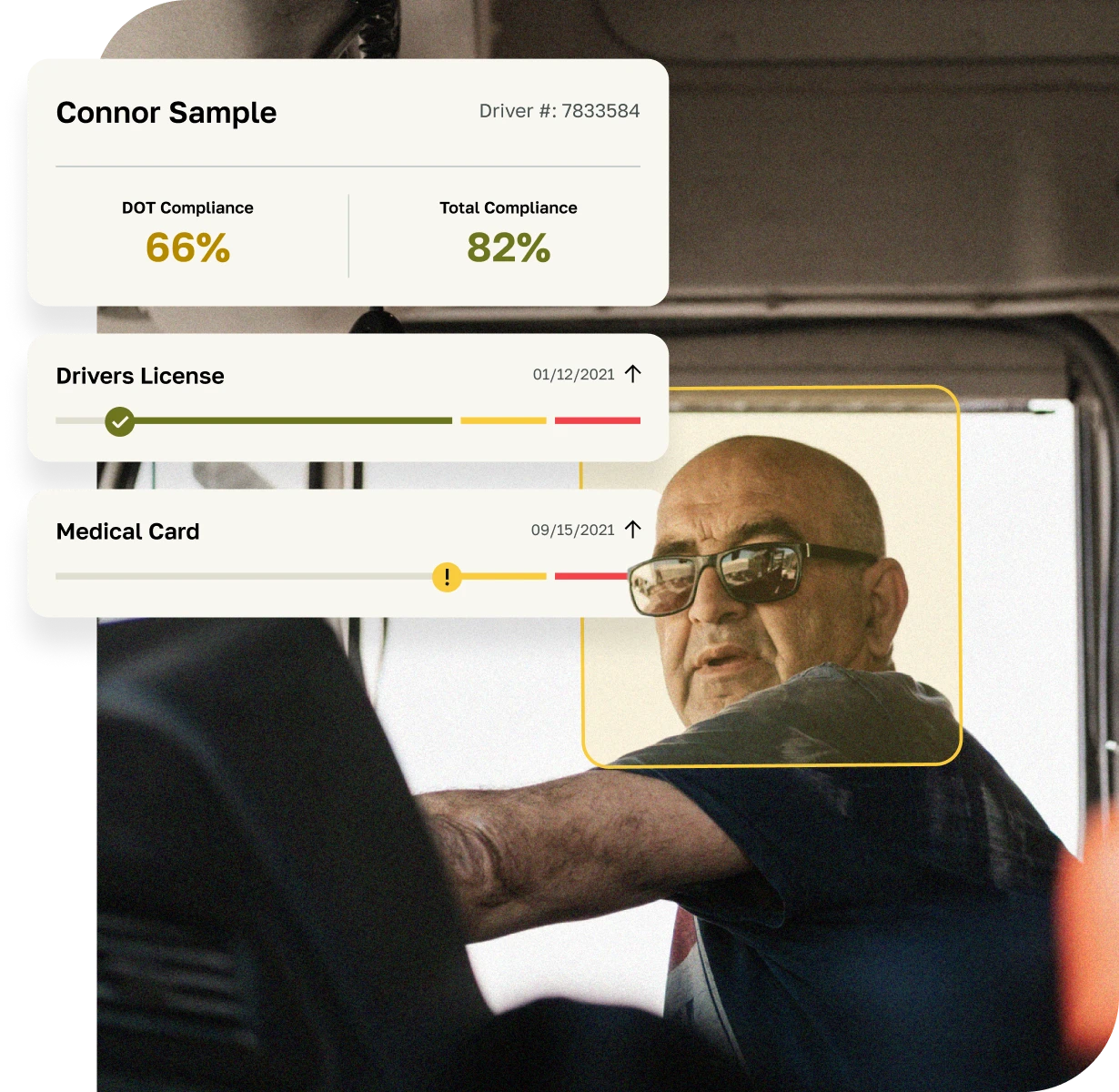

Missing records and expired documents create a familiar compliance problem. A file might be “mostly complete,” but if the annual MVR review note is missing, the medical certification evidence is outdated, or the carrier cannot show documented good-faith efforts to obtain prior-employer history, the file is not audit-ready. FMCSA guidance is direct on the point:
“All motor carriers must maintain a qualification file for each employed driver.” — FMCSA Safety Planner 3
Auditors do not only look for documents. They also look for timing, traceability, and evidence of ongoing compliance activity. A better workflow lowers risk by assigning ownership, enforcing no-dispatch gates, and leaving a timestamped trail.
Qualification File Management: What Does A Repeatable System Need To Include?
Qualification file management works best when it is treated as a controlled business process rather than a shared drive full of PDFs. In practical terms, that means one source of truth, one file index, clear naming rules, and a standard checklist tied directly to 49 CFR 391.21, 391.23, 391.25, 391.41, and 391.51 1. The goal is not only to gather records, but to prove that required records were collected, reviewed, and retained on time.
The first design decision is to define what belongs in the DQF and what should remain outside it. Under 49 CFR 391.51, the DQF must include the driver application, initial State MVRs, road test certificate or accepted equivalent, annual MVR inquiry results, annual review notes, and medical qualification evidence, along with variance documentation when applicable 2. By contrast, payroll records, benefits forms, and general performance notes belong in the broader personnel file, not mixed into the regulated DQF structure.

| DQF Item | Why It Belongs In The Regulated File | Key Rule |
|---|---|---|
| Employment application | Establishes initial qualification basis before driving | 49 CFR 391.21 1 |
| Initial State MVRs | Confirms license history in the prior 3 years | 49 CFR 391.23 1 |
| Road test or accepted equivalent | Shows the driver met operating qualification requirements | 49 CFR 391.31 / 391.33 1 |
| Annual MVR and review note | Documents recurring fitness review | 49 CFR 391.25 1 |
| Medical certification evidence | Confirms physical qualification to operate a CMV | 49 CFR 391.41 / 391.51 1 2 |
A practical next step is to audit ten to twenty percent of active files and classify each missing item by root cause. That quickly shows whether the problem is collection, indexing, or escalation.
Compliance Workflow: How Should Safety, HR, And Drivers Share The Work?
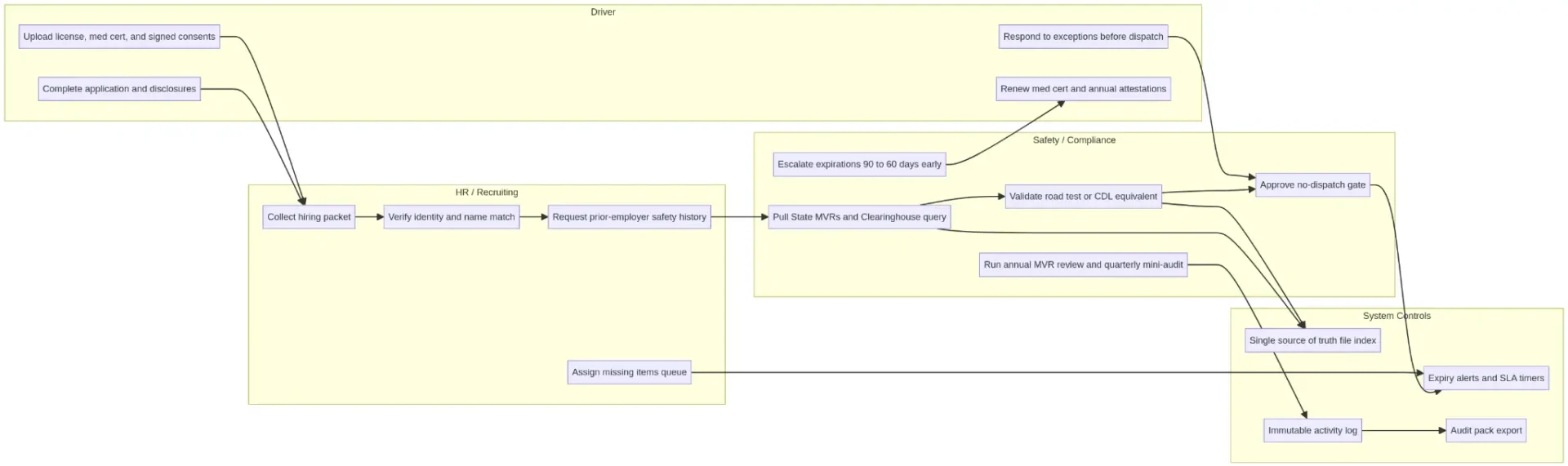
A resilient compliance workflow maps each task to an owner, a due date, and a control. HR or recruiting should own intake completeness, safety should own qualification validation and annual review requirements, and drivers should own timely document submission and renewal follow-through.
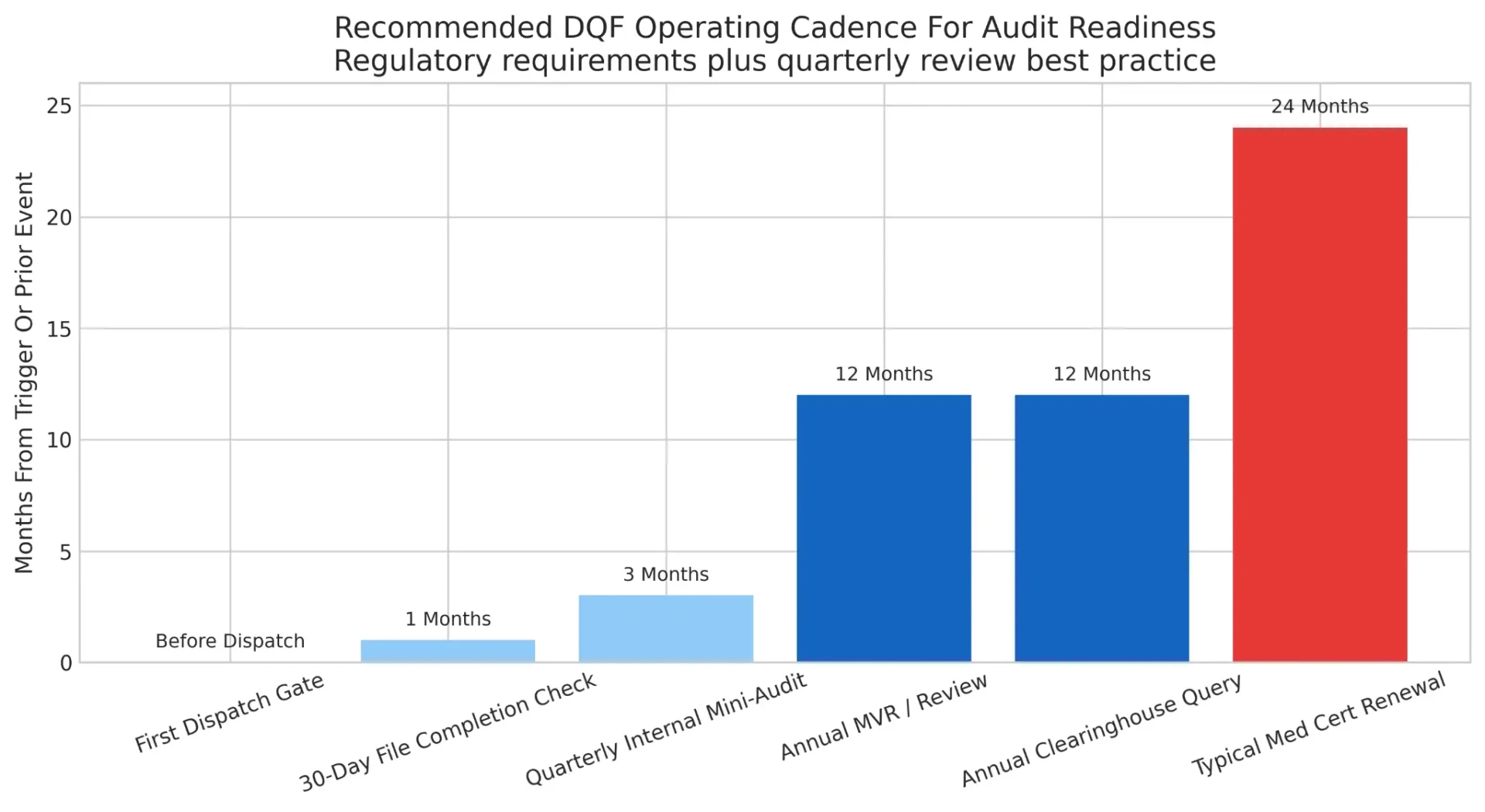
The strongest workflow has distinct gates. Before dispatch, the carrier should verify that the application is complete, the required MVR requests are underway, the road test or CDL equivalent is documented, and the medical qualification evidence is current. Within the first 30 days, the system should confirm that State MVRs and prior-employer safety history responses—or documented good-faith efforts—have been filed as required 1. After that, the workflow shifts into recurring annual and renewal cycles.
For example, if a medical examiner’s certificate will expire in 75 days, the system should trigger renewal outreach, require proof of appointment, and escalate to no-dispatch if updated evidence is not received in time. That is how a compliance workflow prevents disruption instead of merely recording it.
Let Fleetworthy Do it for You
Learn more about our Driver Qualification software and take the stress out of driver compliance.
Fleet Audit Readiness: What Makes A Driver File Retrievable In Minutes Instead Of Hours?
Fleet audit readiness is the result of architecture, not heroics. A file is audit-ready when documents are current, indexed consistently, searchable by driver, and exportable with an evidence log showing who completed each action and when.
An audit-ready structure separates regulated file content from sensitive investigation-history records and broader HR material. It also applies retention rules consistently. Under 49 CFR 391.51(c), the DQF must be kept for the duration of employment and for three years afterward, while certain recurring records may be removed three years after execution under 49 CFR 391.51(d) 2. Investigation-history files under 49 CFR 391.53 must be kept in a secure location with controlled access 4.

| Audit-Readiness Control | Why It Lowers Risk | What To Check Quarterly |
|---|---|---|
| Standard folder and naming rules | Speeds retrieval and reduces filing errors | Driver ID, document type, effective date |
| Evidence log | Proves ongoing compliance activity | Reviewer name, timestamp, source |
| Exception register | Prevents unresolved gaps from being forgotten | Aging, owner, SLA, escalation status |
| Exportable audit packet | Reduces pre-audit cleanup time | Index, roster, document status dashboard |
A quarterly internal file review should test not only completeness but retrieval speed. If a manager cannot produce a clean file within a few minutes, the architecture is not yet good enough.
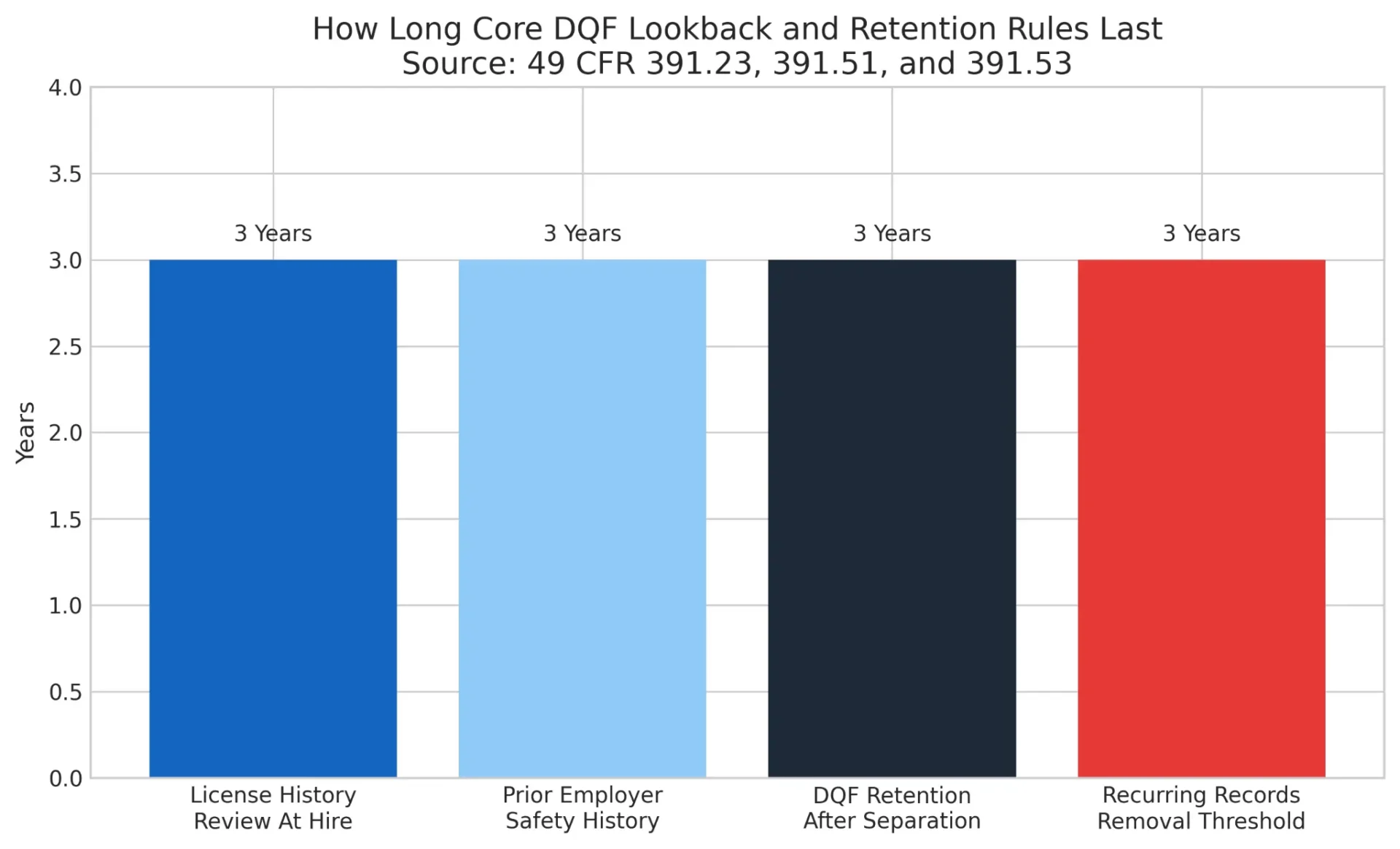
The retention picture is simpler when it is visualized for operators. Initial license-history and prior-employer history checks look back three years, while post-employment retention and the removal threshold for certain recurring records also use a three-year rule under Part 391 1 2 4. When teams understand those repeating timeframes, they make fewer filing and purge mistakes.
Driver Records Process: How Do You Control The File Across The Full Driver Lifecycle?
A mature driver records process begins before hire and continues through separation. The pre-hire stage captures the application, disclosures, license history inquiries, previous-employer checks, and drug-and-alcohol inquiry steps. The onboarding stage confirms the road test or equivalent, medical qualification evidence, registry verification note, and file indexing. The operating stage adds annual MVR review, annual Clearinghouse query where applicable, and periodic file-quality reviews.
DQF errors usually happen at handoffs. A driver may upload a document, but no one confirms that it is legible, signed, or matched to the right person. Date validation, name-match checks, and owned exceptions solve many of those defects before they become audit findings.
Driver Qualification File Management Software: What Capabilities Actually Prevent Compliance Gaps?
Driver qualification file management software should be evaluated by how well it automates the exact failure points carriers face most often. The essentials are expiry tracking, reminders, checklist-driven onboarding, configurable document requirements by driver type, e-signature support, immutable activity logs, and exportable audit packs. If a system cannot show what was missing, who was notified, and whether the issue was resolved before dispatch, it does not really reduce audit risk.
The best platforms also support primary-source workflows. For example, the software should track whether an initial State MVR was requested, whether it was received within the required window, and whether a documented good-faith effort is attached when a response is delayed 1. For CDL drivers subject to Clearinghouse rules, the system should maintain evidence of annual query activity and the consent model used for limited or full queries 5.

| Capability | Manual Process | Better Software Workflow |
|---|---|---|
| Expiration tracking | Spreadsheet reminders that depend on updates | Rule-based alerts with escalation tiers |
| File completeness | Visual review of folders | Required-field and missing-item logic |
| Audit evidence | Screenshots and email reconstruction | Immutable activity logs and exportable packets |
| Driver intake | Email attachments and rekeying | Mobile upload, e-signature, checklist routing |
A good selection process should also ask whether the system can sync driver master data from HRIS, ATS, telematics, and training systems. Fewer manual touchpoints usually mean fewer file defects.
Driver File Management: How Should You Separate DQFs From The Broader Personnel File?
Driver file management includes far more than regulated qualification documents. The challenge is to keep the DQF clean enough for auditors while still maintaining the broader operational and HR record around the driver. The right answer is structured separation with controlled linkage, not co-mingling.
A carrier can maintain a single digital driver profile, but the regulated DQF folder should remain distinct from payroll forms, benefits information, performance documentation, and other HR records. That separation reduces both audit confusion and unnecessary exposure of sensitive employment information. It also aligns with FMCSA’s direction that some investigation-history records must be stored securely with controlled access 4.
In practice, this means using a master index that points to multiple record zones: regulated DQF items, secure investigation-history files, and general personnel records. Auditors can then be shown only what they need, while the business still maintains a unified operational record behind the scenes.
DOT Driver Qualification File Management: Which Part 391 Anchors Should Shape The Calendar?
DOT driver qualification file management should be built directly from the cadence in 49 CFR Part 391, not from informal office habits. The core anchors are straightforward. The application must be complete before the driver operates a CMV. State MVR inquiries and prior-employer safety history efforts must be completed and documented within the first 30 days of employment. Annual MVR inquiries and annual driving-record reviews must occur at least once every 12 months 1. Medical qualification evidence must remain current, with a standard medical certificate generally renewed every two years unless a shorter period is specified by the examiner 3.
The benefit of anchoring the calendar to the regulation is consistency. Everyone can see which tasks are legally fixed, which are internal best-practice controls, and which are triggered by exceptions. That clarity also makes it easier to explain the program to executives, auditors, and insurers.
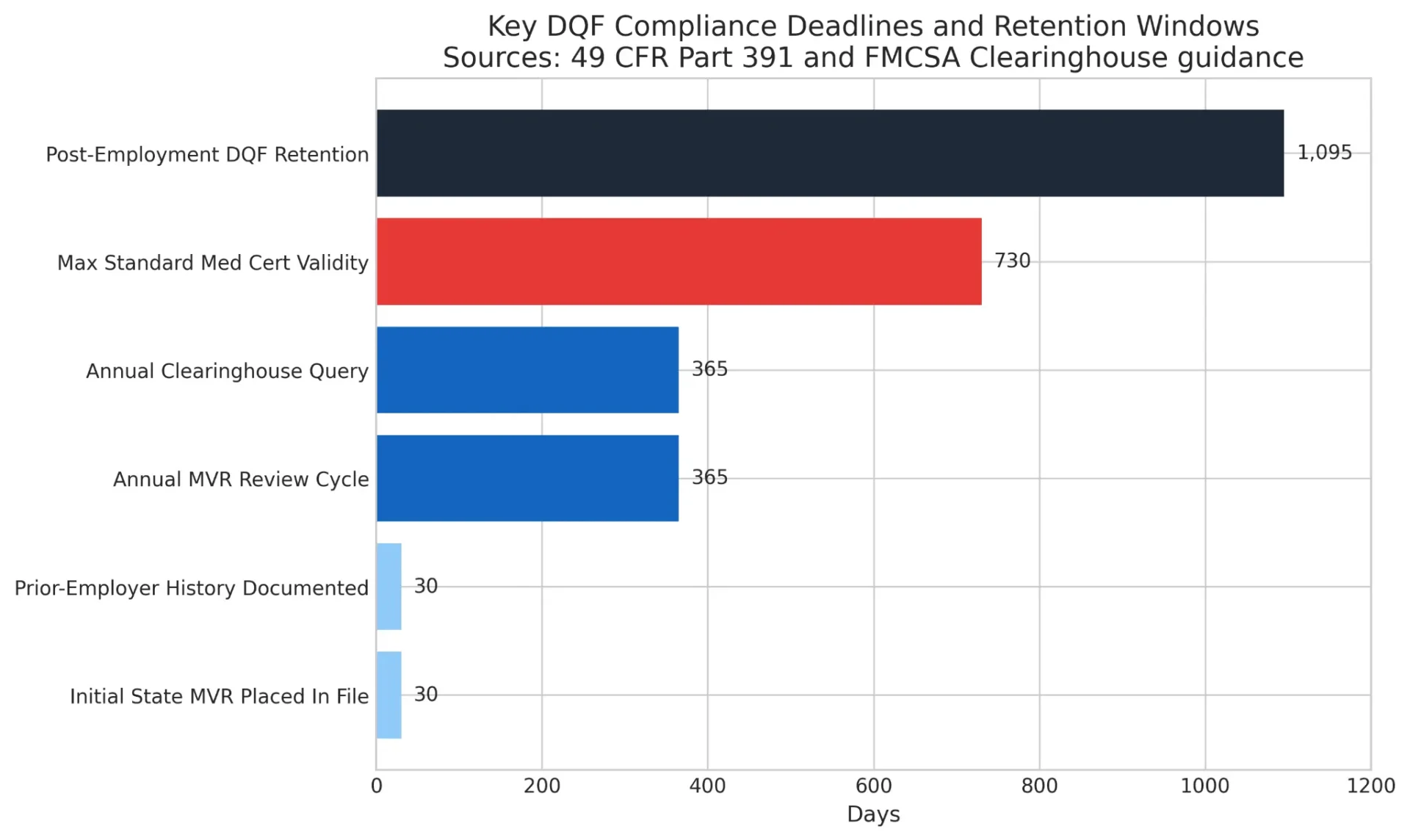
A strong compliance calendar pairs the formal regulatory dates with earlier internal trigger points. That is why many fleets start renewal outreach 60 to 90 days before expiration and run quarterly mini-audits even though the regulation itself focuses on annual cycles.
DOT Driver Qualification File Management Software: How Should It Handle Consent, Queries, And Evidence?
DOT driver qualification file management software should map directly to Part 391 and, where CDL obligations apply, to Clearinghouse workflows under Part 382. FMCSA explains that limited Clearinghouse queries require general consent obtained outside the Clearinghouse and may cover more than one year if the timeframe is stated, while full queries require the driver’s electronic consent in the Clearinghouse 5. FMCSA also states that the annual query requirement runs on a rolling 365-day basis 6.
Those details matter because software should not only store the final query result. It should also retain the consent record, the date of the query, any follow-on full-query requirement, and the related corrective action if information is returned. In an audit, that evidence chain shows that the carrier did not treat Clearinghouse obligations as an isolated screen check, but as part of a governed compliance process.
The same principle applies to medical qualification workflows. The software should preserve the document, the effective date, the next action date, and any variance documentation. That complete audit trail is what turns automation into defensible compliance.
Driver File Management Software: How Do You Compare Coverage, Security, And ROI?
Selecting driver file management software should start with risk exposure, not feature volume. A system that stores documents elegantly but cannot enforce rules around expirations, validation, and controlled access may improve convenience without materially reducing audit risk. The better comparison is coverage versus labor versus exposure.
One practical ROI model is to measure three things before and after implementation: missing-document rate per 100 drivers, expired-document count, and average time required to assemble an audit packet. Those KPIs match the brief because they reflect whether the workflow is actually reducing defects, not just digitizing them. Even without a fully mature platform, fleets can start measuring these metrics in a dashboard and use them to support future tool investments.
A security review should be part of the same decision. Role-based access, audit logs, encryption, and controlled access to investigation-history files are not optional extras. They are central to a defensible driver file management program.

Driver File Management Tool: What Can Smaller Fleets Put In Place Right Now?
A driver file management tool does not have to begin as enterprise software. Smaller fleets can reduce risk quickly with standardized checklists, a compliance calendar, a document naming convention, an exception log, and a dashboard that shows red-amber-green status by driver and document type. The critical requirement is not sophistication; it is consistency.
For a small operation, that might mean one onboarding checklist, one annual review checklist, one corrective-action register, and one monthly compliance meeting where open exceptions are reviewed. Those simple controls can dramatically reduce last-minute audit cleanup because they convert hidden work into visible work.
The most important immediate action is to create a no-dispatch rule for expired or missing high-risk items such as medical certification evidence. When a document gap can stop a driver from being dispatched, the workflow becomes real for everyone involved.
The next step is to turn the process into a simple operating package: one workflow template, one audit-readiness checklist, one dashboard, and one owner for open exceptions. If you are publishing this article on a company site, connect readers to related resources such as compliance services, audit support, DQF resources, driver training, and state-by-state compliance guides.
| Implement Now | Why It Matters This Quarter | Owner |
|---|---|---|
| Launch a no-dispatch control for expired med certs | Prevents avoidable out-of-service and audit defects | Safety |
| Standardize file naming and indexing | Improves retrieval speed during reviews and audits | Compliance admin |
| Run a quarterly mini-audit on a file sample | Finds broken handoffs before regulators do | Safety + HR |
| Track missing-document rate per 100 drivers | Gives leadership a measurable risk trend | Operations |
The cleanest CTA is operational: download the workflow template, use the audit-readiness checklist, and schedule a compliance review after the current-state gap analysis is complete.
Frequently Asked Questions: How Can Driver Qualification File Management Reduce Audit Risk
What Is Included In A Driver Qualification File?
A compliant DQF generally includes the signed employment application, initial State MVRs, road test certificate or accepted equivalent, annual MVR inquiry results, annual review note, and medical qualification evidence, with variance documents where applicable under 49 CFR 391.51 2. Additional investigation-history records are maintained separately under 49 CFR 391.53 4.
How Do I Organize Driver Qualification Files For DOT Compliance?
Use a standard file index tied to Part 391, maintain a separate secure area for investigation-history records, and apply naming rules that identify the driver, document type, and effective date. The goal is fast retrieval, not just storage convenience.
How Long Must I Keep Driver Qualification Files?
Under 49 CFR 391.51(c), the DQF must be retained for as long as the driver is employed and for three years thereafter 2. Certain recurring records may be removed three years after execution under 49 CFR 391.51(d) 2.
What Documents Expire In A DQF And How Often?
The most visible expiring document is the medical certification evidence. FMCSA explains that the medical certificate is generally renewed every two years, unless the medical examiner specifies a shorter period 3. Annual MVR reviews and, for applicable CDL drivers, annual Clearinghouse queries must also be refreshed on a 12-month cadence 1 6.
How Often Should MVR Checks Be Run?
At minimum, carriers must obtain and review each employed driver’s MVR at least once every 12 months under 49 CFR 391.25 1. Many fleets monitor more frequently as a risk practice, but the annual review is the regulatory floor.
What Is The Difference Between A DQF And A Personnel File?
The DQF contains regulated qualification and review records required for CMV driver compliance, while the personnel file contains broader HR and employment records. Keeping them distinct reduces audit confusion and helps protect sensitive information.
How Can Software Help Manage Driver Qualification Files?
Software can automate reminders, enforce checklist completion, track expirations, preserve consent and query evidence, and generate auditor-ready packets. Its value comes from reducing manual touchpoints and proving that compliance activity happened on time.
Get Started with Driver Qualification
Fleetworthy's Driver Compliance solution allows for easy management of driver qualification. Talk to our team to see if it's right for your fleet.