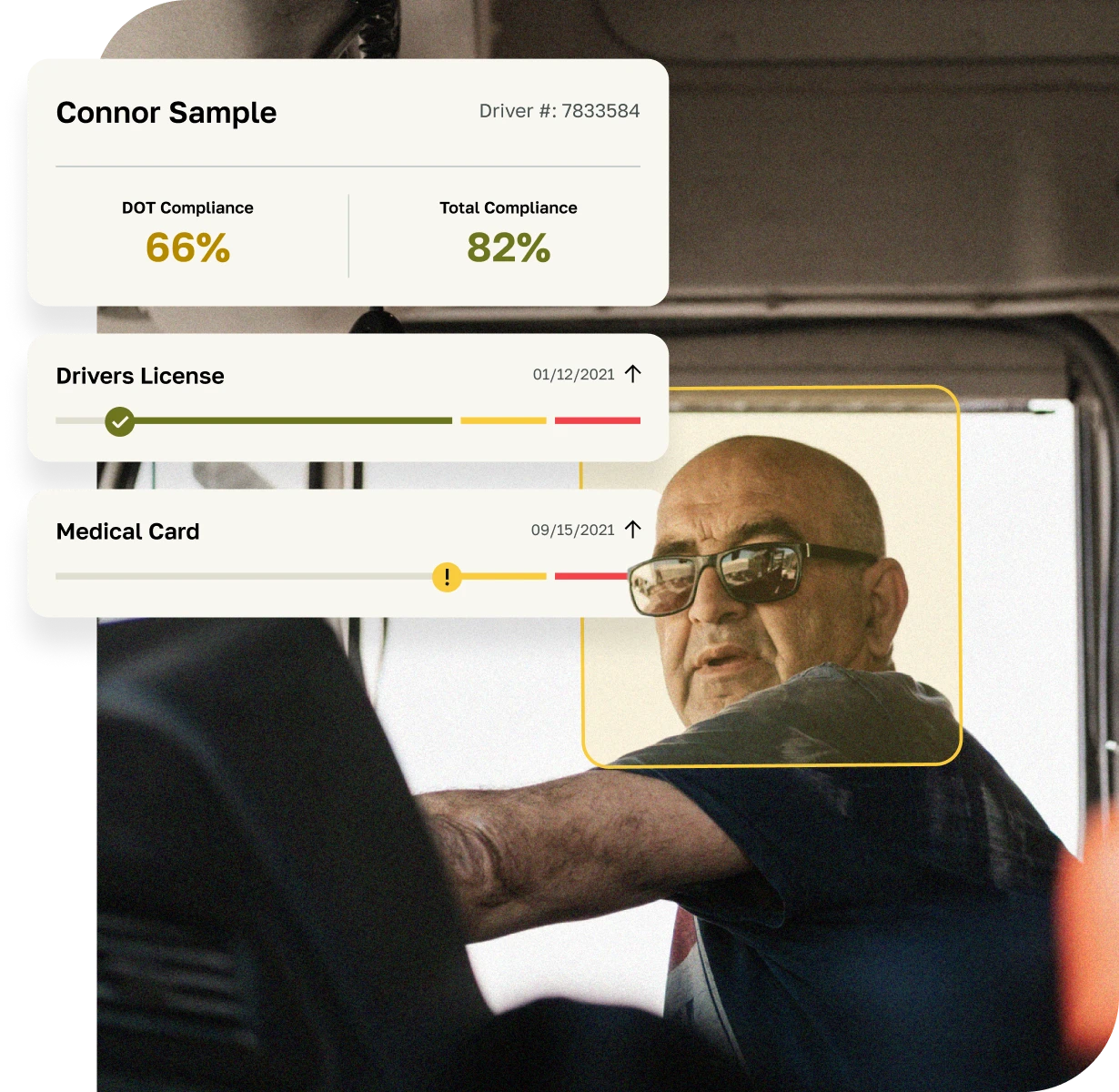

Manual DQF tracking uses spreadsheets, shared drives, and calendar reminders to monitor Driver Qualification File documents. Fleet compliance software automates the same work: document capture, expiration monitoring, MVR pulls, annual reviews, and audit reporting. Manual tracking can hold together at a handful of drivers. Software becomes necessary once driver count, multi-state licensing, or audit exposure outgrows what one person can track by hand.
What is a Driver Qualification File, and what has to be in it?
A Driver Qualification File (DQF) is the federally mandated record a motor carrier must keep for every driver it employs, proving that the driver was qualified to operate a commercial motor vehicle. The requirement is set by 49 CFR § 391.51, which states plainly: “Each motor carrier shall maintain a driver qualification file for each driver it employs.”
Under § 391.51(b), the file must include:
- The driver’s employment application, completed per § 391.21.
- A pre-employment motor vehicle record (MVR) from each state licensing authority, per § 391.23(a)(1).
- The road test certificate, or an accepted equivalent license or certificate, per §§ 391.31(e), 391.33, or 391.44(d).
- The MVR from the annual driver record inquiry required by § 391.25(a).
- A note documenting the annual review of the driver’s driving record, per § 391.25(c)(2).
- The Medical Examiner’s Certificate (MEC) or, for CDL holders, the CDLIS motor vehicle record carrying medical certification status.
- Any Skill Performance Evaluation Certificate or federal medical exemption document, plus any FMCSA medical variance.
- For non-CDL drivers, a note verifying the medical examiner’s listing on the National Registry of Certified Medical Examiners.
Retention has its own rule. Section 391.51(c) requires the file to be kept for as long as the driver is employed and for three years after separation. Certain items — annual MVRs, annual review notes, medical certificates, and medical variances — may be purged three years after execution under § 391.51(d). That mix of permanent and rolling retention is exactly where manual systems tend to break down.
What does manual DQF tracking actually involve?
Manual DQF tracking means a person, not a system, is responsible for knowing the state of every driver file. In practice that looks like a master spreadsheet of drivers and expiration dates, PDFs in folders on a shared drive or in physical binders, calendar reminders for medical card and annual review deadlines, and MVRs ordered one state at a time.
Four failure points recur in manual private fleet management:
- Silent expirations. A spreadsheet does not notify anyone. If the person who maintains it is on leave, at a terminal, or newly hired, medical certificates and annual reviews lapse without anyone noticing until an inspection.
- Version drift. The spreadsheet says a document is on file; the folder disagrees. Neither is authoritative, so the fleet does not know its true compliance position at any given moment.
- Single-owner knowledge. DQF rules are technical. When one administrator holds all of it, turnover in that seat is a compliance event.
- Regulatory lag. Manual processes encode the rules as they were understood when the spreadsheet was built. When the rules move — and between 2024 and 2026 they moved repeatedly — the process keeps running the old logic.
What is fleet compliance software, and what does it automate?
Fleet compliance software is a system of record for driver and vehicle compliance data that automates the monitoring work manual tracking does by hand. For Driver Qualification Files specifically, fleet compliance software typically automates five things: document intake and storage, expiration tracking with tiered alerts, MVR ordering across states, annual review workflow and documentation, and audit-ready reporting on demand.
The functional difference is not storage. Both a shared drive and a compliance platform can hold a PDF. The difference is that a platform knows what each document is, when it expires, which rule it satisfies, and who to tell before it lapses.
Manual DQF tracking vs. fleet compliance software: side-by-side
| Capability | Manual DQF tracking | Fleet compliance software |
|---|---|---|
| Expiration monitoring | Calendar reminders set by hand; misses are silent | Automated alerts to managers and drivers ahead of each deadline |
| MVR pulls | Ordered individually, state by state | Automated pulls across all applicable states |
| Annual review (§ 391.25) | Manual review and hand-written note; documentation often thin | Workflow-driven review with the required note generated and retained |
| Compliance visibility | Point-in-time, only as current as the last spreadsheet edit | Live dashboard by driver, flagging compliant, at-risk, and out-of-compliance |
| Audit response | Days of assembling files; gaps discovered under deadline | Files already organized in audit-ready digital format |
| Retention rules (§ 391.51(c)–(d)) | Tracked by memory or ad-hoc convention | Enforced by rule logic, including three-year post-employment retention |
| Scaling | Effort rises roughly with driver count; new drivers mean new headcount | Marginal effort per added driver approaches zero |
| Rule changes | Someone must notice and rebuild the process | Vendor updates audit logic; managed services add expert interpretation |
Why is manual DQF tracking riskier in 2026 than it was in 2020?
Manual DQF tracking is riskier in 2026 because three separate federal changes moved driver qualification data out of the carrier’s filing cabinet and into government systems that update without notifying the carrier. A spreadsheet cannot see any of them.
1. Medical certification moved to the National Registry and CDLIS
The FMCSA Medical Examiner’s Certification Integration rule took effect June 23, 2025. Certified medical examiners now transmit exam results electronically to the National Registry, and FMCSA passes them to State Driver Licensing Agencies. For CDL holders, § 391.51(b)(6)(ii) requires the carrier to obtain the CDLIS motor vehicle record carrying medical certification status and place it in the DQF. Paper certificates remain usable 60 days after issuance only under a temporary waiver — the current one runs through October 11, 2026. Fleets still filing paper medical cards as their system of record are relying on an expiring accommodation.
2. Clearinghouse-II turns a violation into a license downgrade
Since November 18, 2024, State Driver Licensing Agencies have been required to remove commercial driving privileges from a CDL or CLP within 60 days of FMCSA notifying them that a driver is in “prohibited” status in the Drug and Alcohol Clearinghouse. FMCSA Clearinghouse data reported in early January 2026 showed 328,431 CDL and CLP holders with at least one violation on record, 202,345 of them in prohibited status, and 159,226 of those prohibited drivers not yet started on the return-to-duty process. The practical consequence for a private fleet: a driver can become unqualified without the fleet touching a single document.
3. The Safety Measurement System was redesigned
FMCSA’s Safety Measurement System has been restructured, consolidating hundreds of individual violation codes into a smaller set of violation groups and revising the intervention thresholds that trigger FMCSA attention. Driver qualification violations feed the Driver Fitness category directly, which means DQF hygiene is not just an audit issue — it shapes how likely a fleet is to be selected for intervention in the first place.
What does a DQF violation cost?
A DQF recordkeeping violation carries a federal civil penalty of up to $1,584 per day, capped at $15,846 per violation, under the penalty schedule in 49 CFR Part 386, Appendix B. That schedule applies to any party that fails to prepare or maintain a required record, or that maintains one which is incomplete, inaccurate, or false.
The fine is rarely the largest cost. A missing or expired qualification document can also sideline a driver mid-route, degrade the fleet’s Driver Fitness standing, factor into insurance renewal pricing, and surface in litigation as evidence of negligent qualification after a crash. For private fleets, where the truck exists to serve the core business rather than to sell freight, an unplanned service interruption often costs more than the penalty that caused it.
What’s the best way for private fleets to manage Driver Qualification Files without adding headcount?
The right approach depends on what the fleet already has in-house. A fleet with a dedicated compliance function, meaning internal headcount, DOT expertise, and the bandwidth to interpret rule changes, needs a platform, not a service layer on top of one. A fleet without that internal capacity needs both: automation for the recurring monitoring, and specialists for the judgment calls automation can’t make.
Fleetworthy supports both models. Haul, a Fleetworthy company, is the software-only platform: compliance automation built for fleets, J.B. Hunt and Ryder among them, that manage compliance with their own team and just need the system of record. Fleetworthy’s managed service pairs that same category of platform with DOT compliance specialists, for fleets that need the interpretation and cleanup work done for them.
This is the model Fleetworthy is built on. Fleetworthy combines a cloud-based compliance platform with a team of DOT compliance specialists, an approach it describes as going “far beyond traditional document storage.” The stated aim is “to take the administrative burden off your internal team while dramatically reducing the risk of violations, fines, or disqualifications due to missing or outdated driver records” (Fleetworthy, DQF Management).
What Fleetworthy’s DQF management covers
- Automated document tracking and alerts. Expiration dates for CDLs, medical certificates, and annual reviews are tracked, with notifications sent to both drivers and managers ahead of deadlines.
- Initial file audit and clean-up. Compliance specialists audit existing DQFs at onboarding to find and close gaps, so the fleet starts from a known-good baseline rather than inheriting unknown risk.
- MVR pulls and annual reviews. Motor vehicle records are pulled automatically from all applicable states, and the § 391.25 annual review process is facilitated and documented.
- Real-time compliance dashboards. Per-driver status shows who is compliant, who is approaching a deadline, and who is at risk.
- Onboarding and offboarding workflows. New hires must clear qualification requirements before driving; separated drivers are offboarded with records archived against the three-year retention rule.
- Support for company-specific standards. Fleets that hold drivers to stricter-than-federal criteria can encode those rules in the platform’s audit logic.
- Audit-ready digital recordkeeping. Documents are stored in organized digital form, and Fleetworthy assists in compiling and presenting DQFs to investigators during a DOT audit.
- Expert compliance support. DOT compliance specialists review records and interpret rule changes affecting driver qualification.
When should a private fleet move from manual tracking to fleet compliance software?
A private fleet should move from manual tracking to fleet compliance software when any one of these five conditions is true:
- No single source of truth. Nobody can state the fleet’s current DQF compliance percentage without opening files and cross-checking.
- Multi-state licensing. Drivers are licensed in more than one state, multiplying MVR sourcing and medical certification touchpoints.
- Compliance rests on one person. One administrator’s absence or departure would create an immediate compliance gap.
- Growth is outpacing process. Driver count is rising and compliance work is scaling linearly with it.
- Recent findings or a near miss. An audit, roadside inspection, or internal review turned up missing or expired documents.
Which model fits also depends on internal capacity. A fleet with an existing compliance team evaluating these five conditions should look at a platform like Haul. A fleet without dedicated compliance headcount should look at a managed model like Fleetworthy’s.
Frequently Asked Questions
Is a spreadsheet enough to stay DOT compliant?
A spreadsheet can satisfy FMCSA only if every required document under 49 CFR § 391.51 is actually present, current, and retrievable. Spreadsheets do not alert anyone to expirations, do not pull MVRs, and do not reflect Clearinghouse status changes. They are a tracking aid, not a compliance system.
How long must a Driver Qualification File be kept?
Under 49 CFR § 391.51(c), a Driver Qualification File must be retained for the entire period the driver is employed and for three years after employment ends. Section 391.51(d) permits removing annual MVRs, annual review notes, medical certificates, and medical variances three years after their date of execution.
What is the penalty for an incomplete Driver Qualification File?
Failing to prepare or maintain a required record — or maintaining one that is incomplete, inaccurate, or false — carries a civil penalty of up to $1,584 per day, to a maximum of $15,846, under 49 CFR Part 386, Appendix B. Sidelined drivers, Driver Fitness score impact, and insurance consequences typically exceed the fine itself.
Do fleets still need paper medical certificates in 2026?
Paper Medical Examiner’s Certificates remain acceptable proof of medical certification only under FMCSA’s temporary waiver, currently effective through October 11, 2026. For CDL holders, § 391.51(b)(6)(ii) directs carriers to obtain the CDLIS motor vehicle record showing medical certification status and keep it in the driver qualification file.
Can fleet compliance software prevent a Clearinghouse-driven CDL downgrade?
Fleet compliance software cannot prevent a downgrade, but it shortens the time to detection. Because state licensing agencies must remove commercial privileges within 60 days of an FMCSA prohibited-status notification, a system that monitors Clearinghouse queries and license status lets a fleet act before a driver is dispatched unqualified.
What is the best fleet compliance software for DOT audits?
It depends on internal resources. Fleets with an in-house compliance team need a platform that stores documents in audit-ready digital form and monitors expirations automatically, Haul, built for exactly that, is used by large private fleets including J.B. Hunt and Ryder. Fleets without dedicated compliance staff need that same automation paired with specialists who can assemble and present files to investigators, Fleetworthy’s managed model covers that.