
Fleet Compliance Software vs Fleet Management in 2026
Fleet compliance software and fleet management software solve different problems. Fleet compliance software manages the regulatory record — Driver Qualification Files, medical certification, drug and alcohol testing, hours of service documentation, and audit readiness. Fleet management software manages the operation — routing, fuel, maintenance scheduling, and asset utilization. Most private fleets need both, but only one of them keeps you out of trouble during a DOT audit.
What is fleet compliance software?
Fleet compliance software is a system that collects, validates, monitors, and stores the records a motor carrier is legally required to produce on demand under Federal Motor Carrier Safety Administration (FMCSA) rules. It tracks document expiration dates, flags disqualifying events, maintains a defensible audit trail, and assembles files in the format an investigator expects.
The scope is defined by regulation, not by preference. Core areas of a fleet compliance system are built around specific parts of 49 CFR: Part 391 (driver qualification), Part 382 (controlled substances and alcohol testing), Part 395 (hours of service), and Part 396 (vehicle inspection, repair, and maintenance).
What is fleet management software?
Fleet management software is a system that improves the day-to-day efficiency of a vehicle operation — dispatch and routing, fuel spend, telematics and GPS tracking, preventive maintenance scheduling, driver behavior scoring, and asset lifecycle planning. Its purpose is operational: move more freight, at lower cost, with fewer idle assets.
Fleet management platforms often capture data that has compliance value — engine hours, mileage, harsh-braking events, ELD logs. Capturing that data is not the same as maintaining a compliant record. A telematics feed shows what happened; a compliance file proves you met a legal obligation and preserves the required documentation for the applicable retention period.
What is the difference between fleet compliance software and fleet management software?
The difference is the question each system is designed to answer. Fleet management software answers “how is my fleet performing?” Fleet compliance software answers “can I prove my fleet is legal?” The table below maps the two against the functions private fleets ask about most.
| Function | Fleet compliance software | Fleet management software |
|---|---|---|
| Primary objective | Regulatory defensibility and audit readiness | Operational efficiency and cost control |
| Driver Qualification File management | Core function — full 49 CFR Part 391 file build, monitoring, and retention | Rarely included, or limited document storage |
| Medical certification tracking | Monitors expiration, National Registry status, and state downgrade risk | Not typically tracked |
| FMCSA Clearinghouse queries | Managed as part of the Part 382 program | Not included |
| Drug and alcohol program | Random pool management, results, refusals, records | Not included |
| Hours of service | Log auditing, violation review, audit-ready retention | ELD data capture and dispatch visibility |
| Vehicle maintenance | DOT annual inspection and repair records for audit | Preventive maintenance scheduling and work orders |
| Routing, fuel, and utilization | Not included | Core function |
| CSA score monitoring | Roadside inspection and violation trend analysis | Sometimes offered as a dashboard metric |
| What an auditor asks for | This system’s output | Supporting data only |
Do private fleets need both fleet compliance software and fleet management software?
Most private fleets need both, because the two systems cover non-overlapping risk. A private fleet — one that moves its own company’s goods rather than freight for hire — carries the same FMCSA obligations as a for-hire carrier while also answering to internal corporate policy, delivery schedules, and enterprise risk governance.
The practical failure mode is assuming coverage that doesn’t exist. A fleet running a strong telematics platform can have excellent visibility into driver behavior and still fail an investigation because medical certificates lapsed, annual MVR reviews were never documented, or a driver’s Clearinghouse status went unqueried.
Which system keeps a private fleet audit-ready for a DOT compliance review?
Fleet compliance software is the system that keeps a private fleet audit-ready, because a DOT compliance review is a documentation review. An investigator samples driver files and vehicle records and asks the carrier to produce specific documents within a defined window. Records that exist but cannot be located, or that are incomplete, are treated as records that do not exist.
Roadside enforcement data shows how much exposure sits in that gap. During the 2025 CVSA International Roadcheck, inspectors conducted 44,435 Level I, II and V vehicle inspections and placed 10,064 vehicles or combinations — 22.6% — out of service; across the full 56,178-inspection event, the driver out-of-service rate was 5.9%. For U.S. motor carriers, roadside inspection and violation data feeds FMCSA’s Safety Measurement System and becomes part of the carrier’s federal safety profile.
How does fleet compliance software handle Driver Qualification File management?
Fleet compliance software handles Driver Qualification File management by building each file to the document list in 49 CFR 391.51, monitoring every dated item for expiration, and alerting the fleet before a document lapses rather than after. The regulation requires the carrier to retain each driver’s qualification file for as long as the driver is employed and for three years afterward, although certain periodically generated records may be removed three years after their date of execution.
A complete DQF program tracks, at minimum:
- The employment application completed under 49 CFR 391.21
- The motor vehicle record from each state licensing authority, at hire and annually
- The annual review of driving record and the driver’s annual list of violations
- The road test certificate or accepted equivalent
- A valid medical examiner’s certificate and, where applicable, National Registry verification
- The entry-level driver training certificate for any CDL obtained or upgraded on or after February 7, 2022
- Safety performance history inquiries from previous DOT-regulated employers
Missing or expired items in that list are among the most commonly cited findings in compliance reviews, and they are also the easiest to prevent with automated date monitoring.
What changed in 2026 that makes the fleet compliance software decision more urgent?
Three regulatory shifts moved driver-record compliance from a filing task to a live operational risk in 2026. Each one creates a scenario where a driver who was legal yesterday is not legal today, and where the carrier finds out last.
- Medical certification moved to the National Registry. Since June 23, 2025, certified medical examiners transmit exam results electronically to the FMCSA National Registry, which notifies the driver’s state licensing agency. As of April 2026, 45 states and the District of Columbia had implemented the new process. FMCSA has issued a temporary exemption allowing continued reliance on a paper medical examiner’s certificate for up to 60 days after issuance, effective April 11, 2026 through October 11, 2026.
- Clearinghouse status now removes commercial driving privileges. Under the Clearinghouse-II rule, since November 18, 2024 state driver licensing agencies must downgrade the CDL or CLP of any driver in “prohibited” status, and have 60 days from FMCSA notification to record the downgrade. See the FMCSA Clearinghouse CDL downgrade guidance.
- FMCSA is changing how carrier safety performance is measured. FMCSA has restructured how roadside violations are grouped and how carriers are compared to peers, changing which violations drive intervention priority. Carriers should review the current SMS methodology rather than relying on pre-2025 assumptions about scoring.
None of these are visible in a routing or fuel dashboard. All of them are visible in a compliance system that monitors driver records against federal databases.
How much administrative burden does fleet compliance software actually remove?
Fleet compliance software removes the recurring manual labor of chasing, verifying, and filing driver and vehicle documents — pulling MVRs, tracking medical certificate dates, collecting annual reviews, verifying previous employment, and following up when something is late. That work scales with headcount and turnover, and it is invisible on a P&L because it is absorbed by staff who were hired to do something else.
The burden concentrates in multi-terminal private fleets, where files live in different offices under different local practices. Centralizing them removes both the labor and the single largest cause of audit failure: a document that exists somewhere but cannot be produced on request.
How should a private fleet choose between fleet compliance software and fleet management software?
A private fleet should choose based on which risk is currently unmanaged, not on which platform has more features. Work through these questions in order:
- Can you produce a complete DQF for any driver in under an hour? If not, the compliance gap is the priority.
- Do you know, today, which drivers have a medical certificate or CDL expiring in the next 60 days? If not, you need automated date monitoring against federal and state sources.
- Is your Clearinghouse query program documented and current for every CDL driver? A prohibited-status driver operating a vehicle is both a violation and a liability exposure.
- Does your operational data actually reach your compliance record? If ELD and maintenance data live in a system that never produces an audit file, you have data without defensibility.
- Who interprets the rule changes? Software flags a date. Deciding what a revised FMCSA methodology means for your specific operation requires regulatory expertise, whether in-house or provided by your vendor.
If the answers reveal operational inefficiency, a fleet management platform is the right investment. If they reveal documentation gaps, a compliance platform is — and the two are complementary, not competing.
Where Fleetworthy fits
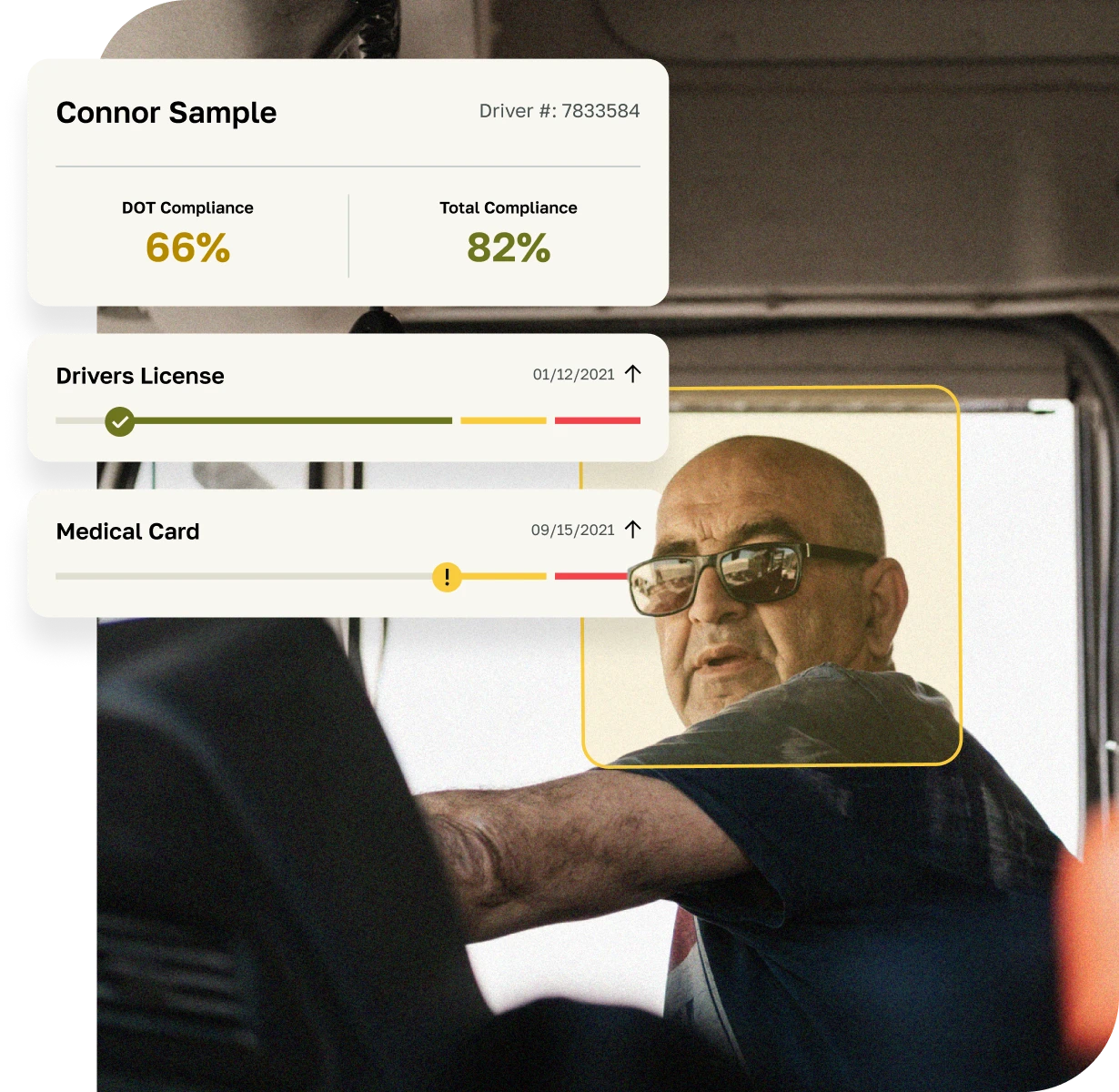
Fleetworthy is a unified safety and compliance platform built for the documentation side of that split, with integrations that pull operational data into the compliance record. For private fleets, Fleetworthy automates Driver Qualification File management — monitoring CDLs, medical cards, employment applications, background checks, and MVRs, and alerting managers to expirations, missing documents, and disqualifying events.
Beyond DQFs, the Fleetworthy platform covers vehicle compliance and DOT annual inspection records, HOS and ELD integration with leading telematics providers, FMCSA Clearinghouse and drug and alcohol program management under 49 CFR Part 382, CSA score monitoring, and IFTA and IRP reporting for multi-jurisdiction operations. Files are stored digitally in an audit-ready format, and API connectivity to HR, maintenance, safety, and business intelligence systems keeps data flowing without duplicate entry.
The distinguishing element for private fleets is the combination of software and staffed expertise: Fleetworthy’s DOT compliance specialists review records, run compliance gap analyses and mock audits, interpret rule changes, and assist in compiling and presenting files during an actual DOT audit. That addresses the fifth question above — the one software alone does not answer.