
If you hire CDL drivers, FMCSA English proficiency rules are not a soft standard or a cultural preference. They are part of the federal driver-qualification rule. Under 49 CFR §391.11(a), a motor carrier may not require or permit a person to drive a commercial motor vehicle unless that person is qualified, and §391.11(b)(2) makes English ability one of those qualifications 1. That means your hiring process, your driver qualification file, and your day-to-day operating controls should all reflect the rule.
In plain language, the rule asks a practical question: can this driver function safely and independently in an English-language highway environment? FMCSA says the driver must be able to converse with the general public, understand English traffic signs and signals, respond to official inquiries, and make entries on reports and records 1. The agency’s 2025 guidance then explains how you should test that standard during hiring without masking the candidate’s actual ability 2.
What Do FMCSA English Proficiency Rules Actually Require Under 49 CFR §391.11(b)(2)?
The phrase fmcsa english proficiency rules refers to the requirement in 49 CFR §391.11(b)(2) that a driver must read and speak the English language sufficiently to converse with the general public, understand highway traffic signs and signals in English, respond to official inquiries, and make entries on reports and records 1. Those four tasks matter because they connect directly to how a commercial driver operates in the real world: talking with enforcement personnel, reading roadside information, answering inspection questions, and recording required information accurately.
| Regulatory Requirement | Plain-Language Meaning For Carriers | Where You Should Test It |
|---|---|---|
| Converse with the general public | Driver can answer ordinary work-related questions in English | Hiring interview and supervisor observation |
| Understand highway traffic signs and signals in English | Driver recognizes standard roadside messages and instructions | MUTCD sign check and refresher coaching |
| Respond to official inquiries | Driver can answer inspection, scale house, checkpoint, or crash-scene questions | English interview with follow-up questions |
| Make entries on reports and records | Driver can complete logs, inspection reports, and related records | HOS/logbook discussion and record review |
FMCSA’s own guidance aligns with this plain-language reading. The agency says the assessment should evaluate whether the driver can communicate with law enforcement during a roadside inspection and understand highway traffic signs encountered while driving 2. FHWA’s MUTCD is the national source for sign standards, which is why FMCSA points carriers to it when building sign-comprehension checks 2 3.
How Should You Assess English Proficiency For Drivers During Hiring?
English proficiency for drivers should be assessed during the driver qualification process, before you complete final hiring and before the candidate begins operating for your carrier 2. FMCSA recommends that a motor carrier manager conduct an interview in English and use questions that show whether the driver can handle real inspection and operating topics. This is where many carriers either become audit-ready or create risk: a vague conversation is hard to defend, but a standardized workflow is easy to explain and repeat.
A practical hiring system begins with expectation-setting. Before the assessment starts, tell the candidate that this is the English-language qualification portion of the interview and that answers must be given in English because the purpose is to determine whether the driver can respond to official inquiries without assistance 2. Once that is clear, move through a structured set of prompts that mirror the situations the driver will face on the road.
The most workable format is a brief, repeatable sequence such as the following:
- Ask the driver to explain the origin, destination, and route for a recent or planned trip.
- Ask the driver to describe on-duty time, driving time, and how the record of duty status or ELD works.
- Ask the driver to identify and explain key information shown on the CDL.
- Ask the driver to explain shipping papers, including hazardous materials papers if that applies to the job.
- Ask the driver to identify vehicle equipment that an inspector might review, such as lights, tires, or brakes 2.
This sequence works because it is job-specific. You are not testing abstract grammar. You are testing whether the applicant can handle normal compliance communication.
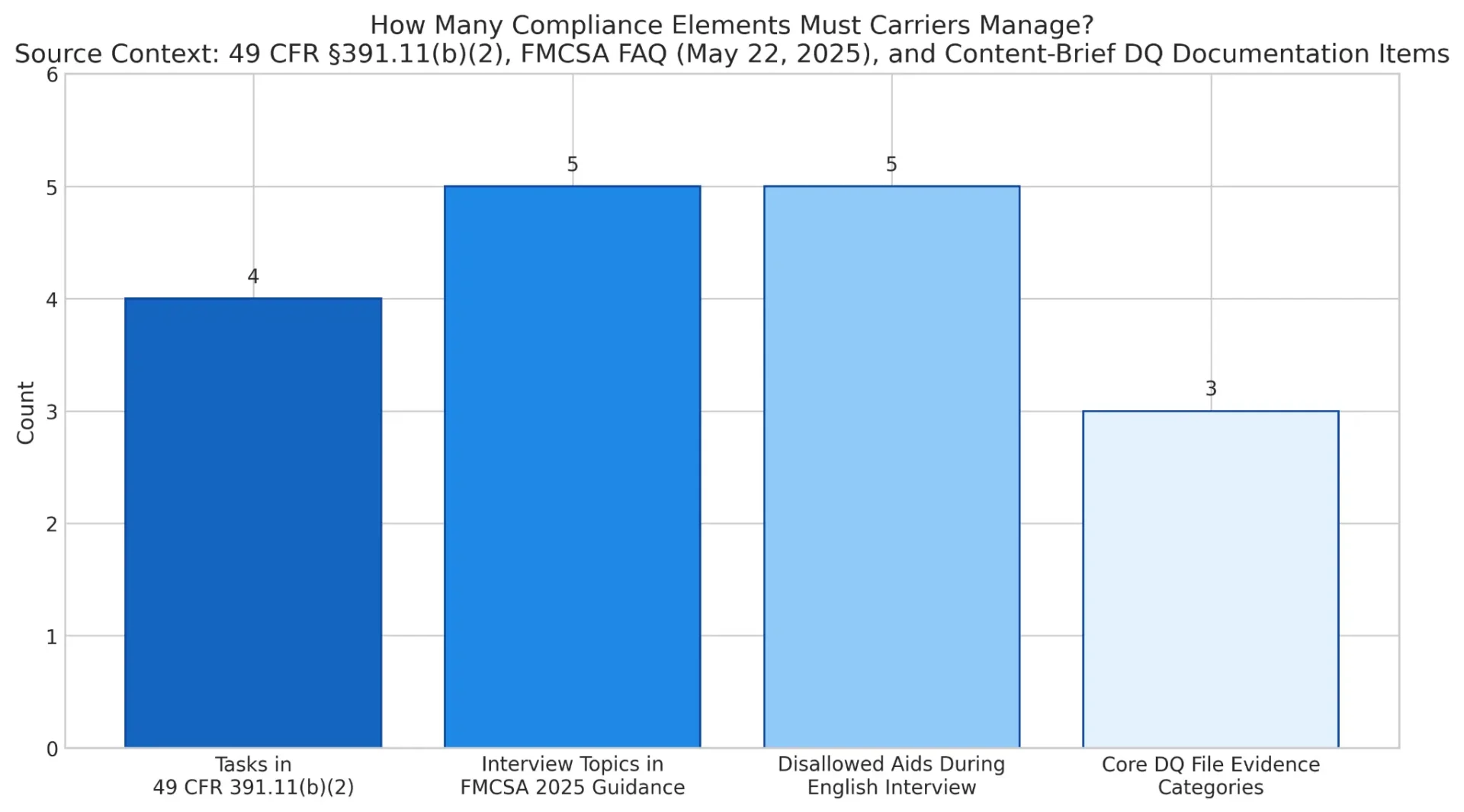
The chart above shows why a written process matters. The rule itself names four required English-language functions, while FMCSA’s 2025 guidance expands that into five interview topics and identifies multiple tools you should not use because they can hide a real proficiency problem 1 2. The more structured your workflow is, the easier it becomes to train recruiters, document outcomes, and defend your decision-making.
What Do CDL Driver Language Rules Mean During The Interview And Sign Check?
CDL driver language rules become most concrete during the English interview and the traffic-sign review. FMCSA says the manager should tell the driver to respond in English during the interview and should not use interpreters, I-Speak cards, cue cards, smartphone applications, or on-call interpretation services for that portion because those tools may mask the driver’s inability to communicate in English 2. For carriers, that single paragraph from the guidance is operationally important: it tells you not only what to test, but also how not to distort the result.
The sign check deserves equal attention. FMCSA recommends selecting various signs from the MUTCD, as well as examples of dynamic message signs, and asking the driver to explain their meaning 2. FHWA describes the MUTCD as the national standard for traffic control devices, including highway signs and signals, which makes it the right source for building a defensible sign bank 3. In practice, your sign set should include a mix of regulatory, warning, and guide-style examples that a driver could encounter in interstate operations.
FMCSA also says the driver’s explanation of the sign meaning may be given in any language if the manager understands it 2. That means the sign check measures comprehension, while the interview measures English communication.
| Assessment Element | What FMCSA Permits | What FMCSA Discourages Or Bars |
|---|---|---|
| English interview | Questions asked by a carrier manager in English | Interpreters or tools that mask proficiency |
| Sign comprehension | MUTCD signs and dynamic message examples | Informal guessing without documented examples |
| Language used for sign explanations | Any language the manager understands | Treating sign comprehension as a substitute for the English interview |
| Language used for the rest of the interview after ELP is passed | Another language, if appropriate | Skipping the ELP step and relying only on a later bilingual interview |
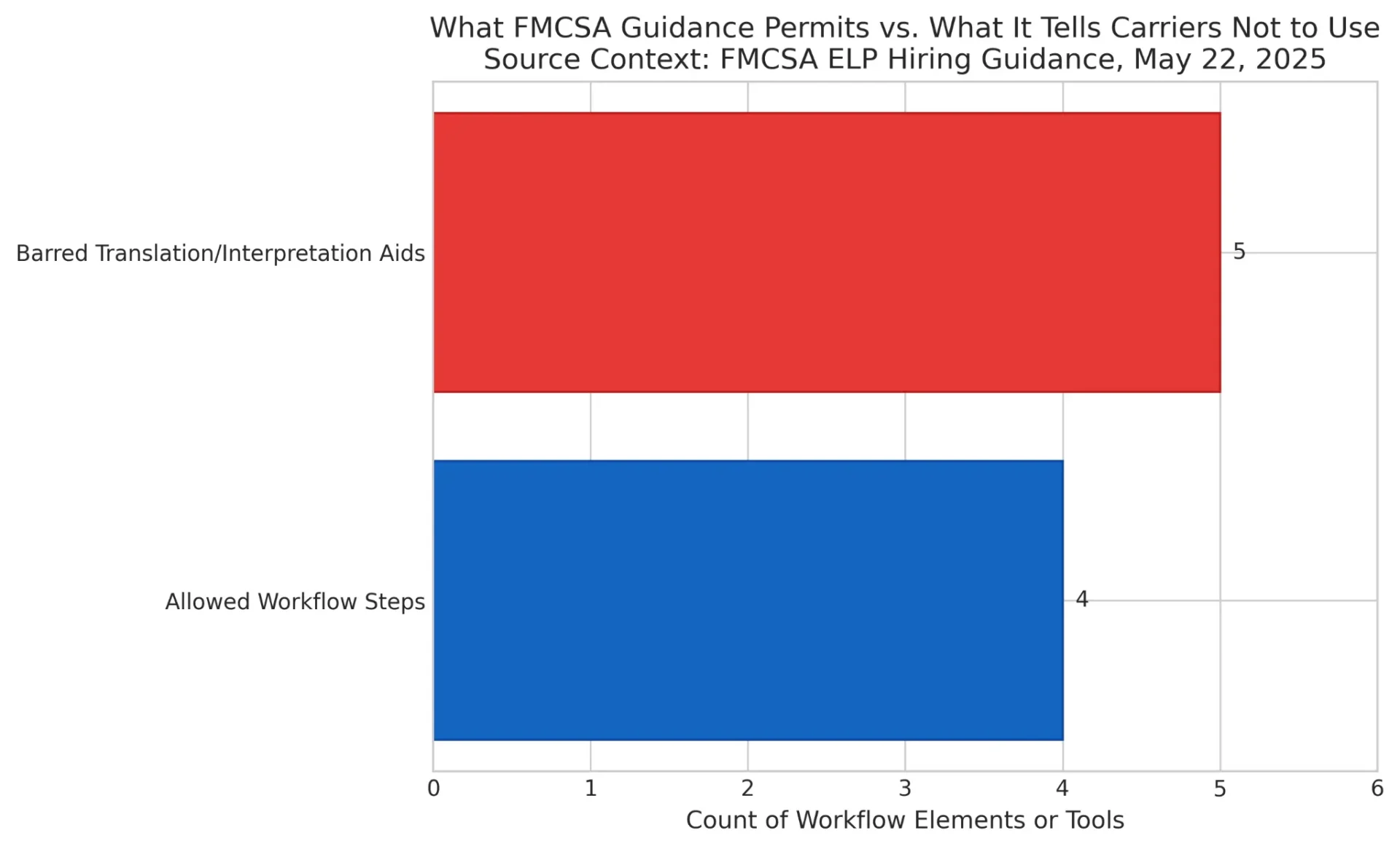
For day-to-day recruiting, the main takeaway is simple. Your verbal ELP step should be in English, your sign bank should come from recognizable U.S. traffic-control sources, and your assessor should record enough detail to show how the decision was made. That approach is both more compliant and more defensible than a casual interview with no script.
Which Fleet Compliance Requirements Should You Document In The DQ File And SOP?
Fleet compliance requirements do not end when a candidate passes the interview. They continue through documentation, records retention, training, and corrective action. If your carrier is audited or has to explain why a driver was qualified, the strongest answer is a file that shows what you assessed, who assessed it, when it was done, what materials were used, and how you responded to later operational issues.
A signed assessment form, interviewer notes, and evidence of the sign-comprehension portion create a far stronger record than a single checkbox saying “English okay.” Because FMCSA places the obligation on the carrier not to require or permit an unqualified driver to operate, the file should show your process, not merely your conclusion 1 2.
The easiest way to standardize this is to build an ELP subsection inside your normal driver qualification file checklist. For example, your records-to-retain list might include the following:
- A signed ELP assessment form showing the interviewer, date, and pass/fail result.
- Notes covering the trip, HOS, CDL, shipping papers, and equipment questions asked.
- A copy or list of the MUTCD and dynamic message signs used in the assessment.
- Any follow-up review, coaching note, or second-assessor confirmation if the first result was borderline.
| Record Type | Why It Matters | Best Practice For Retention |
|---|---|---|
| ELP assessment form | Shows the step occurred and identifies the reviewer | Use one version across terminals |
| Interview notes | Explains the basis for pass/fail | Capture short but concrete observations |
| Sign-check evidence | Shows how traffic-sign comprehension was evaluated | Keep the sign list or screenshots used |
| Manager training record | Proves the process is applied consistently | Train recruiters and safety staff annually |
| Corrective-action record | Connects operational issues to coaching | File with supervisor notes and retraining date |
SOPs matter just as much as files. Train hiring managers on the same script, define what a marginal response looks like, and decide in advance when a second reviewer is required. That consistency helps you avoid a common enforcement weakness: different terminals applying different standards to the same rule.

How Do FMCSA Driver Qualifications Connect ELP To Audits, Roadside Inspections, And Risk?
FMCSA driver qualifications include age, licensing, physical qualification, safe-operation capability, and the English-language requirement in §391.11(b)(2) 1. Treating ELP as one item in that larger qualification system is useful because it keeps the issue out of the realm of personal opinion. A driver either satisfies a qualification standard under a documented process or does not. That framing helps carriers keep the rule tied to safety and compliance rather than to informal impressions.
The operational stakes increased in 2025. FMCSA announced that, beginning June 25, 2025, English-language proficiency violations would again be included in the out-of-service criteria 4. That matters because roadside enforcement can expose weaknesses in a carrier’s qualification and oversight process. Post-hire oversight should therefore track roadside communication issues, tie those issues to coaching, and trigger rechecks when supervisors see recurring problems.
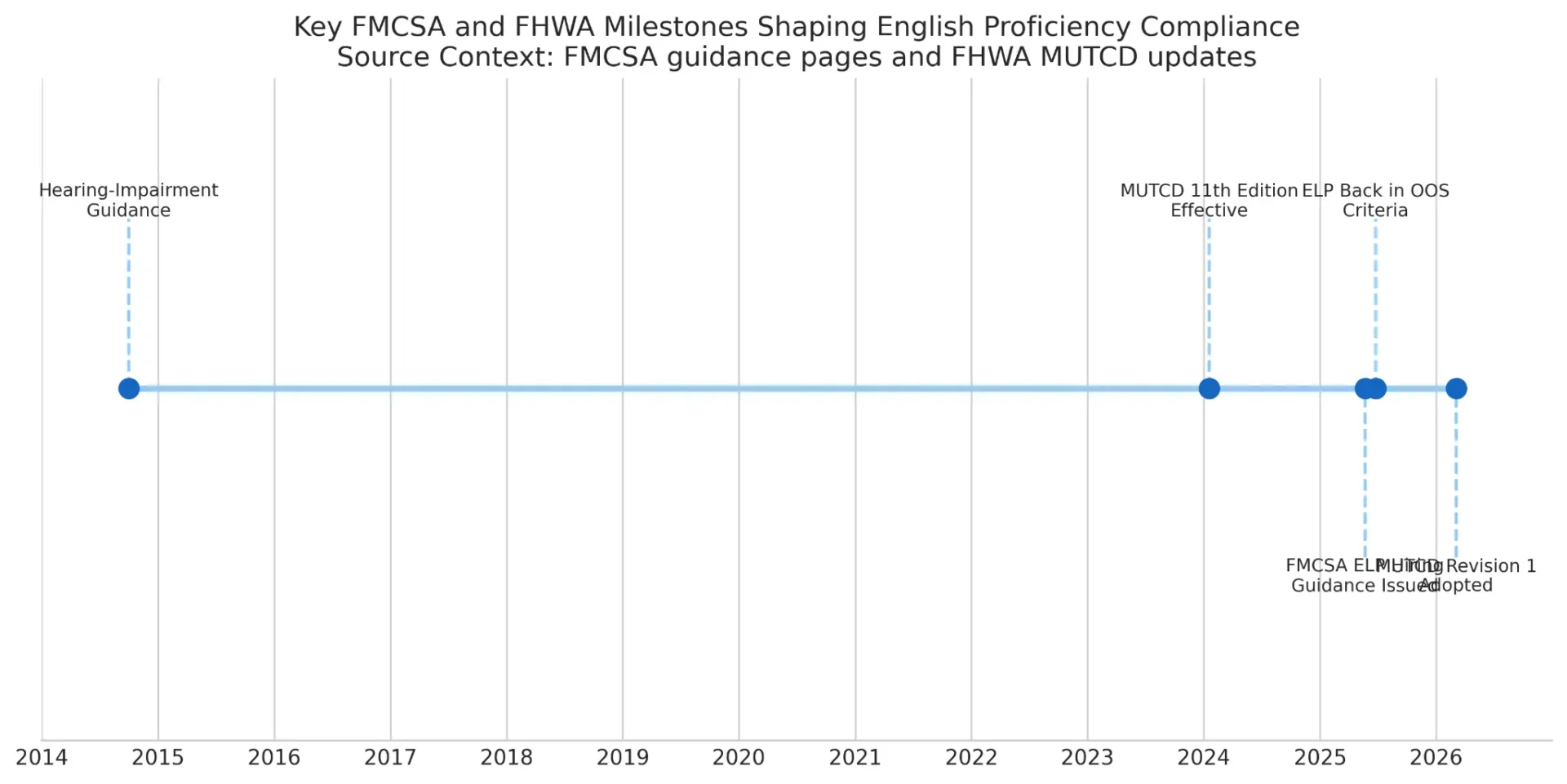
The timeline above shows how the current compliance environment developed. FMCSA’s 2014 hearing-related guidance clarified that the language rule should not be misread to bar hearing-impaired drivers who can read and write English but do not speak for that reason 5. FHWA’s current MUTCD framework remains the national reference for traffic-control devices 3. FMCSA then issued hiring guidance in May 2025 and announced renewed out-of-service enforcement effective June 25, 2025 2 4. Together, those milestones support a practical conclusion: carriers should use a job-related ELP assessment, document it carefully, and apply it consistently.
What Edge Cases And Anti-Discrimination Issues Should Carriers Plan For?
The hardest part of English-language compliance is often not the rule itself but how you apply it. A defensible process is focused on job tasks, uses the same core workflow for similarly situated applicants, and avoids drifting into judgments about national origin, accent, or background. The more your process is anchored to trip questions, HOS records, shipping papers, sign meanings, and inspection communication, the easier it is to show that you tested what the regulation actually covers 1 2.
Hearing-related cases deserve special care. FMCSA’s 2014 guidance explains that the English language rule should not be construed to prohibit operation by hearing-impaired drivers who can read and write in English but do not speak, for whatever reason 5. That does not eliminate all legal questions, but it does show why carriers should coordinate with counsel when accommodation laws or hearing issues overlap with ELP reviews.
Finally, remember the practical flexibility built into FMCSA’s own guidance. Once the driver successfully completes the English-language assessment, the rest of the interview may continue in another language if appropriate 2. That point matters because it lets you preserve a compliant ELP screen while still supporting clear onboarding and training for a multilingual workforce.
Frequently Asked Questions
Do CMV drivers have to speak English under FMCSA rules?
Yes. For interstate commercial motor vehicle drivers, 49 CFR §391.11(b)(2) requires the driver to read and speak English sufficiently to converse with the general public, understand highway signs and signals in English, respond to official inquiries, and make entries on reports and records 1. The standard is functional and job-related, not a general fluency test.
What does “read and speak the English language sufficiently” mean in practice?
It means the driver can operate safely and independently in English-language highway and enforcement settings. FMCSA’s guidance translates that into practical checks involving roadside-style questions and traffic-sign comprehension 1 2.
How do carriers assess a driver’s English proficiency during hiring?
FMCSA recommends an English interview conducted by a carrier manager, combined with a review of traffic signs and dynamic message signs drawn from the MUTCD 2 3. The interview should cover trip details, HOS and logs, CDL information, shipping papers, and inspection-related vehicle equipment 2.
What questions should be asked in an English proficiency interview for CDL drivers?
The strongest prompts are the ones FMCSA lists: recent or planned trip origin and destination, on-duty and driving time, driver’s license information, shipping-paper details, and vehicle equipment subject to inspection 2. Follow-up questions are helpful because they show whether the driver truly understands the topic rather than repeating memorized phrases.
Are interpreters allowed during the English proficiency assessment?
Not during the English-language interview portion. FMCSA says interpreters, I-Speak cards, cue cards, smartphone applications, and on-call interpretation services should not be used because they may mask the driver’s inability to communicate in English 2.
Can drivers explain traffic sign meanings in a language other than English?
Yes, according to FMCSA’s May 2025 guidance, as long as the manager understands the explanation 2. That reflects the fact that the sign portion is testing comprehension of the sign meaning, while the verbal interview is testing the driver’s ability to communicate in English.
What happens if a driver fails the English proficiency assessment?
The carrier should not qualify the driver to operate until the deficiency is addressed because §391.11(a) prohibits requiring or permitting an unqualified person to drive a CMV 1. Many carriers choose to document the failed assessment, provide clear next-step communication, and reassess later using the same standard if company policy allows.
How do carriers prepare for audits related to ELP?
Audit readiness depends on standardization. Use one assessment form across terminals, train assessors to use the same script, preserve the sign bank used, and connect roadside communication issues to documented corrective action. That gives you a coherent story if an auditor asks how your carrier determines and monitors driver qualification 1 2 4.
How does ELP interact with anti-discrimination laws and accommodation issues?
The safest approach is to test only the job-related tasks named in the rule and apply the same process consistently. FMCSA’s 2014 hearing-related guidance shows that the language rule should not be read more broadly than the regulation requires, which is why carriers should involve counsel when accommodation questions arise 5.
Compliance Note: This article provides general compliance information and is not legal advice. You should review policy language, state-law variation, and accommodation questions with qualified counsel.