New research shows in-cab alerts cut hard braking by 84% and reduce secondary crashes by 29%. Here’s what the data means for your fleet.
Large trucks make up about 10% of the miles driven on U.S. highways but are involved in nearly 13% of roadway fatalities. Part of the reason is physics: a loaded tractor-trailer needs far more room to stop than a passenger car, which means the difference between a near-miss and a crash often comes down to how early a driver reacts.
A new round of research set out to answer the question: do real-time in-cab alerts change driver behavior, or do drivers slow down because of the traffic they’d have seen regardless?
Three independent 2024 academic studies out of Ohio and Indiana, combined with new control group data from Fleetworthy’s Black Box behavioral model, now have an answer. In-cab alerts measurably change how drivers respond to danger on the road, often before they can see it coming. For fleet leaders managing safety programs, driver scorecards, and insurance costs, the findings are worth a closer look.
We’ve broken down the findings most relevant to fleets below. The full literature review, In-Cab Alerts for Commercial Vehicles, is available now as a free download.
Drivers Slow Down Before They Can See the Danger
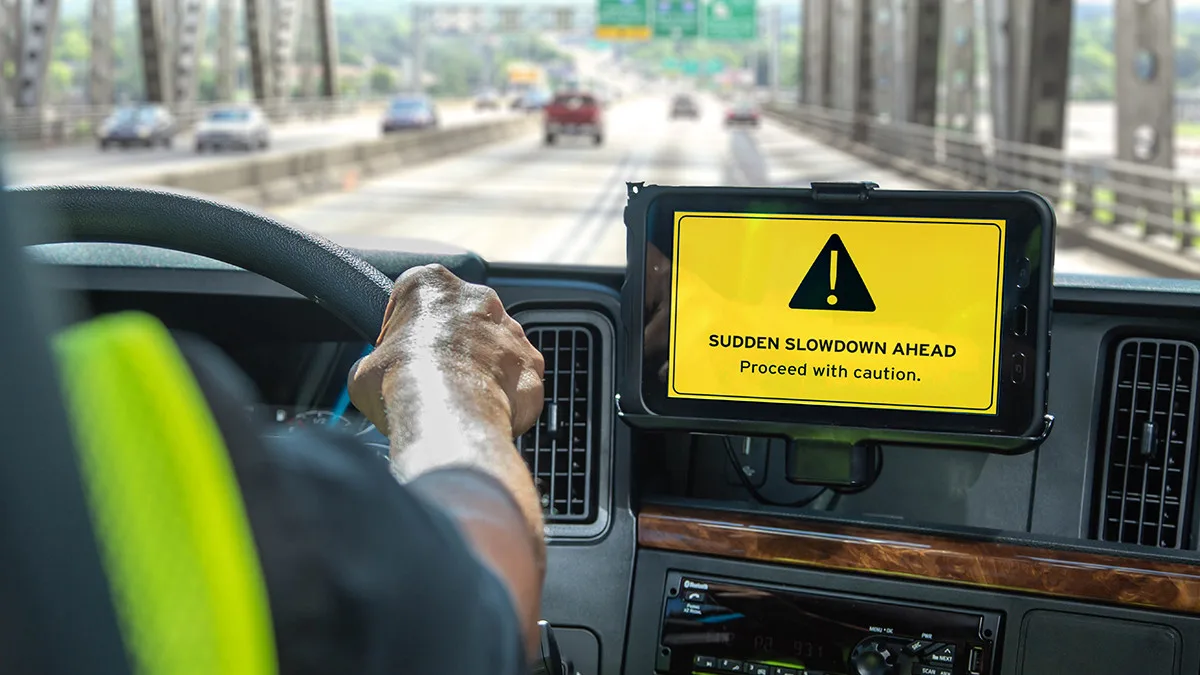
The most striking finding across all three studies is what researchers call “anticipatory braking.” Drivers receiving alerts started slowing down one to three minutes before the hazard was visible, not after.
Within 30 seconds of receiving a Dangerous Slowdown alert, 15% to 26% of drivers had already cut their speed by at least 5 mph. The high end of that range came from drivers already traveling 70 mph or faster, exactly the group with the least margin for error.
That head start matters. A driver who begins decelerating before reaching a queue of stopped traffic controls the stop. A driver who reacts only when traffic appears is reacting to it.
Fewer Hard Stops Means Fewer Claims and Less Wear
For fleet leaders, the hard-braking data is the number to pay attention to. Among drivers who received a Dangerous Slowdown alert and went on to reach the back of a traffic queue, 84% slowed down without a hard-braking event.
Hard braking shows up everywhere a fleet already tracks risk and cost: driver scorecards, CSA-adjacent behavior data, brake wear, cargo shift, and insurance claims. A technology that gets drivers decelerating smoothly instead of stopping short doesn’t just prevent the crash in front of them; it also reduces the wear-and-tear incidents that quietly drive up maintenance and claims costs over a year.
This Isn’t Correlation. Fleetworthy Built a Control Group to Prove It.
Earlier studies could show that alerted drivers slowed down, but not whether they would have slowed down anyway because of the traffic itself. In 2026, Fleetworthy closed that gap.
Using its Black Box behavioral data model, Fleetworthy compared 378,289 drivers who received an alert against 297,720 drivers traveling the exact same corridors, at the exact same time, who did not. Both groups hit the same traffic. Only one got a warning first.
The result: alerted drivers slowed by at least 5 mph about 25% more often than non-alerted drivers and slowed by at least 10 mph about a third more often. That gap held true every week the data was measured, across 16 states. It’s the clearest evidence yet that the alert itself, not the road conditions, is what’s changing driver behavior.
Drivers Aren’t Fighting the Technology
Any fleet that has rolled out a new safety system knows the harder problem is often adoption, not accuracy. Drivers can tune out tools that feel like surveillance or nag them with false alarms.
That doesn’t appear to be happening here. In a survey of 623 truck drivers across Ohio, 89% rated Sudden Slowdown alerts as effective, and 51% called them “very effective.” Trucking companies surveyed separately reported the same thing: fewer at-fault crashes and drivers who saw the alerts as genuinely useful rather than one more thing beeping at them.
It’s Already Available for Free
Every driver in the alerted group above was using Fleetworthy Foundations (formerly Drivewyze Free), the no-cost in-cab alert system built into Fleetworthy’s connected vehicle network. If your fleet already runs Fleetworthy for weigh station bypass or safety and compliance, this isn’t a new purchase or a pilot program. It’s a feature many fleets haven’t turned on yet.
Get the Full Research
The findings above are a fraction of what’s in the full report. The white paper includes the complete methodology behind all three academic studies, the state-by-state control group data, and the economic case that convinced Ohio DOT to expand the program statewide.
Download In-Cab Alerts for Commercial Vehicles
Free, no form required.