The number on the claims report is just the beginning.
Ask most fleet managers what cargo theft costs their operation, and they’ll give you the value of the stolen load. Maybe the deductible. But the real number that eats into margins is much larger.
The direct loss is just the beginning. According to ATRI research, indirect costs such as downtime, redelivery, administrative burden, strained customer relationships, can run 3 to 6 times the value of the stolen cargo itself.
And then there’s insurance. Carriers are reporting cargo premiums climbing 12–18% on high-risk lanes. Some specialty underwriters now require documented GPS beacons, tamper-alert door locks, and active geofencing as conditions for coverage. Fleets that can’t meet those standards face higher deductibles or no coverage at all.
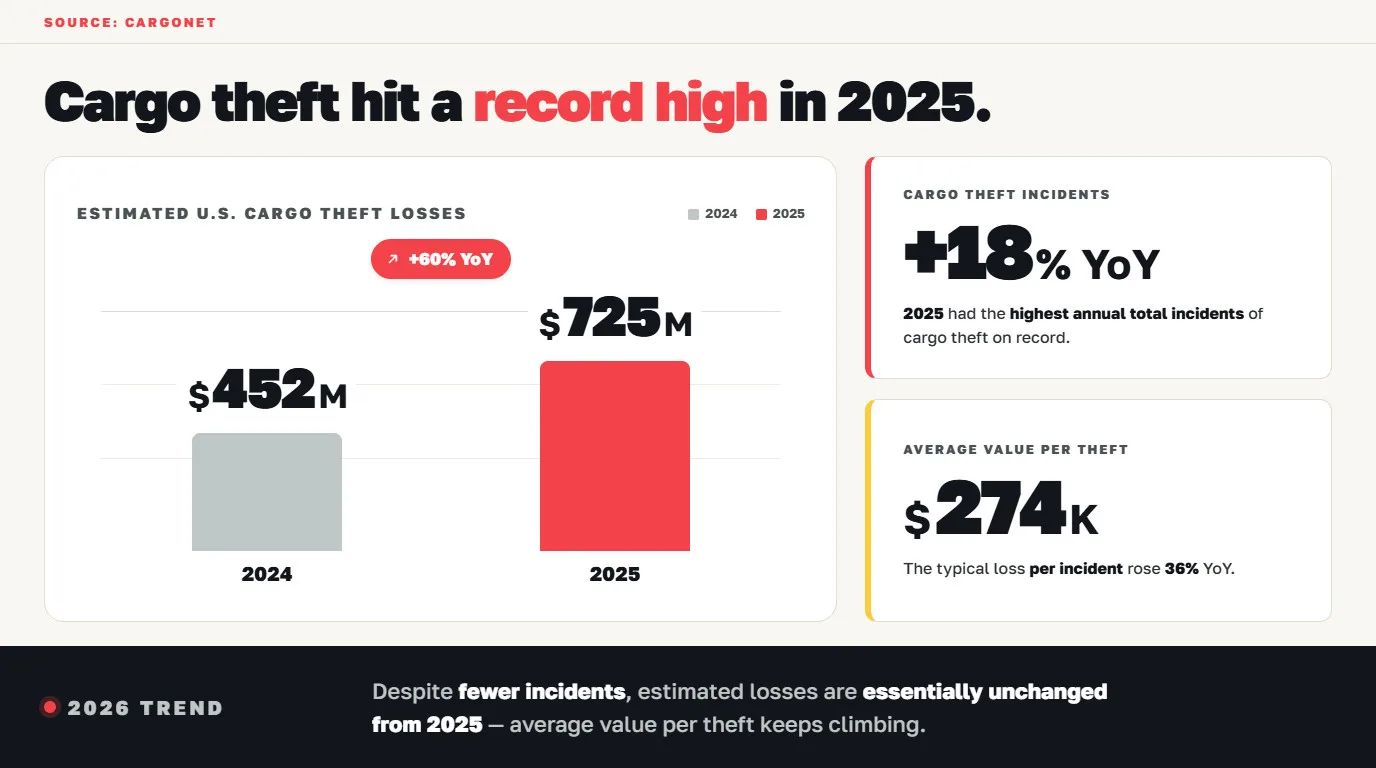
With average theft values up 36% in a single year, each incident carries more financial weight than ever. Here are 4 approaches separating the fleets absorbing the losses from the ones controlling them.
1. Proactive In-Cab Alerts: Prevention Before the Decision Is Made
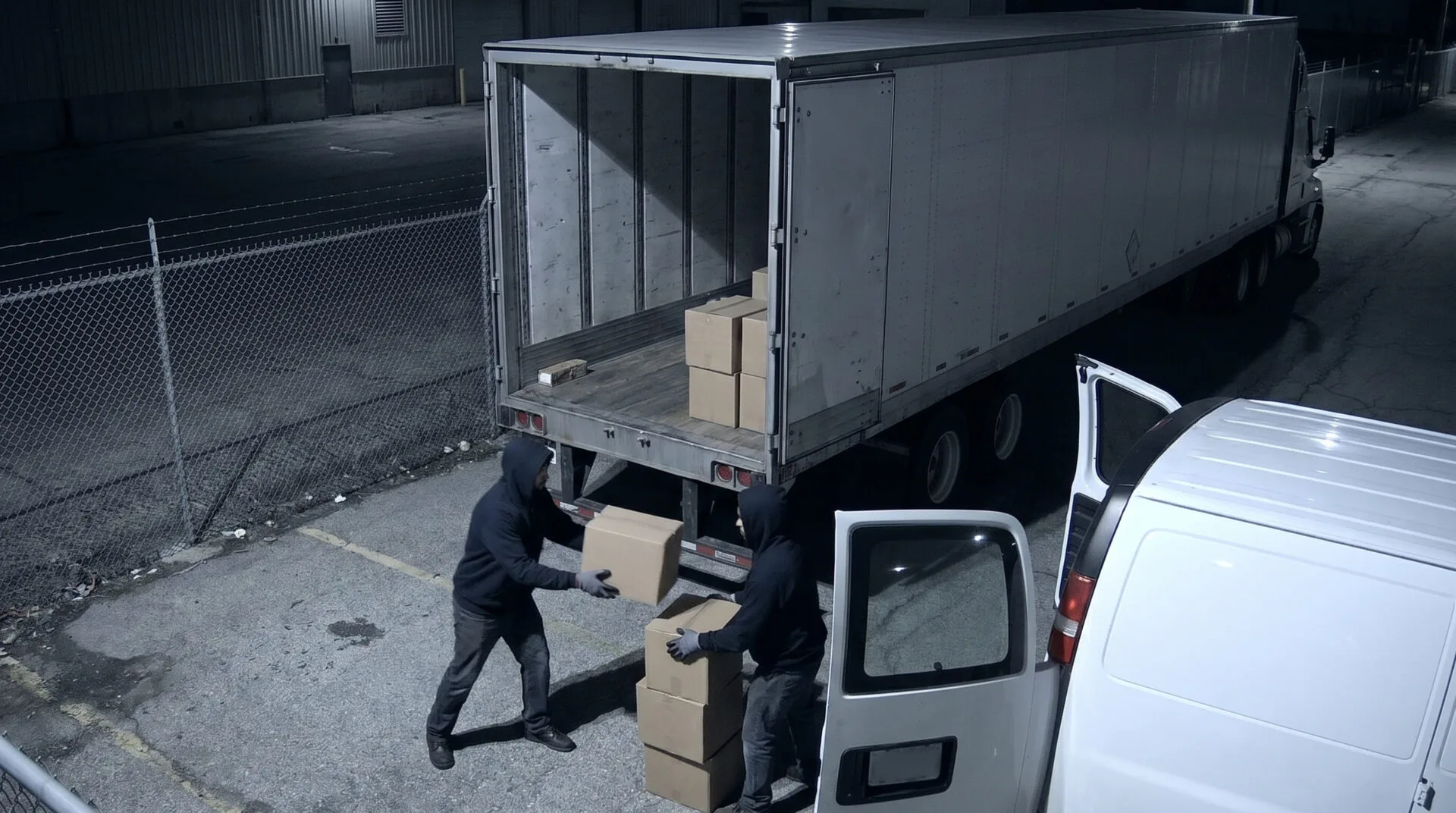
Most cargo theft doesn’t look like a movie heist. It starts with an ordinary decision: a driver pulls into an unsecured lot, parks a loaded trailer overnight at an unfamiliar truck stop, or idles for too long in a high-risk area. The freight doesn’t disappear because of a dramatic moment. It disappears because a small, everyday choice created an opening.
That’s the gap proactive in-cab alerts are designed to close.
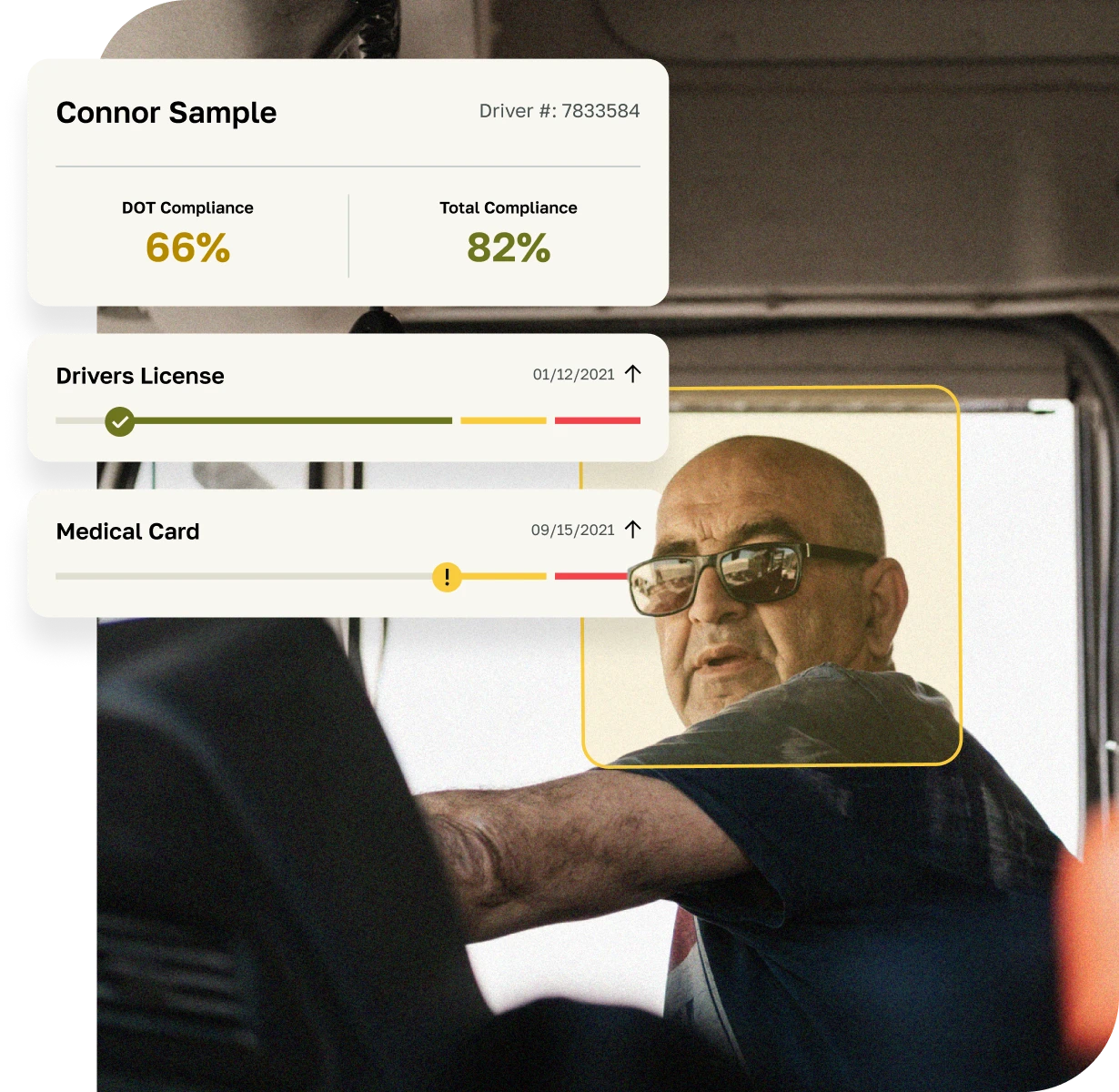
In-cab alert systems use real-time location data, route intelligence, and risk databases to flag high-risk situations before they become incidents. When a driver approaches a known theft hotspot, the alert fires in the cab on the existing ELD, giving the driver time to make a decision to not stop there.
Cargo theft is most common at truck stops, parking lots, distribution centers, and rest areas — all routine stops in a driver’s day.
The advantage over other approaches is timing. Most theft prevention is retrospective — it responds to an incident, processes a claim, and updates a protocol. In-cab alerts operate upstream of all of that. A driver who gets a notification that the lot they’re pulling into has had three theft events in the past 90 days can choose a different stop. That decision takes 30 seconds. The alternative can take weeks and absorb thousands in administrative costs.
For operations, safety, and compliance teams, the compounding value is in documentation. Systems that log driver behavior at risk points create a verifiable trail — useful for insurance negotiations, for demonstrating due diligence during audits, and for building the case for rate adjustments with underwriters who increasingly tie premiums to demonstrable security protocols.
In a market where cargo premiums are rising and self-insured retentions are growing, the ability to show underwriters a pattern of proactive behavior — not just reactive claims — is a material differentiator.
The Real Cost Starts Before the Load Goes Missing
Real-time, in-cab alerts warn drivers about high-risk stops before they become incidents — protecting your freight, your premiums, and your margins.
2. Internal Dispatch & Driver Notification Programs: High Effort, Variable Follow-Through
Some fleets build their own communication-based prevention programs. The model is straightforward:
- Dispatchers monitor routes and identify risk windows
- Drivers are contacted directly when a situation looks concerning
- Drivers report back at regular check-in intervals
- Anything suspicious triggers an escalation chain
It works — up to a point.
The challenge is the one that affects every manual process at scale: consistency. A dispatcher covering 30 drivers across multiple time zones can’t monitor every stop in real time. Check-ins can be missed. A driver who encounters a suspicious situation at 2 AM in a new city may not reach anyone on the first call. The protocol that looks solid in a training document becomes thinner in practice when loads are heavy and staffing is lean.
A thread on r/Truckers makes the point: drivers from different fleets were stopping at locations one carrier had flagged as high-risk and off-limits — not because they ignored a policy, but because they had no way of knowing the risk existed.”
This is the core limitation of manual notification programs: they depend on a chain of human action that can break at any link. A dispatcher who meant to send the alert, a driver who missed the call, a policy that never made it into the onboarding packet for a new hire.
For fleets that have the staffing run these programs with discipline, they can be effective, particularly for high-value loads that warrant dedicated oversight. But as a primary prevention strategy at scale, the operational drag is real. Every manual touchpoint is a cost: dispatcher time, driver interruptions, documentation burden, and the unrecoverable losses when follow-through fails.
Fleets that rely primarily on manual notification often find themselves investigating incidents that began with a known risk — a route, a stop, a timing pattern — that simply wasn’t communicated in time.
Put Risk Intelligence in the Cab, Not Just the Boardroom
Fleetworthy Safety+ delivers location-based alerts directly to your drivers' existing devices — no new hardware, no manual follow-up, no gap between knowing the risk and acting on it.
3. Cargo Recovery Programs: Recovering What’s Already Gone
Some fleets invest in dedicated cargo recovery capabilities — either through internal security teams or third-party firms that specialize in locating and recovering stolen freight. When a theft occurs, these teams activate:
• Coordinating with law enforcement
• Tracking assets in real time
• Pursuing leads through industry intelligence networks
• Attempting to intercept loads before they disappear into secondary markets
Recovery programs have real value. A well-run program can locate stolen freight that would otherwise be written off, reduce the net financial impact of an incident, and provide the documentation trail that supports insurance claims and prosecutions.
The estimated average value of stolen cargo per incident rose to $273,990 in 2025 — up 36% from 2024. Even a partial recovery changes the financial calculus of a claim significantly.
But the structural limitation is timing. Recovery efforts begin after the loss has already occurred. By that point, the downstream costs are already in motion… the redelivery is being arranged, the customer has been notified, the driver is filing a report, and the operations team is reshuffling capacity. The freight may be recovered, but the operational disruption is not.
For fleets running high-value loads or operating in theft-intensive corridors, recovery capability is a prudent component of a broader risk strategy. But it’s a backstop, not a prevention layer. The costs it addresses in time, resources, and customer trust, are already sunk by the time it activates.
Your Dispatchers Can't Be Everywhere. Your Alerts Can.
Automated in-cab alerts reach every driver, on every route, at the moment risk appears — without adding load to your ops team.
4. Law Enforcement Coordination: Slow to Respond, But Capable of Breaking Rings
Cargo theft is one of the hardest crimes to prosecute. Criminal organizations move stolen goods across multiple state lines before agencies can coordinate a response.
The Combating Organized Retail Crime Act (CORCA), passed by the House and awaiting Senate action, is the most significant federal legislative response to cargo theft in years. The bill does three things relevant to fleets:
- Establishes an Organized Retail and Supply Chain Crime Coordination Center within the Department of Homeland Security — staffed by HSI, FBI, CBP, DEA, ATF, and FMCSA — to coordinate federal investigations of transnational cargo theft rings
- Allows federal prosecutors to aggregate theft values over a 12-month period to meet federal jurisdiction thresholds, closing the gap that organized theft rings have exploited by keeping individual incidents below federal radar
- Strengthens money laundering charges against criminal networks that convert stolen cargo into cash, gift cards, and cryptocurrency.
Law enforcement is most effective at dismantling the organized rings responsible for the largest-scale theft operations. A coordinated federal investigation can break an entire criminal network in a way that no individual fleet-level prevention program can. That matters for the industry broadly.
For an individual fleet, law enforcement remains a critical partner, but engagement alone is not a prevention strategy. Response times can be slow, jurisdictional gaps persist, and the freight is rarely recovered intact. Fleets can improve their position by building strong relationships with local law enforcement contacts, maintaining detailed incident documentation, and filing reports to build the incident records that investigations, proactive warnings and recovery depend on. But they should do so as a complement to proactive prevention, not a substitute for it.
Recovery Starts After the Loss. Prevention Starts Before It.
Fleetworthy Safety solutions give drivers real-time awareness of high-risk areas so your fleet can avoid incidents, not just respond to them.
Prevention Is the Margin Fleets Are Missing
Cargo theft costs the trucking industry millions per day — spread across thousands of incidents that individually looked like routine stops gone wrong.
The fleets absorbing the most damage from cargo theft are not the ones usually making reckless decisions. They’re the ones operating without real-time awareness of where their risk is: relying on protocols that activate too late, notifications that don’t reach the right person, or recovery capabilities that engage only after the damage is done.
No single approach eliminates cargo theft. Law enforcement breaks rings, recovery programs close gaps, internal teams build protocols… But the fleets that see the most durable improvement are the ones investing upstream in tools that create awareness before an incident, put relevant risk information in front of the driver when it matters most.
Proactive and reactive programs both have a place in a fleet’s risk strategy. But only one of them has a chance to stop the incident before it begins.
The Fleets Controlling Cargo Theft Aren't Reacting Faster. They're Acting Earlier.
See how real-time, in-cab safety alerts help fleets reduce incidents, protect insurance positioning, and keep freight moving.
SOURCES:
CargoNet 2025 Annual Supply Chain Risk Trends Analysis: https://www.cargonet.com/news-and-events/cargonet-in-the-media/2025-theft-trends/
CargoNet 2026 Q1 Supply Chain Risk Trends Analysis: https://www.cargonet.com/news-and-events/cargonet-in-the-media/2026-q1-theft-trends/
ATRI: The Fight Against Cargo Theft: Insights from the Trucking Industry (October 2025): https://truckingresearch.org/wp-content/uploads/2025/10/ATRI-The-Fight-Against-Cargo-Theft-10-2025.pdf
ATRI: An Analysis of the Operational Costs of Trucking: 2025 Update: https://truckingresearch.org/2025/07/an-analysis-of-the-operational-costs-of-trucking-2025-update/