
Large carriers should evaluate fleet compliance management platforms on seven things: driver qualification file automation, FMCSA Clearinghouse query management, electronic medical certification tracking, unified driver and asset records, CSA safety event monitoring, on-demand audit evidence packaging, and open integrations. A platform that misses any one of these can leave a documented gap an FMCSA investigator can find.
The evaluation problem has changed. Five years ago, a compliance platform was judged on whether it could store documents and send an expiration reminder. In 2026, the regulatory environment moves faster than a filing system can. Medical certification now flows electronically from examiner to state to motor vehicle record, though full rollout is uneven — 13 states still require paper submissions (Overdrive). Clearinghouse status can strip a driver’s commercial privileges within 60 days of a prohibited-status notification. Safety scoring is being restructured around violation groups rather than individual codes. Each of those changes shifts the burden from “did we keep the paperwork?” to “can we prove, continuously, that every driver and every asset is legal to dispatch right now?”
This guide walks through the seven criteria that separate a records archive from a working compliance program, with the specific questions to ask during a demo and the red flags that should end one.
What is a fleet compliance management platform?
A fleet compliance management platform is a centralized system that automates the tracking, verification, and reporting of DOT and FMCSA regulatory requirements across drivers, vehicles, and safety programs, so a carrier stays continuously audit-ready rather than preparing for audits in bursts. Its scope covers driver qualification, hours of service, controlled substance testing, vehicle inspection and maintenance, and safety performance.
This is not the same category as fleet management software. Fleet management software optimizes routing, dispatch, fuel, and utilization. A fleet compliance platform exists to satisfy 49 CFR and to reduce regulatory and legal risk. The two integrate, but they are judged on different outcomes. Confusing them is the most common sourcing error large carriers make, because a telematics vendor with a compliance module will demo well and then fail on driver qualification depth.
The people who touch the platform daily also differ. Safety and compliance managers monitor risk exposure and prepare for audits. Dispatchers confirm a driver is qualified before assignment. HR manages onboarding documentation. Maintenance tracks preventive schedules and inspection reports. A platform that only serves one of those groups will be worked around by the others, and workarounds are where compliance gaps originate.
1. Does it keep driver qualification files continuously audit-ready?
A fleet compliance platform keeps driver qualification files continuously audit-ready by replacing static document storage with an active workflow: structured digital checklists for every required component under 49 CFR Part 391, automated expiration alerts, and a timestamped audit trail on every change. Driver qualification files are the most scrutinized record set in a DOT compliance review, and they carry the largest share of findings.
The required file components are specific: an employment application, a copy of the driver’s motor vehicle record from the licensing authority, a road test certificate or accepted equivalent, an annual MVR pull with documented review, medical certification, and — where applicable — medical variance documentation and National Registry verification of the examiner. Under 49 CFR 391.51, these files must be retained for the duration of employment plus three years. A platform should enforce that schedule automatically rather than relying on a compliance coordinator to remember it.
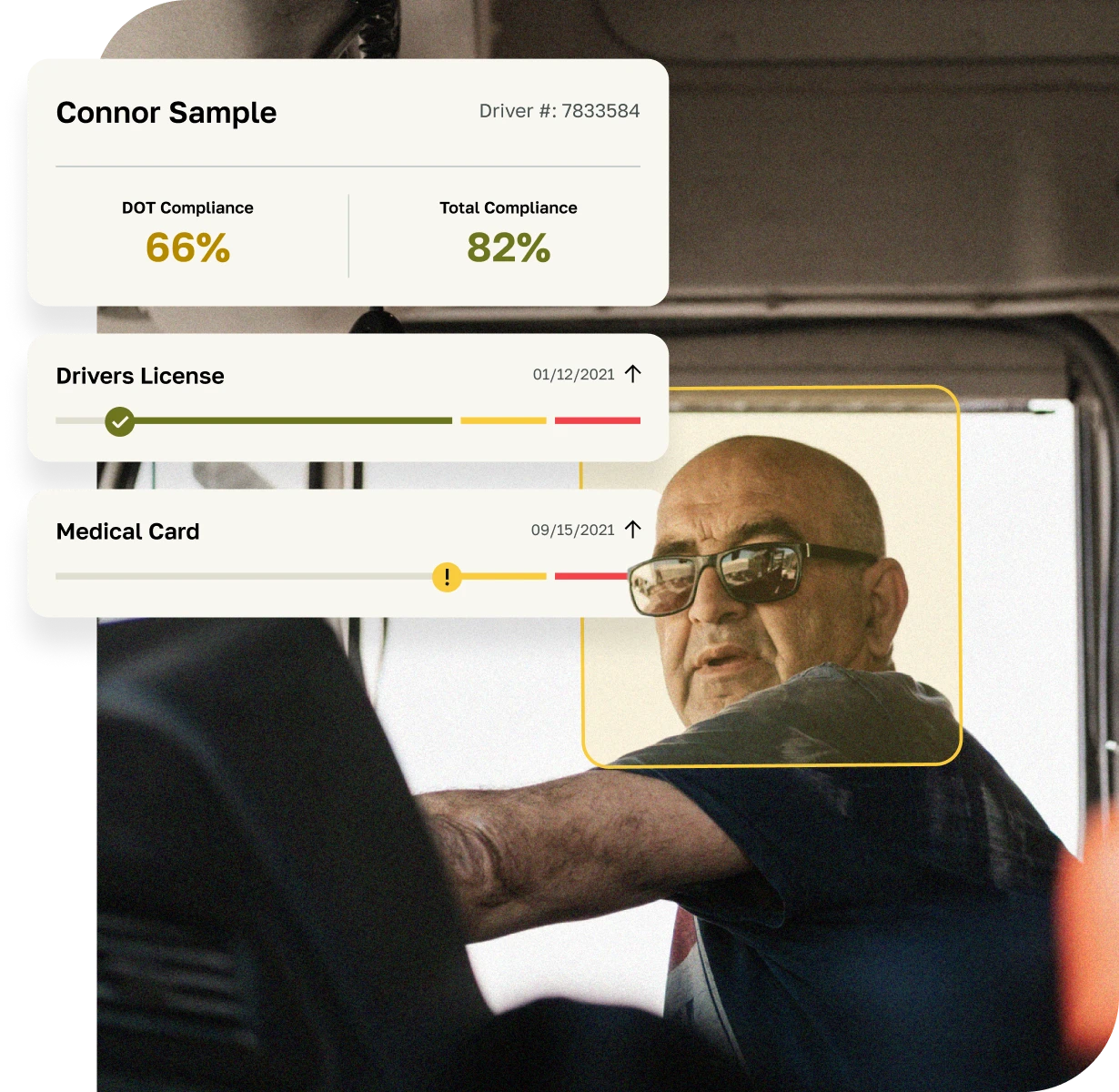
Ask for tiered expiration alerting. Alerts at 90, 60, and 30 days before a CDL, medical certificate, or endorsement expires give safety teams the lead time to act. A single alert at 14 days is not lead time; it is a notification that a problem is already forming. Fleetworthy’s DQ File Management is built around this model, with dashboards that show qualification status across the driver population and flag missing or expiring documents before a driver becomes undispatchable.
Red flag: a platform that stores documents but requires a human to enter the expiration date. Manual date entry is a single point of failure, and it is the failure auditors find most often.
2. Does it manage FMCSA Clearinghouse queries and prohibited-status alerts?
A fleet compliance platform should manage FMCSA Clearinghouse obligations end to end: pre-employment full queries, annual limited queries for every CDL driver, violation reporting, driver consent documentation, and proactive alerting when a driver’s status changes to prohibited. Clearinghouse management is now a licensing issue, not just a testing-program issue, which raises the stakes on getting it automated.
The reason is the second Clearinghouse final rule, commonly called Clearinghouse II. Since November 18, 2024, state driver licensing agencies must remove commercial driving privileges from a CDL or CLP when FMCSA notifies them that a driver holds prohibited status, and states must query the Clearinghouse before issuing, renewing, transferring, or upgrading any CDL or commercial learner’s permit. FMCSA’s own guidance on CDL downgrades confirms the downgrade requirement and the return-to-duty path back to “not prohibited.”
For a large carrier, a discovery lag of even a few weeks on a prohibited-status change is enough to put a driver behind the wheel who is no longer legally qualified.
Ask two questions in the demo. First, does the platform run the annual limited query automatically on a rolling schedule, or does someone have to build a list each January? Second, how quickly does a status change surface to dispatch? Fleetworthy handles required pre-employment and annual queries and violation reporting through its FMCSA Clearinghouse Management and DOT Drug & Alcohol Program Management services, with monitoring designed to catch the gap between a status change and the next scheduled query.
3. Does it verify medical certification through the MVR instead of paper cards?
Fleet compliance platforms must now verify CDL driver medical certification through the CDLIS motor vehicle record, not a scanned paper card, because FMCSA’s Medical Examiner’s Certification Integration rule took effect June 23, 2025 (FMCSA, Medical | Commercial Driver’s License). Certified medical examiners transmit examination results directly to the National Registry by midnight of the next calendar day, FMCSA passes them to the state licensing agency, and the state updates the CDLIS MVR.
The transition had a grace period, and it has closed. FMCSA issued temporary waivers allowing continued reliance on paper medical certificates while states and examiners completed the switch; the final extension ran through April 10, 2026 (FMCSA National Registry, NRII Waiver Through April 10, 2026). Carriers still building driver files around a photocopied medical card are now documenting compliance against a record that is no longer the authoritative source. Fleetworthy’s explainer on the FMCSA medical certification rule covers what changed operationally for safety teams.
What this means for platform evaluation is concrete: the system needs an MVR monitoring capability, not just an MVR upload field. It should pull or receive MVR data on a defined cadence, detect when a driver’s medical certification status changes on the record, and alert before the certification lapses. Ask the vendor directly how their medical certification workflow changed after June 2025. A vendor that has not changed anything has not kept up.
4. Does it unify driver, asset, and roadside data in one record?
A connected fleet readiness platform unifies driver records, asset records, and roadside activity in one authoritative data set, so a fleet updates a vehicle or driver once and every downstream product reflects the change. Fragmentation is the underlying cause of most compliance data errors at large carriers: the same truck exists in a compliance system, a toll account, a bypass service, and a maintenance system, with four slightly different records.
Fleetworthy addressed this directly in its 2026 platform release, adding a unified cross-platform login across safety and compliance, toll management, and weigh station bypass products, plus Centralized Vehicle Management (CVM) as a single authoritative source for vehicle data that synchronizes automatically across products. The same release introduced FleetworthyGO, a mobile app giving drivers and managers access to roadside inspection workflows and bypass alerts from the cab.
The compliance benefit of unification is specific rather than abstract. When a vehicle’s registration renews, a unified record means the toll account, the bypass profile, and the compliance file all reflect the new expiration without three separate data entry tasks. When a driver is added, their bypass eligibility and their qualification file originate from the same record. Every place those systems are separate is a place where a stale record can put a non-compliant asset on the road.
Ask to see the same vehicle in three different modules during the demo. If the vendor has to switch accounts or explain a nightly sync, the records are not actually unified.
5. Does it monitor CSA safety performance and close the loop on corrective actions?
A fleet compliance platform should ingest roadside inspection results, violations, and crash data automatically, surface trends by compliance category and terminal, and track corrective actions from assignment through documented closure. Monitoring a CSA percentile is not enough; investigators look for evidence that a carrier acts on what the data shows.
This matters more under FMCSA’s revised Safety Measurement System. In its November 2024 Federal Register notice, FMCSA described reorganizing 959 roadside violations into 116 violation groups of similar safety behaviors, reorganizing the Vehicle Maintenance and Unsafe Driving categories, and noted that the crash rate for carriers prioritized under the new methodology is 10% higher than under the current one. Grouping violations makes patterns easier for FMCSA to see — which means a recurring brake violation at one terminal is harder for a carrier to lose in the noise. As of August 2026, FMCSA has not implemented the revised methodology — the agency is still reviewing public comments in what it calls Phase 2 of a three-phase rollout, and carriers should continue using the current SMS site for official scores (FMCSA, CSA Prioritization Preview).
In evaluation, look for root-cause tagging on individual violations, the ability to assign targeted coaching or training from inside the violation record, and a closure record showing what was required, who owned it, what was done, and when. Trend analysis by category and operating location is what turns individual incidents into a program. Fleetworthy’s CPSuite reporting includes SmartTiles for asset activity, maintenance and inspection compliance at both the asset and entity level, and weekly task completion trends, giving safety leaders a view of which terminals and regions need support.
6. Can it package audit evidence on demand?
A fleet compliance platform should compile and export the complete evidence set for a specific driver, vehicle, or date range on request, reducing audit preparation from days of manual file gathering to hours. Every other capability in a compliance platform exists to produce this moment: an investigator asks for records, and the carrier delivers them organized and complete.
During a compliance review, investigators typically request driver qualification files for a sample of drivers, ELD data and supporting documents for a defined window, vehicle maintenance and annual inspection records, proof of insurance, and full drug and alcohol program documentation including Clearinghouse query records. They will also review written safety policies and corrective action records tied to prior violations. For a remote audit, carriers can have as little as 48 hours to upload requested files — not enough time to reconstruct a paper trail.
Two capabilities separate real audit readiness from a document search function. The first is one-click evidence packaging that assembles a driver’s or asset’s full record in an accepted export format with secure sharing controls. The second is an internal audit checklist aligned to DOT program areas, so safety managers can run a mock review and find the gaps before an investigator does. Fleetworthy’s guide to fleet compliance software features walks through what each module should produce as audit evidence.
7. Does it integrate with the systems the fleet already runs?
A fleet compliance platform should expose documented APIs that let compliance data move into the HRIS, TMS, maintenance, and business intelligence systems a carrier already operates, rather than requiring staff to rekey the same driver and asset records in multiple places. For large carrier fleet software, integration depth is usually the difference between a platform that gets adopted and one that gets abandoned.
Fleetworthy launched Compliance Open APIs on January 7, 2026, providing programmatic access to CPSuite compliance data across safety, asset, and driver workflows. The endpoint set includes Report Management APIs for retrieving compliance data, Asset APIs for syncing vehicle and trailer information, and People APIs for driver records and qualification data. As David Long, Fleetworthy Vice President of Product, put it in the launch announcement: “Enterprise fleets need compliance data to move freely across systems, not live in silos.”
Evaluate integrations on three points: whether the API documentation is public, whether ELD ingestion is native or requires a middleware layer, and whether the vendor can name customers running the specific HRIS or TMS the fleet uses. A roadmap commitment is not an integration. Fleetworthy publishes an overview of its telematics, HR, and maintenance integrations for teams scoping this in advance.
Fleet compliance platform evaluation checklist
| # | Criterion | Ask in the demo | Red flag |
|---|---|---|---|
| 1 | DQ file automation | Show tiered expiration alerts at 90/60/30 days and the audit trail on a file | Expiration dates entered by hand |
| 2 | Clearinghouse management | How annual limited queries are scheduled and how fast prohibited status reaches dispatch | Query lists built manually each year |
| 3 | MVR-based medical certification | What changed in the medical certification workflow after June 23, 2025 | Workflow still built on scanned paper cards |
| 4 | Unified driver and asset records | Show the same vehicle in three modules from one login | Separate logins or a nightly sync |
| 5 | CSA monitoring and corrective actions | Trace one roadside violation through root cause, coaching, and documented closure | Scores displayed with no corrective action workflow |
| 6 | Audit evidence packaging | Export a full driver evidence packet live, on the call | Export is a per-document download |
| 7 | Open integrations | Public API docs and named customers on your HRIS or TMS | Integration described as roadmap |
FMCSA record retention requirements a platform should enforce
Retention schedules are a fast way to test whether a platform understands DOT compliance. A capable system enforces these periods automatically, alerting administrators as records approach their limit and archiving or purging them according to the carrier’s documented policy.
| Record type | Retention period | Regulatory reference |
|---|---|---|
| Driver qualification files (active drivers) | Employment duration plus 3 years | 49 CFR 391.51 |
| Hours of service / ELD logs | 6 months | 49 CFR 395.8(k) |
| Drug and alcohol test results (positive) | 5 years | 49 CFR 382.401 |
| Drug and alcohol test results (negative) | 1 year | 49 CFR 382.401 |
| Clearinghouse query records | 3 years | 49 CFR 382.701(e) |
| Vehicle inspection records (annual) | 14 months | 49 CFR 396.21 |
| DVIR records | 3 months | 49 CFR 396.11 |
| Accident register | 3 years | 49 CFR 390.15 |
How Fleetworthy approaches connected fleet compliance for large carriers
Fleetworthy builds fleet readiness as a connected system rather than a set of separate tools, uniting safety and compliance, toll management, and weigh station bypass under one platform. We are trusted by 90% of the top fleets in North America and offer the industry’s most adopted toll management solution and largest weigh station bypass network.
On the compliance side, Fleetworthy is a fully managed service — driver qualification files, drug and alcohol program management, Clearinghouse management, HOS/ELD monitoring, licensing and fuel tax support, and audit readiness all run through Fleetworthy’s compliance staff rather than requiring an in-house build.
The connective tissue is what maps to the seven criteria above: Compliance Open APIs moving data into HRIS, TMS, maintenance, and BI systems; Centralized Vehicle Management as one authoritative vehicle record across products; unified cross-platform login; and Drivewyze Safety+ alerts, including Stopped Vehicle Management, which notifies dispatch when a vehicle has been stationary at least 10 minutes within 10 meters of a highway while surrounding traffic is still moving. Fleetworthy’s Smart Roadways program now partners with 24 states to deliver in-cab safety alerts. In addition, Fleetworthy’s Safety+ slowdown alerts get 22% of truck drivers to reduce speed by 5 mph or more, which can lead to lower crash risk.