Driver Qualification File Management
Simplify one of fleet compliance’s most complex requirements by centralizing records, tracking expirations, and keeping every driver audit-ready.
Learn More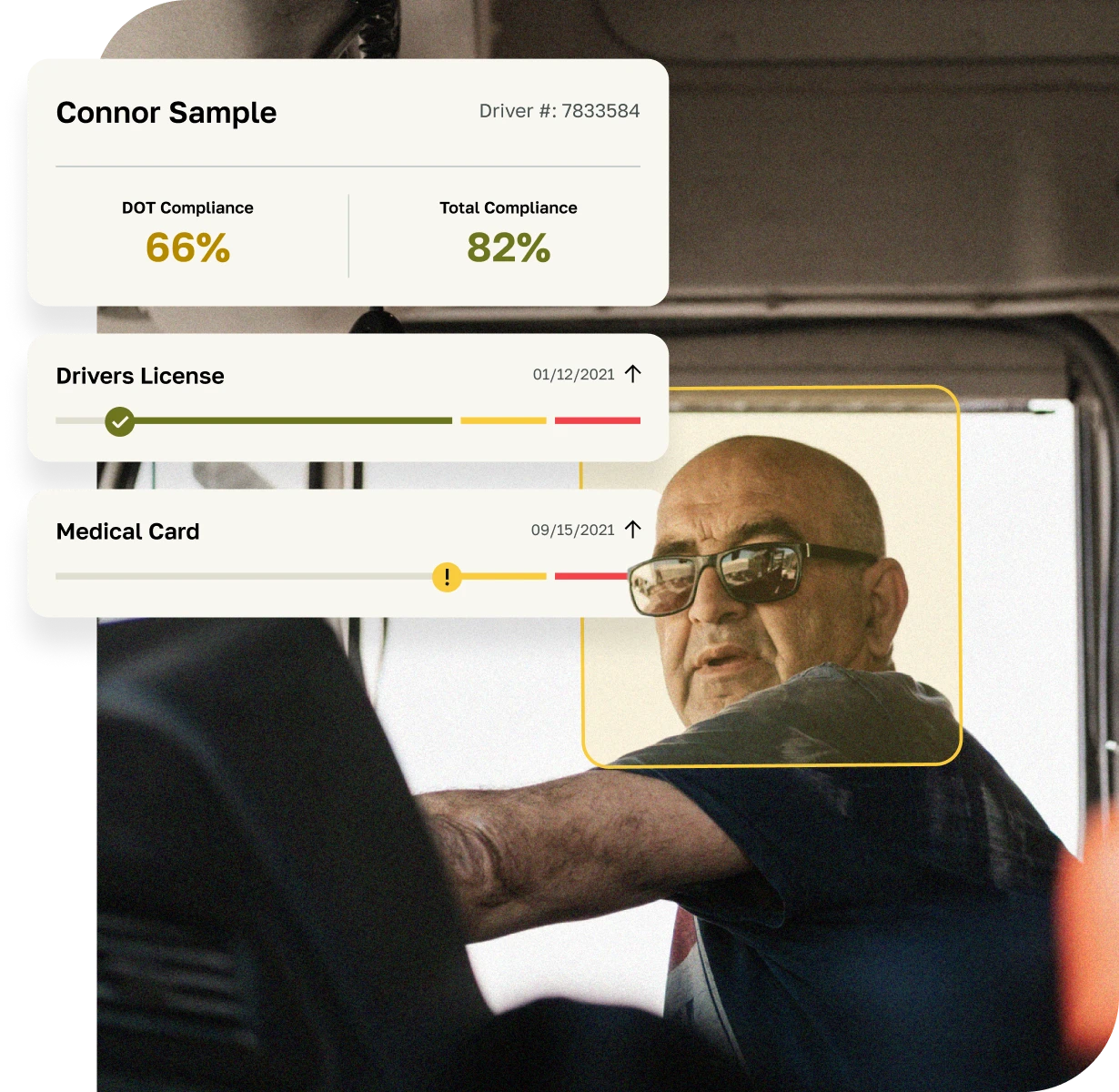
Driver Qualification File Management
Simplify one of fleet compliance’s most complex requirements by centralizing records, tracking expirations, and keeping every driver audit-ready.
Learn More
Staying DOT compliant with a fleet means consistently meeting all safety, operational, and documentation standards required by the U.S. Department of Transportation (DOT) and the Federal Motor Carrier Safety Administration (FMCSA).
To remain compliant, fleets must:
Maintain complete Driver Qualification Files (DQFs) with valid CDLs, medical exams, and background checks.
Ensure vehicles undergo regular DOT inspections and preventive maintenance.
Use FMCSA-approved Electronic Logging Devices (ELDs) to track Hours of Service (HOS).
Conduct drug and alcohol testing as required by FMCSA Part 382.
Keep accurate records for audits, including logs, inspections, and testing results.
Provide driver safety training and enforce company compliance policies.
Many fleets use compliance software and consulting services to automate documentation, track deadlines, and prepare for audits.
In short, staying DOT compliant is about maintaining accurate records, monitoring safety, and proactively managing both drivers and vehicles to prevent violations.
Staying compliant with the Department of Transportation (DOT) is an ongoing process, not a one-time task. For fleet operators, DOT compliance ensures legal operation, safety, and audit readiness under the oversight of the Federal Motor Carrier Safety Administration (FMCSA).
Below are the key areas every fleet must manage to remain compliant and avoid costly violations.
DOT regulations require carriers to maintain accurate Driver Qualification Files for each driver. These files must include:
A copy of the driver’s valid Commercial Driver’s License (CDL).
A current Medical Examiner’s Certificate (DOT physical).
Employment applications, background checks, and MVRs.
Records of drug and alcohol testing results.
Annual driver performance reviews.
Keeping DQFs current is essential during DOT audits or roadside inspections.
Vehicle compliance is one of the biggest components of DOT compliance.
Schedule preventive maintenance and retain inspection records.
Perform pre-trip and post-trip inspections daily.
Keep proof of annual DOT inspections in the vehicle.
Document repairs and ensure all defects are corrected before vehicles return to service.
Failing to maintain proper records can lead to out-of-service violations during roadside checks.
The FMCSA mandates the use of Electronic Logging Devices (ELDs) to record driver hours automatically. To stay compliant:
Use only FMCSA-certified ELDs.
Train drivers on proper log entry, certification, and annotation.
Review logs regularly to catch errors or violations early.
Retain HOS data for at least six months.
Proper ELD use not only ensures compliance but also prevents fatigue-related accidents.
DOT compliance includes a strict drug and alcohol testing program per FMCSA Part 382. Fleets must:
Conduct pre-employment, random, post-accident, and return-to-duty testing.
Enroll in the FMCSA Drug & Alcohol Clearinghouse and report all test results.
Maintain testing records and training documentation for compliance verification.
Failure to comply with testing requirements is one of the most common and costly DOT violations.
Ongoing driver education ensures that everyone understands compliance responsibilities.
Train on Hours of Service (HOS) rules, inspections, and defensive driving.
Refresh training after violations or accidents.
Include policy acknowledgment and documentation for audits.
Strong training programs reduce incidents and improve your fleet’s CSA (Compliance, Safety, Accountability) score.
DOT and FMCSA auditors require complete, organized records to verify compliance.
Store all compliance documents digitally when possible.
Use cloud-based compliance software for easy access.
Maintain retention timelines (e.g., six months for HOS logs, three years for DQFs).
During audits, well-organized documentation is often the difference between a passing and failing review.
Your CSA score reflects your fleet’s safety and compliance performance.
Regularly check your score in the FMCSA portal.
Investigate violations and take corrective action quickly.
Focus on reducing repeat issues like inspection failures or HOS violations.
Consistent score monitoring helps fleets identify risk patterns before they trigger interventions.
Modern compliance management software automates many of these tasks by:
Tracking driver credentials and vehicle inspections.
Sending alerts for upcoming expirations.
Integrating with telematics and ELD data.
Generating audit-ready reports.
This technology reduces administrative burden and ensures continuous compliance.
Simulate DOT or FMCSA audits regularly to test your readiness.
Review all DQFs, inspection logs, and training documentation.
Correct any missing or outdated files before real inspections occur.
Partner with compliance consultants for expert oversight and best practices.
Proactive audits prevent surprises during official reviews.
Staying DOT compliant with a fleet is a continuous process that requires attention to detail, documentation discipline, and ongoing training. By managing driver files, vehicle maintenance, ELD use, and testing programs through structured systems and automation tools, fleets can operate safely, efficiently, and legally.
DOT compliance isn’t just about passing inspections, it’s about building a culture of accountability and safety that keeps your fleet running smoothly and your drivers protected.