Driver Qualification File Management
Simplify one of fleet compliance’s most complex requirements by centralizing records, tracking expirations, and keeping every driver audit-ready.
Learn More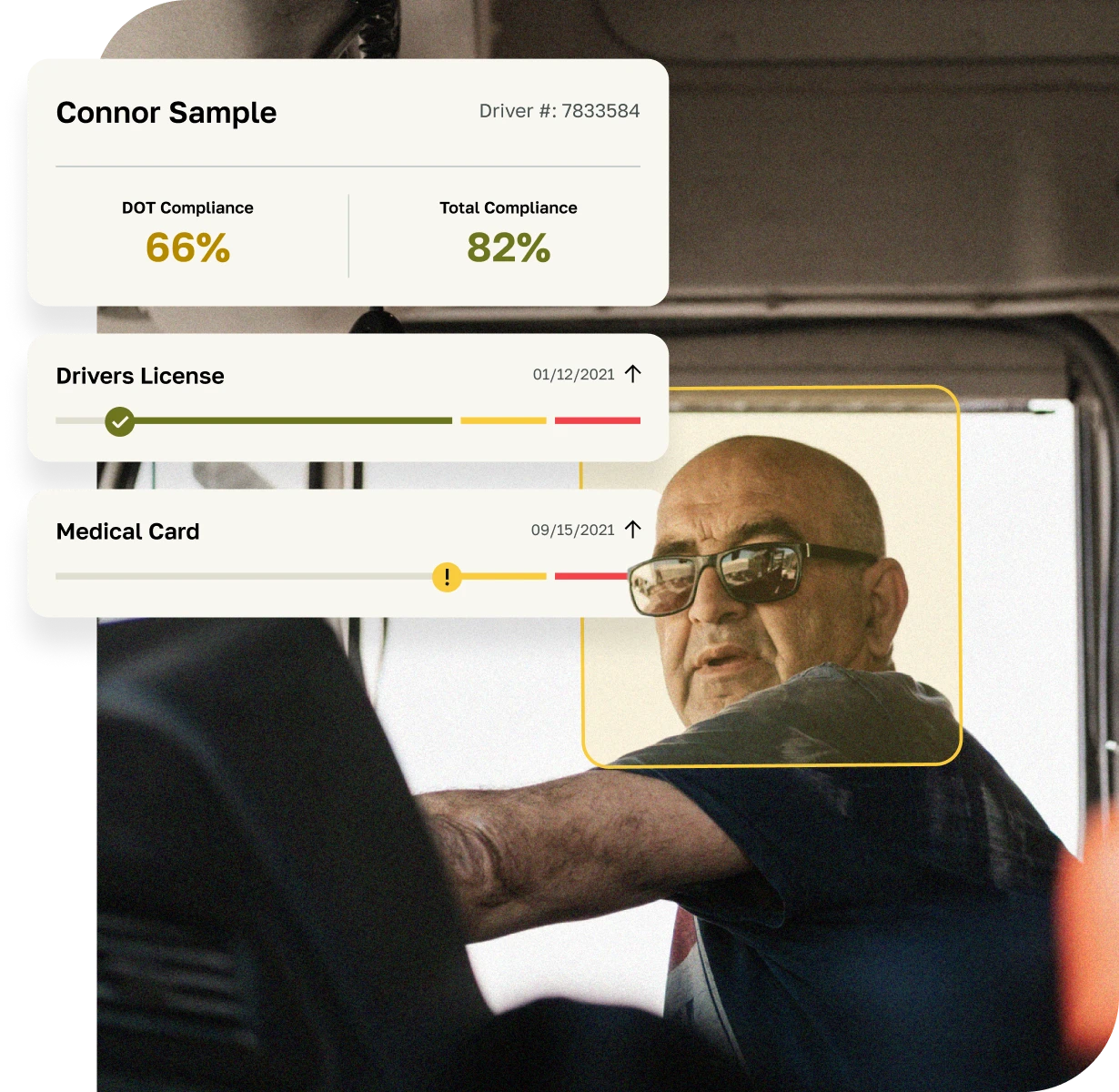
Driver Qualification File Management
Simplify one of fleet compliance’s most complex requirements by centralizing records, tracking expirations, and keeping every driver audit-ready.
Learn More
Construction fleet compliance ensures that all vehicles, equipment, and drivers in a construction operation meet federal, state, and local transportation regulations. It combines DOT and FMCSA compliance with job site safety and equipment management standards.
Key areas of construction fleet compliance include:
Driver Qualification Files: Verifying CDL licenses, medical certificates, and background checks.
Vehicle Maintenance and Inspections: Keeping heavy trucks and equipment in safe working condition.
Hours of Service: Monitoring drive time for CDL operators under FMCSA rules.
Drug and Alcohol Testing: Ensuring safety-sensitive employees meet federal testing requirements.
Equipment Documentation: Maintaining inspection logs, maintenance records, and safety checklists.
Staying compliant prevents costly fines, job-site shutdowns, and safety incidents. Many construction fleets now use compliance software and telematics to automate documentation, track inspections, and ensure full audit readiness.
In the construction industry, fleet compliance extends beyond transportation, it’s about keeping every truck, trailer, and piece of heavy equipment operating safely and within the law.
Construction fleet compliance combines federal DOT/FMSCA requirements with industry-specific standards for equipment safety, driver management, and job site accountability.
Construction fleets often operate in complex environments, mixing on-road and off-road activity. Non-compliance can lead to:
DOT fines and out-of-service orders.
OSHA penalties for unsafe vehicles or untrained operators.
Project delays or contract termination due to audit failures.
A structured compliance program ensures legal operation, worker safety, and project efficiency.
Construction fleets operating commercial motor vehicles must comply with FMCSA Part 391 requirements. Each driver must have:
A valid Commercial Driver’s License if driving vehicles over 26,001 lbs.
A current DOT medical certificate.
A complete Driver Qualification File with employment history, background checks, and annual MVR reviews.
Tip: Even short-haul or intrastate drivers may need DQFs depending on state laws.
Construction vehicles and heavy equipment must be inspected and maintained per DOT and OSHA requirements.
Perform daily pre-trip and post-trip inspections.
Follow manufacturer-recommended preventive maintenance schedules.
Maintain repair records and inspection documentation for each vehicle and piece of equipment.
Include OSHA-required equipment safety checks for cranes, lifts, and loaders.
Benefit: Prevents breakdowns and ensures compliance during job-site or roadside inspections.
Drivers who transport materials or equipment over public roads must follow FMCSA HOS rules.
Use FMCSA-approved ELDs to track hours.
Maintain 6-month records of HOS logs.
Train drivers on log entries and data certification.
Note: Short-haul exemptions may apply to local construction fleets, but proper documentation is still required.
Per FMCSA Part 382, fleets with CDL drivers must maintain a compliant testing program, including:
Pre-employment, random, post-accident, and return-to-duty testing.
Secure record retention and documentation of results.
Registration with the FMCSA Drug & Alcohol Clearinghouse.
Failure to comply can result in large fines or suspended operating authority.
Beyond FMCSA vehicles, construction companies must track compliance for non-DOT-regulated assets such as:
Skid steers, backhoes, loaders, and cranes.
Fuel, service, or utility trucks used off-road.
Best practices:
Keep inspection checklists for all powered equipment.
Maintain proof of operator certifications.
Use telematics to monitor location, usage hours, and maintenance intervals.
Compliance isn’t just about records, it’s about culture.
Train operators on both DOT and OSHA safety rules.
Hold regular toolbox talks covering inspections and accident prevention.
Document all training and certifications for audit readiness.
Tip: Use digital learning management systems to track completion and update records automatically.
Construction fleets increasingly use compliance management software and telematics to automate oversight.
Key features include:
Digital storage for DQFs, inspection reports, and maintenance records.
Real-time alerts for expiring licenses, inspections, or certificates.
Automated reminders for preventive maintenance.
Integration with ELDs and equipment telematics for unified visibility.
Result: Reduced paperwork, fewer violations, and complete audit readiness.
Mixed fleets with both DOT-regulated trucks and off-road machinery.
Manual documentation that leads to lost records.
Irregular maintenance across multiple job sites.
Lack of standardized training for drivers and operators.
Confusion over short-haul or intrastate exemptions.
Solution: Centralize compliance management in one digital platform and standardize processes fleet-wide.
Reduced Fines and Violations: Prevents costly penalties during DOT or OSHA inspections.
Improved Safety: Keeps workers and job sites protected.
Increased Uptime: Well-maintained vehicles and equipment mean fewer breakdowns.
Better Project Reputation: Demonstrates professionalism to clients and general contractors.
Audit Readiness: Organized documentation simplifies state and federal reviews.
Construction fleet compliance ensures that every truck, driver, and machine operates safely and legally, both on the road and on the job site.
By combining FMCSA, DOT, and OSHA requirements with modern compliance technology, construction companies can reduce risk, maintain audit readiness, and keep projects running on schedule.
Compliance isn’t just about checking boxes, it’s about building safer, smarter, and more efficient construction operations.