Driver Qualification File Management
Simplify one of fleet compliance’s most complex requirements by centralizing records, tracking expirations, and keeping every driver audit-ready.
Learn More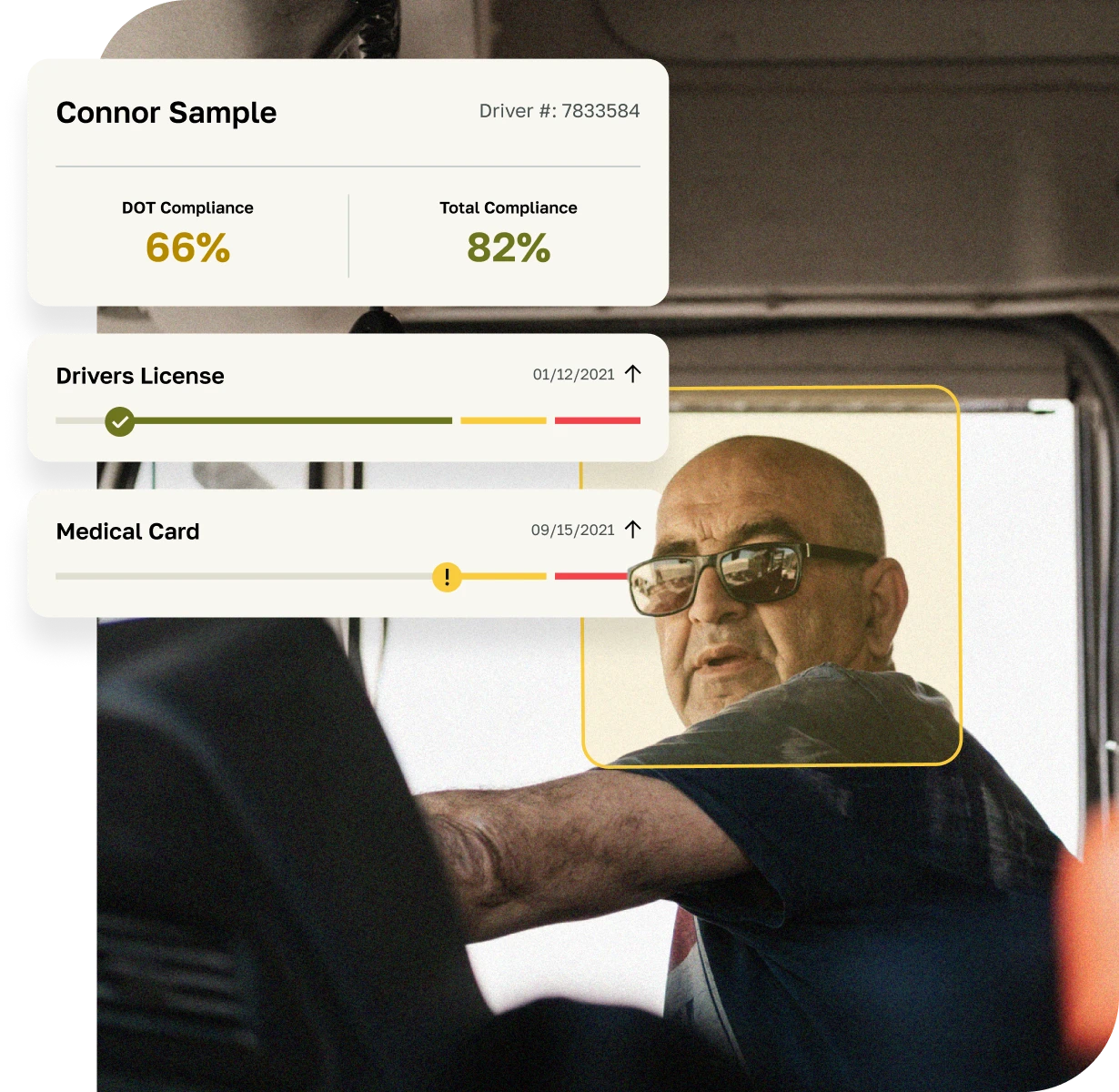
Driver Qualification File Management
Simplify one of fleet compliance’s most complex requirements by centralizing records, tracking expirations, and keeping every driver audit-ready.
Learn More
DOT fleet compliance refers to following all regulations established by the U.S. Department of Transportation and the Federal Motor Carrier Safety Administration to ensure safe, legal, and efficient fleet operations.
A compliant fleet meets federal standards for driver qualifications, vehicle maintenance, Hours of Service, electronic logging device use, and drug and alcohol testing. DOT compliance also requires accurate record-keeping and documentation to prove that all requirements are met during inspections or audits.
Key components of DOT fleet compliance include:
Maintaining up-to-date Driver Qualification Files.
Conducting vehicle inspections and preventive maintenance.
Tracking HOS data with FMCSA-approved ELDs.
Running a compliant drug and alcohol testing program.
Keeping all records accessible for audits.
Staying DOT compliant helps fleets avoid costly fines, reduce accidents, improve safety scores, and protect operating authority.
DOT fleet compliance ensures that transportation companies follow federal regulations governing the operation of commercial vehicles. These standards are enforced by the Federal Motor Carrier Safety Administration under the U.S. Department of Transportation.
Compliance is more than a legal requirement, it’s a safety and operational necessity that protects drivers, assets, and the public.
DOT fleet compliance refers to the ongoing management of all regulatory requirements that apply to commercial motor vehicles. These regulations cover:
Driver qualification and licensing
Vehicle maintenance and inspections
Hours of Service
Electronic Logging Device use
Drug and alcohol testing programs
Recordkeeping and reporting standards
Failure to comply with DOT regulations can result in fines, out-of-service orders, and even suspension of operating authority.
Every driver must have a complete Driver Qualification File that includes:
A valid Commercial Driver’s License with required endorsements.
Current Medical Examiner’s Certificate.
Pre-employment screening and MVRs.
Annual MVR reviews and background checks.
Signed policy acknowledgments and safety training records.
Tip: Use compliance software to track expirations and store all driver documents digitally.
Drivers must comply with FMCSA’s HOS regulations, which limit driving and on-duty hours.
Use FMCSA-approved Electronic Logging Devices to record driving time automatically.
Retain ELD records for at least six months.
Regularly review logs for violations or falsifications.
Benefit: Reduces fatigue-related accidents and ensures accurate, auditable records.
Fleets must maintain all vehicles in safe working order and document all inspections and repairs.
Perform daily Driver Vehicle Inspection Reports.
Conduct annual DOT inspections.
Keep preventive maintenance schedules and repair logs.
Tip: Record all inspections electronically for easy retrieval during audits.
FMCSA Part 382 requires carriers to implement a comprehensive testing program.
Conduct pre-employment, random, post-accident, and return-to-duty tests.
Maintain secure test result records.
Register and report violations through the FMCSA Drug & Alcohol Clearinghouse.
Failure to comply with testing rules is one of the most common DOT audit violations.
Carriers must report all DOT-recordable accidents and retain documentation for at least three years.
Records should include:
Police reports
Corrective action logs
Driver retraining documentation
Auditors use this information to verify a carrier’s safety management controls.
DOT and FMCSA require specific retention timelines for compliance records.
DQFs: 3 years after driver leaves employment.
HOS logs: 6 months minimum.
Maintenance records: 12 months after vehicle leaves service.
Tip: Store all compliance data in a centralized digital system to stay audit-ready.
Safety: Compliance reduces the risk of accidents and injuries.
Legal Protection: Ensures your company can defend itself during audits or claims.
Operational Efficiency: Structured compliance programs streamline management and reduce downtime.
Financial Impact: Avoids fines, improves CSA scores, and can lower insurance premiums.
Reputation: Demonstrates professionalism and reliability to clients and regulators.
Missing or incomplete driver qualification files.
Expired medical certificates or CDLs.
Failure to maintain ELD or HOS logs.
Incomplete maintenance records.
Drug and alcohol testing lapses.
Poor record retention practices.
Solution: Regular internal audits and automated compliance alerts can eliminate most of these issues before official reviews.
Centralize Documentation: Use cloud-based compliance software.
Automate Alerts: Set notifications for expiring licenses, inspections, and certificates.
Train Continuously: Keep drivers updated on regulatory changes.
Conduct Mock Audits: Identify and fix compliance gaps early.
Integrate Telematics: Combine real-time vehicle data with compliance reporting for accuracy.
Modern compliance integrate telematics, ELD data, and document management to:
Track compliance metrics automatically.
Generate audit-ready reports instantly.
Reduce manual errors and paperwork.
Automation allows fleets to maintain compliance continuously, not just before an audit.
DOT fleet compliance is essential for safe, legal, and efficient fleet operations. By managing driver qualifications, vehicle maintenance, and safety reporting through organized systems and technology, fleets can minimize risk and stay ahead of regulatory changes.
Compliance is more than meeting the bare minimum, it’s about building a culture of safety and accountability that protects your drivers, your reputation, and your bottom line.