Driver Qualification File Management
Simplify one of fleet compliance’s most complex requirements by centralizing records, tracking expirations, and keeping every driver audit-ready.
Learn More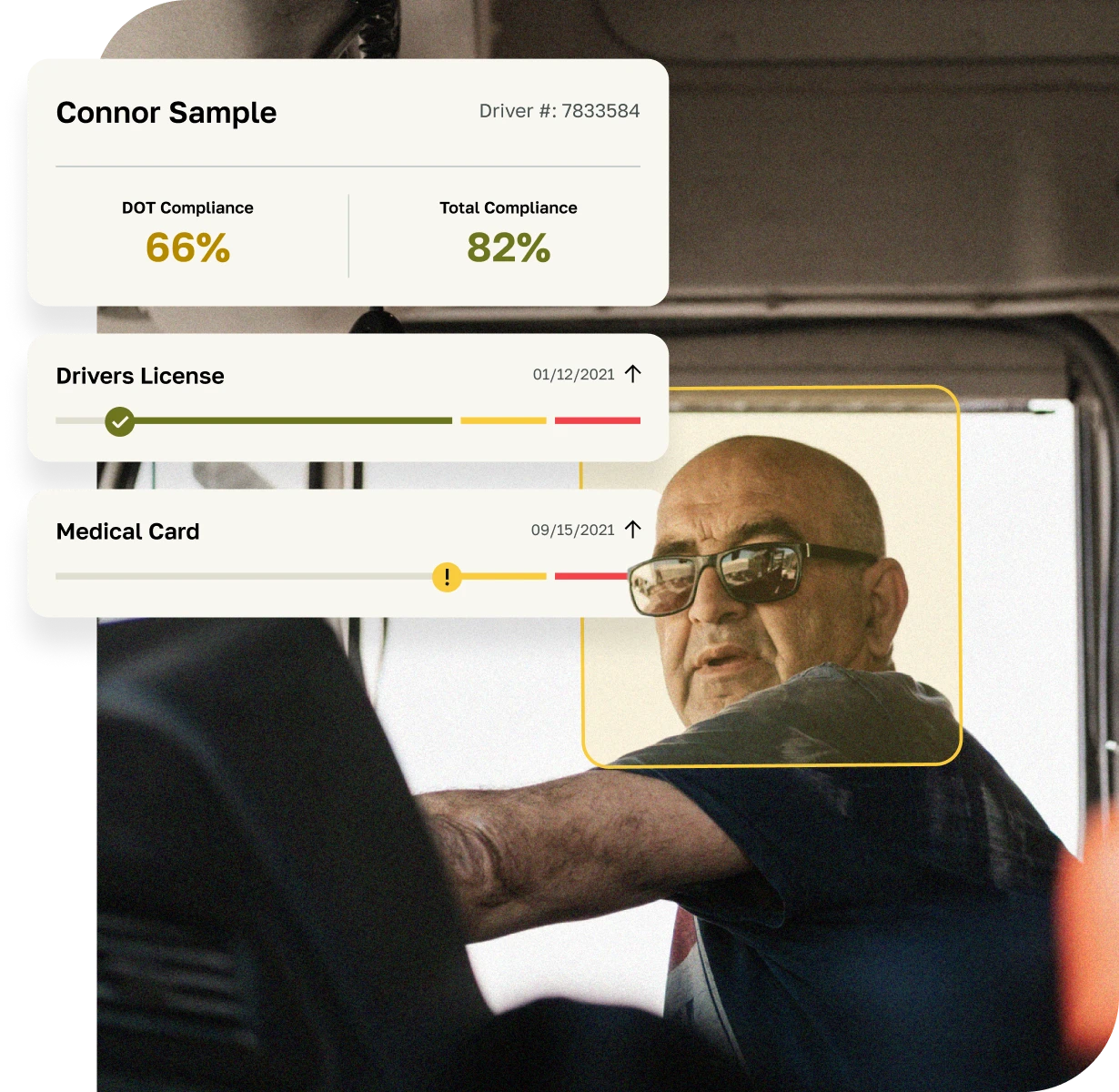
Driver Qualification File Management
Simplify one of fleet compliance’s most complex requirements by centralizing records, tracking expirations, and keeping every driver audit-ready.
Learn More
Fleet compliance reporting is the process of collecting, organizing, and submitting the data and documentation required by the Department of Transportation (DOT) and the Federal Motor Carrier Safety Administration (FMCSA) to prove regulatory compliance.
These reports track key areas such as driver qualification files, Hours of Service (HOS) logs, electronic logging device (ELD) data, vehicle inspections, maintenance schedules, drug and alcohol testing results, and accident records.
Fleet compliance reporting ensures a company can demonstrate that it follows safety and operational standards during audits or inspections. Most fleets now use compliance software to automate reporting, generate alerts for missing documents, and store digital records securely.
Accurate compliance reporting helps fleets maintain good CSA (Compliance, Safety, Accountability) scores, avoid fines, and stay audit-ready. In short, fleet compliance reporting is the documentation backbone that keeps transportation companies safe, legal, and transparent.
Fleet compliance reporting refers to the organized collection and submission of compliance-related data required by the Department of Transportation (DOT) and the Federal Motor Carrier Safety Administration (FMCSA). These reports prove that a company’s drivers, vehicles, and operations meet regulatory standards for safety and accountability.
Proper reporting isn’t just a paperwork exercise, it’s the proof that a fleet operates responsibly and legally.
A comprehensive compliance reporting program should document and track the following areas:
Valid Commercial Driver’s License (CDL) and medical certificates.
Annual Motor Vehicle Records (MVRs).
Employment verification and safety performance history.
Training completion and safety meeting attendance.
Annual DOT inspection certificates.
Preventive maintenance schedules and repair logs.
Daily driver vehicle inspection reports (DVIRs).
Documentation of out-of-service repairs and follow-up inspections.
Electronic Logging Device (ELD) records for all drivers.
HOS summary reports and violation logs.
Data transfer logs for audits or roadside inspections.
Pre-employment, random, post-accident, and return-to-duty test results.
Enrollment verification in the FMCSA Drug & Alcohol Clearinghouse.
Annual management information system (MIS) reports if applicable.
Crash reports meeting FMCSA Part 390.15 requirements.
Documentation of root-cause investigations and corrective actions.
Driver retraining or disciplinary records when required.
Audit Readiness – Organized reporting ensures fast and accurate responses during DOT or FMCSA audits.
Legal Protection – Detailed documentation protects your business in the event of a claim or investigation.
Improved Safety Performance – Tracking compliance data highlights patterns that can prevent future incidents.
Better CSA Scores – Accurate reporting supports lower violation counts and improved safety ratings.
Operational Efficiency – Automation reduces manual data entry and ensures deadlines are never missed.
Centralize Data – Use a single platform to manage all compliance information (drivers, vehicles, testing, inspections).
Automate Reminders – Set alerts for renewals, maintenance, or training requirements.
Standardize Documentation – Ensure every file follows the same structure and naming conventions.
Conduct Internal Audits – Regularly review reporting accuracy before official inspections.
Use Digital Storage – Replace paper filing systems with secure cloud-based document management.
Modern compliance software automates much of the reporting process by:
Generating required DOT/FMCSA reports automatically.
Integrating telematics, ELD, and maintenance data.
Creating audit-ready dashboards.
Sending notifications for expiring credentials or missing documents.
These tools not only improve accuracy but also save significant administrative time, especially for multi-state or large fleets.
Missing or inconsistent driver qualification documentation.
Failure to retain HOS logs for the required six-month minimum.
Inaccurate or incomplete inspection records.
Overlooking updates to FMCSA reporting requirements.
Using disconnected systems that create data silos.
Avoiding these errors ensures compliance confidence during both internal and external reviews.
Typically, compliance reporting responsibilities are shared among:
Fleet Compliance Managers – Oversee the reporting structure and ensure accuracy.
Safety Directors – Monitor incidents and ensure timely accident reporting.
Dispatchers and Operations Teams – Collect daily HOS and inspection data.
Third-Party Compliance Consultants – Conduct mock audits and review reports for accuracy.
Collaboration between departments ensures nothing falls through the cracks.
Fleet compliance reporting is the evidence that your organization runs a safe, efficient, and fully compliant operation. By organizing data, automating reporting and integrating technology, fleets can maintain continuous compliance while reducing administrative burden.
Accurate, transparent reporting isn’t just for regulators, it’s also a strategic advantage that improves safety, builds trust with customers, and protects your company’s operating authority.